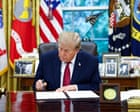
Presidential proclamations govern the symbolic and administrative posture of the executive branch, yet they operate within strict statutory and constitutional boundaries that prevent one administration from permanently binding the interior design choices of its successors. When President Donald Trump signed a proclamation aimed at locking in the gold-heavy aesthetic of the Oval Office, the action tested the friction between unilateral executive authority, historic preservation statutes, and the practical mechanics of White House stewardship.
Understanding why this directive functions primarily as a political signaling mechanism rather than an irreversible legal barrier requires examining how executive actions interact with the Administrative Procedure Act, the National Historic Preservation Act, and the operational mandate of the White House Office of the Curator.
The Structural Architecture of Presidential Proclamations
A presidential proclamation is an instrument of executive power used to state a condition, declare a law and require obedience, recognize an event, or trigger the implementation of a statute. Unlike executive orders—which typically direct federal agencies on how to manage operations under existing statutory authority—proclamations often address ceremonial matters or invoke specific powers delegated by Congress, such as tariff adjustments under the Trade Expansion Act or monument designations under the Antiquities Act.
For a proclamation to carry binding legal force beyond the tenure of the issuing president, it must satisfy two conditions:
- Statutory Delegation: The directive must rest upon an explicit grant of authority from Congress that restricts subsequent executive modification without formal rulemaking or legislative repeal.
- Procedural Entrenchment: The action must trigger a regulatory process—such as notice-and-comment rulemaking under the Administrative Procedure Act—that forces a future administration to expend significant administrative capital to reverse it.
A directive governing the interior decor of the primary executive workspace satisfies neither condition. The Constitution vests executive power in the sitting president, and the management of the immediate workspace within the Executive Residence and West Wing falls under the discretionary authority of the current officeholder, balanced against institutional preservation norms. Because no statute empowers a president to permanently freeze the aesthetic configuration of the Oval Office, a future president retains the unilateral authority to revoke, supersede, or simply ignore the proclamation on the first day of a new term.
Institutional Custody and the White House Preservation Framework
The physical spaces of the White House are not treated as ordinary federal office buildings. They are governed by a dual-track custodial system that separates structural preservation from temporary decorative expression.
- The Committee for the Preservation of the White House: Established by Executive Order 11145 in 1964 during the Lyndon B. Johnson administration, this advisory body works alongside the White House Curator to maintain the museum-quality standard of the public rooms and historic furnishings. While the committee exercises strong institutional influence over the State Floor, the Oval Office occupies a hybrid status as both a historic symbol and the active workspace of the commander in chief.
- The White House Office of the Curator: This office catalogs, conserves, and manages the permanent collection of fine and decorative arts. When a president introduces specific stylistic elements—such as gold-leaf accents, gilded frames, velvet draperies, or specific busts and portraits—the Curator’s office ensures that the installations do not inflict structural damage on the underlying historic fabric of the room, designed by Nathan C. Wyeth in 1909 and expanded under Franklin D. Roosevelt in 1934.
- The General Services Administration and National Park Service: The National Park Service administers the White House grounds and historic structure as part of the National Park System, while the General Services Administration handles operational logistics. Under the National Historic Preservation Act of 1966, Section 107 explicitly exempts the White House, the U.S. Capitol, and the Supreme Court building from the mandatory Section 106 review processes that bind standard federal properties.
This statutory exemption is the critical operational variable. Congress intentionally excluded the White House from external preservation vetoes so that sitting presidents could adapt their working environment to their functional and symbolic needs without bureaucratic gridlock. By attempting to use a proclamation to restrict future alterations, the administration attempts to construct an internal barrier where Congress deliberately left the authority fluid.
The Precedent of Oval Office Reconfiguration
Every incoming administration treats the Oval Office as a physical extension of its governing brand. The room’s layout—defined by four doors, three tall south-facing windows, a fireplace, and the elliptical ceiling—remains constant, while the surface aesthetics undergo systematic rotation every four to eight years.
Historically, these transitions follow a predictable operational sequence during the five-hour window between the outgoing president’s departure for the Capitol and the incoming president’s return from the inaugural parade:
- Carpet Extraction and Installation: The custom-woven wool rug, often featuring the presidential seal or historical motifs selected by the incoming officeholder, replaces the predecessor's floor covering.
- Drapery and Wall Covering Replacement: Heavy silk or damask curtains and striped or solid silk wall fabrics are swapped to alter the room's acoustic and visual tone.
- Furniture and Art Curation: The Resolute Desk—or an alternative from the White House collection, such as the Wilson or C&O desks—is positioned, flanked by seating arrangements tailored to the president's preferred meeting style, alongside loans from the White House permanent collection or national museums.
Gold and gilded aesthetics have appeared cyclically in this rotation. During the Bill Clinton administration, designer Kaki Hockersmith introduced rich gold, crimson, and navy tones to project classical formality. George W. Bush replaced that palette with muted cream and wheat tones designed to brighten the space, while Barack Obama favored warm neutrals and striped wallpaper. Donald Trump’s first term reintroduced gold-toned draperies and gilded accents, and a subsequent return to extensive gold ornamentation reflects a deliberate choice to project imperial grandeur and traditional opulence.
Attempting to codify this specific aesthetic via proclamation breaks with the established norm of mutual non-interference across transitions. Previous presidents relied on institutional memory and aesthetic persuasion rather than legalistic decrees to preserve their stylistic legacies.
The Cost Function of Symbolic Entrenchment
From a strategic governance perspective, issuing a proclamation to protect interior design choices creates an asymmetric cost-benefit profile. The immediate political utility lies in media cycle dominance and signaling permanence to a domestic political base. The proclamation frames the gold-covered aesthetic not as a transient decorating choice, but as a definitive standard of national prestige.
The long-term institutional costs, however, degrade the utility of formal executive instruments:
- Dilution of Proclamation Authority: When proclamations are deployed for non-binding aesthetic preferences, the perceived weight of the instrument diminishes when applied to substantive national emergencies, trade actions, or clemency grants.
- Zero Enforcement Mechanism: A directive lacking an enforcement agency, budgetary penalty, or judicial standing invites immediate, friction-free reversal. A successor does not need to navigate litigation or congressional pushback to remove gold leaf or swap curtains; a simple verbal instruction to the Chief Usher initiates the physical removal within hours.
- Asymmetric Reversal Optics: By elevating decor to the level of formal executive policy, the issuing president guarantees that a successor’s routine redecoration will be framed as a direct political repudiation rather than a standard administrative transition.
Strategic Implications for White House Operations
For administrative historians, legal analysts, and executive branch practitioners, this maneuver illustrates the boundary between hard executive power and performative governance. True institutional permanence in the executive branch requires either congressional legislation, permanent endowment funding through the White House Historical Association, or structural integration into the permanent museum collection.
Because a proclamation cannot override the constitutional authority of a future chief executive over their own workspace, the gold-covered Oval Office remains entirely contingent on the tenure of its occupant. Any future administration seeking to alter the room’s appearance will face zero legal friction in rescinding the proclamation and executing a complete aesthetic overhaul on Inauguration Day.