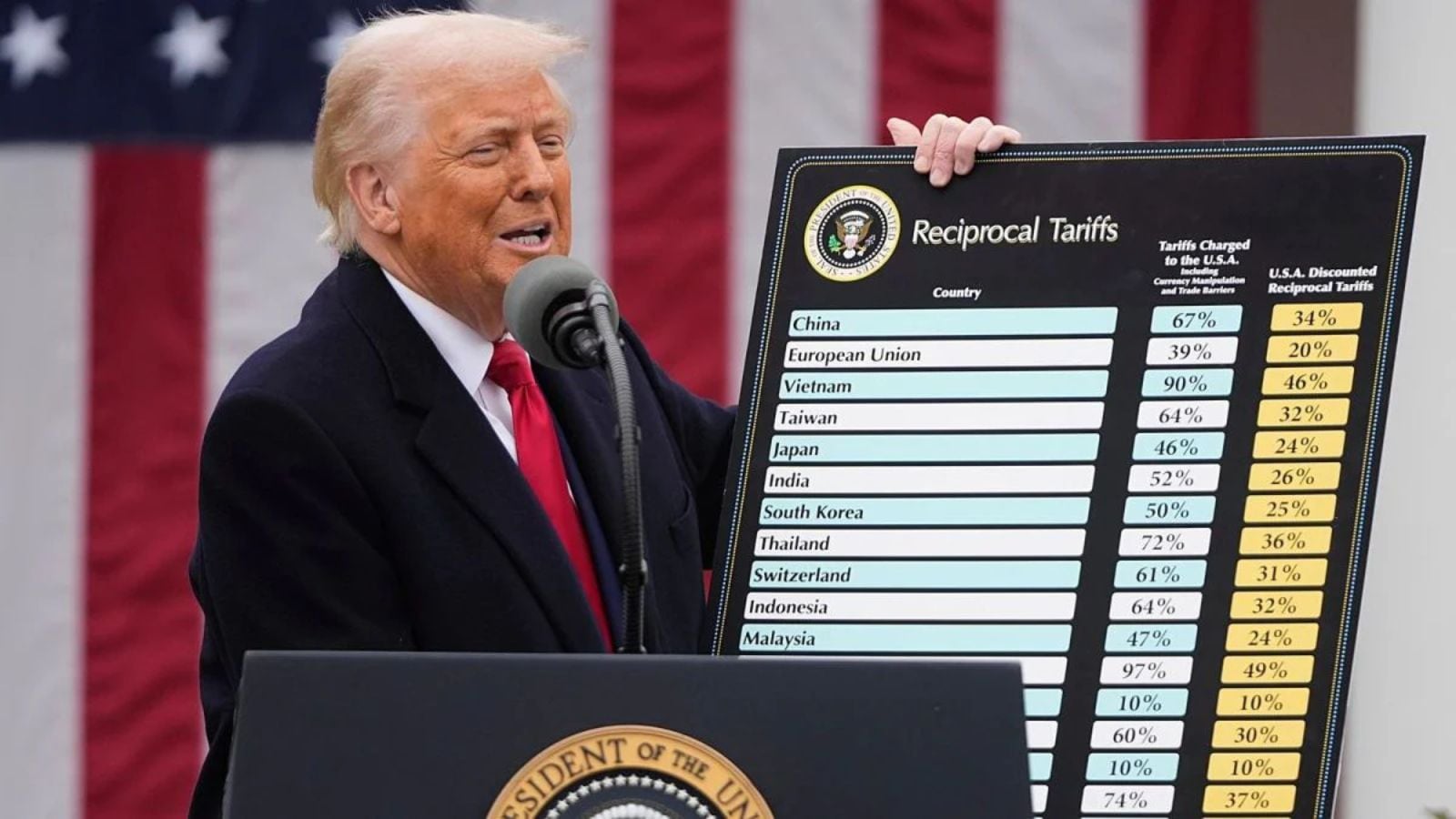
The convergence of executive trade policy and constitutional interpretation has reached a critical bottleneck. Recent public critiques of the judiciary by the executive branch regarding tariff rulings do not merely represent a disagreement over trade law; they signal a fundamental tension between Administrative State Autonomy and Judicial Review. When an administration challenges a court’s authority to restrict tariff implementation, it sets a precedent that directly impacts the legal viability of ending birthright citizenship through executive order. The survival of these policies depends on a specific judicial philosophy: the expansion of executive "plenary power" in matters of national security and border integrity.
The Structural Mechanics of Tariff Litigation
The judiciary's role in trade policy is primarily focused on whether the executive branch exceeded the scope of authority granted by Congress under statutes like Section 232 of the Trade Expansion Act of 1962 or Section 301 of the Trade Act of 1974. A "setback" in tariff ruling usually occurs when a court finds that the administration failed to provide a rational nexus between the proposed tariff and the statutory objective.
This creates a Dual-Constraint Framework:
- Procedural Constraint: Did the administration follow the Administrative Procedure Act (APA)? This requires "reasoned decision-making" and a lack of "arbitrary and capricious" actions.
- Substantive Constraint: Does the Constitution or a specific statute permit the executive to act in this domain without further Congressional input?
When the executive branch criticizes specific judges—even those it appointed—it is reacting to the judiciary's refusal to grant "Chevron-style" deference, which has been significantly weakened by recent Supreme Court pivots. The friction arises because the executive views tariffs as a tool of foreign policy (where executive power is at its zenith), while the courts view them as a tax or regulation (where Congressional power is primary).
The Birthright Citizenship Correlation
The logic used to defend or strike down tariff mandates shares a structural DNA with the legal arguments surrounding the 14th Amendment’s Citizenship Clause. The administration’s fear of a "setback" in birthright citizenship cases is rooted in the risk of Judicial Consistency.
If a court rules that the executive cannot unilaterally redefine "national security" to impose tariffs, that same court is mathematically more likely to rule that the executive cannot unilaterally redefine "subject to the jurisdiction thereof" to end birthright citizenship. The legal barrier in both instances is the principle of Constitutional Supremacy over executive interpretation.
The Three Pillars of the Birthright Legal Challenge
- The Territoriality Principle: The established consensus that "jurisdiction" refers to geographical presence rather than political allegiance.
- The Statutory Preclusion: The argument that because the 14th Amendment is self-executing, no executive order or Act of Congress can narrow its scope without a subsequent Amendment.
- The Plenary Power Doctrine: The counter-argument used by the executive, suggesting that the sovereign right to exclude or define the "national body" is an inherent executive function that bypasses standard judicial scrutiny.
The executive strategy relies on the hope that the judiciary will adopt an "Originalist" interpretation of the 14th Amendment that excludes children of those without legal status. However, the recent tariff rulings suggest the court is leaning toward Institutional Formalism—a preference for clear, long-standing procedural rules over aggressive new interpretations of executive power.
Quantification of Judicial Friction
The tension is not evenly distributed across the federal court system. Analysis of recent rulings indicates a "Circuit Divergence" where different regions apply varying levels of scrutiny to executive actions.
- The District Court Level: Often the site of initial injunctions. The executive branch views these as "bottlenecks" that prevent the immediate implementation of national policy.
- The Appellate Level: Where the "rational basis" for a policy is most rigorously tested.
- The Supreme Court: The final arbiter of whether the "Unitary Executive Theory"—the idea that the President possesses all executive power granted by Article II—can override the "Non-Delegation Doctrine," which prevents Congress from handing too much power to the President.
The failure to secure a favorable tariff ruling indicates a breakdown in the Deference Model. If the courts are unwilling to defer to the President on trade—a domain traditionally linked to international relations—they are highly unlikely to defer on the domestic application of the 14th Amendment.
The Feedback Loop of Executive Critique
Publicly identifying and criticizing judges creates a high-stakes psychological and political environment. From a strategic perspective, this serves two distinct functions:
- Base Mobilization: It frames the judiciary as an "activist" hurdle to a populist agenda, shifting the blame for policy failure from the administration to the court.
- Pre-emptive Delegitimization: By framing an adverse ruling as biased before it is even delivered, the executive branch builds a narrative that justifies potential future defiance or "court-packing" rhetoric.
However, the risk of this strategy is the Backfire Effect. Judges, particularly those with lifetime appointments, often react to executive pressure by asserting their independence more forcefully. This creates a "Correction Cycle" where the court applies stricter scrutiny to the administration's legal briefs to prove it is not a rubber stamp for the executive branch.
Mapping the Causality of Policy Failure
The failure of a tariff or citizenship policy usually follows a predictable sequence:
- Broad Executive Proclamation: A policy is announced that tests the limits of existing statutes.
- Lower Court Injunction: A plaintiff proves "irreparable harm," and a judge pauses the policy.
- Executive Narrative Shift: The administration attacks the ruling as a violation of the "Will of the People."
- Legal Over-extension: In an attempt to bypass the injunction, the administration’s legal team submits increasingly aggressive interpretations of Article II power.
- Final Judicial Retrenchment: The Supreme Court or an en banc appellate panel issues a ruling that not only stops the policy but narrows the legal definition of executive power for future administrations.
This cycle suggests that the current "slams" against the judiciary are a recognition that the legal foundation for the birthright citizenship challenge is eroding. The administration is essentially fighting a two-front war: one against the specific legal precedents (like United States v. Wong Kim Ark) and another against the procedural rules of the APA.
Strategic Realignment Requirements
To move beyond the current impasse, a pivot from "Executive Fiat" to "Legislative Anchoring" is the only sustainable path. If the executive branch wishes to change the birthright citizenship standard or secure permanent tariff authority, it must secure explicit Congressional authorization that survives the "Major Questions Doctrine."
The Major Questions Doctrine holds that if an agency or executive wants to decide an issue of vast "economic and political significance," it must have clear permission from Congress. Without this, the judiciary will continue to act as a systemic brake. The current reliance on creative interpretations of the 14th Amendment or old trade laws is a high-risk strategy with a low probability of long-term success.
The most effective move for the executive is to cease public litigation of judicial character and instead focus on building a record of "National Security Necessity" that meets the court’s evidentiary standards. The courts have shown they will grant power if the data is incontrovertible, but they will withhold it if the policy appears driven by political expediency rather than documented crisis.
The executive must now choose between continuing a campaign of judicial friction, which yields short-term political capital but long-term legal losses, or restructuring its legal arguments to fit within the formalist constraints the current Supreme Court has signaled it prefers. The latter requires a degree of procedural discipline that has been absent from recent trade and immigration maneuvers.