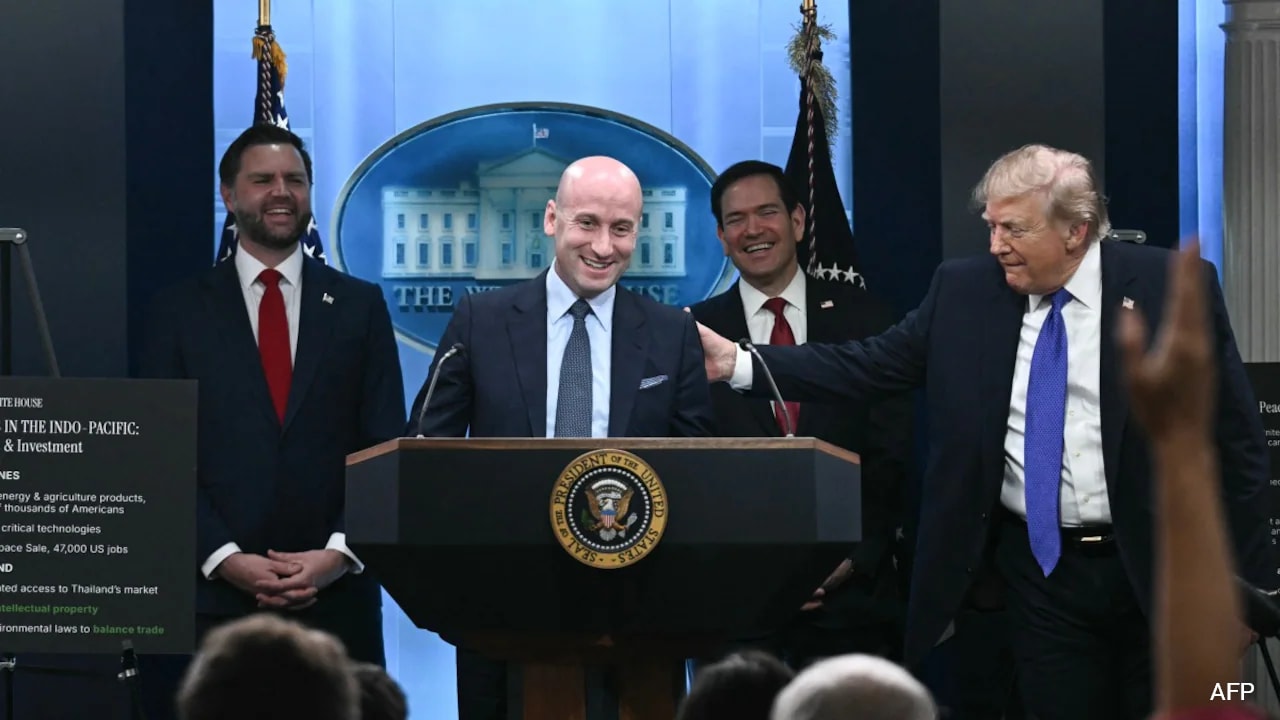
Offhand presidential remarks in front of senior aides rarely serve as literal campaign announcements, yet they act as high-resolution probes into internal coalition incentives and succession signaling. When a headline points to a president asking a chief of staff whether he wants to run for president in the presence of high-profile political figures such as JD Vance and Marco Rubio, the analytical task is not to treat a passing question as a formal candidacy. The analytical task is to map the signaling mechanics, define the structural roles at the table, and trace how executive proximity affects political ambition.
At the same time, a strict rule governs this analysis because no full competitor text or URL content was supplied in the prompt. Treating an unverified headline or a hypothetical room dynamic as settled fact would violate basic standards of evidence. Where exact dialogue, private room dynamics, or specific future plans are not established in the provided prompt, this analysis treats them as analytical hypotheses or open variables rather than verified facts. The focus stays on mechanisms: how principal-agent dynamics operate inside a White House, how visible rivals and staffers read executive attention, and what incentives shape post-presidential positioning.
The Signaling Architecture of Executive Banter
Political communication inside an executive administration operates on two distinct tracks at once. The surface track consists of jokes, rhetorical jabs, or casual questions delivered before staff or allies. The underlying track consists of status calibration, loyalty testing, and expectations management across a faction that must eventually coordinate around a successor.
To analyze a moment like this without overreading it, separate three analytical variables:
- Audience composition: Who hears the remark in real time, and who learns about it through leaks or press reporting?
- Institutional posture: Does the speaker hold an elected or Senate-confirmed constitutional office, or an unconfirmed senior staff position reporting directly to the president?
- Reversibility: Can the speaker walk back the remark as a joke within seconds without altering formal chain-of-command authority?
High reversibility lowers the immediate cost of raising a sensitive topic. A chief executive can test reactions, tease an aide, or project confidence about movement longevity while preserving complete deniability. Yet low cost in the moment does not mean zero downstream effect. Observers inside the movement track who gets teased, who stands nearby, and how allies react, because those micro-signals hint at where the leader's personal trust and ideological affinity sit.
Consider a standard corporate analogy. When a founder or CEO jokes with a head of strategy or general counsel in front of division presidents about taking over the top job someday, the comment rarely creates a formal succession plan. It does remind the division heads that no single heir apparent holds a monopoly on the founder's ear, while reminding the staff lead that their influence remains derivative of the founder's mandate. Political rooms run on a parallel logic, except public legitimacy and electoral coalitions add layers that a private boardroom does not face.
Institutional Roles and Asymmetric Power in the Room
A chief of staff, a vice president, and a cabinet secretary occupy fundamentally different structural positions in American politics. Conflating them obscures why a casual question directed at one person hits differently when others are present.
The first structural distinction lies in electoral accountability versus appointment power. A vice president stands on the national ticket and builds an independent public profile through campaign exposure, media appearances, and institutional duties tied to the presidency. A cabinet secretary such as the secretary of state leads a massive statutory department, manages foreign and diplomatic portfolios that carry heavy public visibility, and answers to Senate confirmation and global counterparts. A White House chief of staff, by contrast, wields immense operational gatekeeping power inside the executive branch—controlling schedule access, paperwork flow, and staff alignment—without holding an independent electoral constituency or a cabinet department of their own.
The second distinction lies in public brand versus internal leverage. Internal influence inside the West Wing does not automatically convert into statewide or national voter appeal. Policy architects and message strategists often shape executive orders, speeches, and legislative strategy from behind the scenes. Running a national campaign requires fundraising networks, retail and media appeal across swing states, debate readiness, and coalition-building beyond the core base. A shift from behind-the-scenes strategist to front-line candidate changes the skill set required almost completely.
This creates a classic principal-agent dynamic in political strategy. The chief of staff's primary institutional duty is to advance the president's agenda and protect the president's political position. Exploring an independent presidential run introduces competing incentives: personal brand building, donor outreach, and long-horizon positioning can pull attention away from immediate executive execution. Even when a comment is meant purely as banter, it highlights the tension between serving the current executive and planning for a post-incumbency era.
Coalition Mechanics and Succession Timing
Why do questions about future runs surface around figures like Vance, Rubio, and Stephen Miller? Even without relying on unverified specifics from an unseen article, the broader structural logic is clear. In modern political movements, succession dynamics begin long before a term ends, even when a sitting president remains the central gravitational force.
Several mechanisms drive early succession speculation:
- Faction mapping: Movements are rarely monolithic. Different figures often appeal to distinct sub-coalitions—such as populist-nationalist voters, traditional conservative or foreign-policy constituencies, and hard-line message or immigration advocates.
- Option value: Keeping multiple potential standard-bearers in the conversation preserves flexibility for the dominant leader and prevents any single lieutenant from feeling indispensable or untouchable.
- Media amplification: Any hint of internal hierarchy or future ambition attracts intense press scrutiny, turning routine meetings into stories about loyalty, rivalry, and post-term alignment.
A common error in political commentary is assuming that proximity to power equals readiness to run, or conversely that an aide's behind-the-scenes role makes a future candidacy impossible. History offers examples of senior aides and officials who eventually sought higher office, as well as many who remained far more effective as strategists, communicators, or cabinet officials than as top-of-the-ticket candidates. Transitioning from shaping policy to persuading millions of swing voters involves a steep translation cost: arguments that energize committed insiders or base activists can fail or backfire in broader general-election environments if not adapted to undecided voters.
Another mechanism often overlooked in surface-level coverage is information asymmetry. Outsiders see a headline or a brief account of a room conversation; insiders understand the running joke, the policy context of the meeting, and the power dynamics already settled that day. Treating an anecdote as a master plan misreads signal-to-noise ratio, while dismissing it entirely ignores how narratives harden once printed.
Analytical Blind Spots and Limits of Inference
Rigorous analysis requires stating where the evidence stops. When working from a headline without verified primary text, transcript context, or confirmed reporting details, three analytical limits apply.
First, intent cannot be verified from a headline alone. A question like "Wanna run for president?" could be dry humor, a comment on an aide's media visibility or policy clout, a way of ribbing someone about grueling hours, or a pointed remark aimed at someone else in the room. Guessing intent without context is speculation, not measurement.
Second, presence in a room does not prove rivalry. Seeing prominent political figures together during a presidential remark shows proximity or overlapping work, not necessarily an active succession contest. Officials frequently cross paths in routine briefings, policy meetings, or ceremonial events without plotting campaigns.
Third, hypothetical ambition is cheap; structural viability is expensive. Anyone can be asked or joked with about running for office. Actual viability depends on timing, fundraising infrastructure, party rules, broader electability, and whether the sitting president's endorsement or coalition transfers cleanly.
Strategic Play for Readers and Analysts
To read stories like this without getting pulled into premature horse-race narratives, apply a four-step filter whenever a headline pairs a president's offhand question with senior aides or prominent figures:
- Separate banter from commitment: Treat informal remarks as sentiment and status signals until backed by concrete organizational steps, formal filings, or clear strategic shifts.
- Audit institutional incentives: Ask what each person in the scene stands to gain or lose from the current president's success versus a future election cycle.
- Track translation costs: Distinguish between influence inside the administration (access, drafting, coordination) and assets required to win a broad electorate (coalition breadth, public persuasion, campaign operations).
- Demand primary verification: Flag claims about exact tone, room reactions, or hidden motives as provisional until corroborated by reliable reporting or direct evidence.
Applying that discipline keeps attention on real power mechanics rather than headline theater.