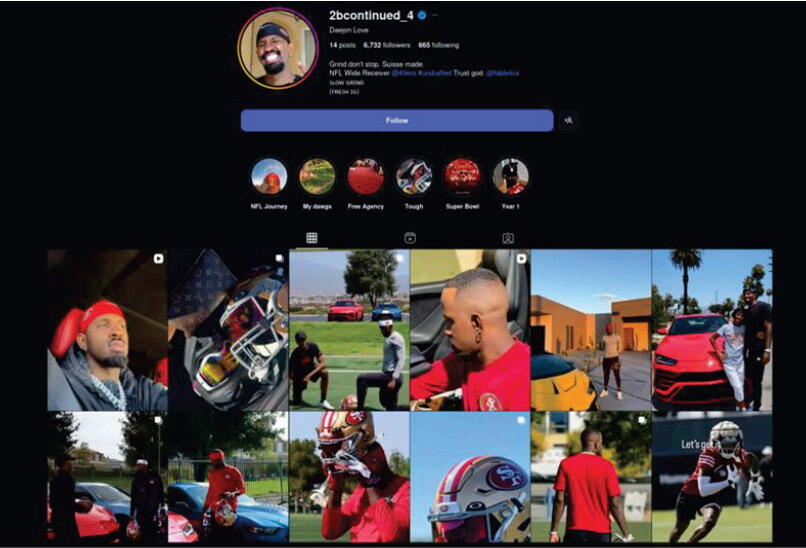
Federal authorities recently dismantled a multi-state romance and investment fraud operation led by 35-year-old Daejon Labrayae Love, who allegedly posed as a San Francisco 49ers wide receiver to defraud at least 26 women out of roughly $1.3 million. Working alongside an 18-year-old accomplice named Taylor Jamie Chan, Love utilized dating platforms like Tinder, Hinge, and Facebook Dating between February 2022 and August 2026 to cultivate intimate relationships backed by fictitious athletic and real estate wealth.
The mechanics of the operation relied heavily on social engineering rather than technical sophistication. Love donned 49ers gear, circulated staged photographs of a high-rolling lifestyle, and deployed fake bank applications displaying multi-million-dollar balances. To cement credibility, Chan routinely joined three-way FaceTime calls disguised as a professional financial advisor, confirming explosive investment returns that existed only on paper. Victims were systematically encouraged to empty personal savings or take out high-interest bank loans to fund non-existent ventures.
The Anatomy of Modern Romance Fraud
Fraudulent actors increasingly mimic elite cultural markers to bypass traditional skepticism. Professional athletes represent a prime archetype for exploitation because their profession marries immense wealth with public visibility, yet maintains enough logistical distance that an ordinary person cannot easily verify a roster status.
When a predator claims to be a professional football player, the victim rarely demands a physical playbook or a tax document. Instead, the illusion is propped up by circumstantial signifiers.
- The Uniform Prop: Wearing team-issued workout gear or posing near restricted stadium areas provides instant, low-effort validation.
- The Accomplice Illusion: Introducing a secondary person to act as a fiduciary creates a manufactured echo chamber of professional authority.
- The Urgency Loop: Fabricating high-yield investment windows forces victims to wire funds before critical analytical thinking can take over.
Financial crimes investigators note that these topologies are expanding past basic catfishing into corporate-grade operations. Syndicates now mimic the structured hierarchy of legitimate wealth management firms.
Why Dating Apps Remain Vulnerable
Platforms designed for casual swiping prioritize frictionless user acquisition over rigorous identity verification. While major networks offer optional blue-check verification tiers, millions of active profiles operate anonymously or under superficial aliases.
Love cycled through multiple names including Jon Love, Avril Lyto Love, and Jordan Love across California, Oregon, Washington, and Idaho. Each geographic relocation served as a structural reset, allowing the operation to target fresh demographics while evading localized community warnings. Cross-platform identity tracking remains fractured. A user blocked on Facebook Dating can easily migrate to Hinge under a modified persona without triggering platform-wide security flags.
The Cost of Isolation
The most destructive element of these multi-state schemes involves psychological containment. Victims are frequently isolated from their support networks through engineered urgency and emotional dependency. When individuals began questioning fund discrepancies or asking for physical principal returns, Love reportedly responded with financial abandonment, verbal intimidation, or outright communication blocks.
Federal prosecutors arrested Love and Chan at the Boise Airport on August 24, 2026, as Love traveled to establish contact with new targets. Both face federal charges of wire fraud and conspiracy to commit wire fraud, carrying severe custodial sentences. Investigators suspect the identified group of 26 victims represents only a fraction of the total affected population, leaving open the sobering reality that millions more may remain silent due to social stigma.