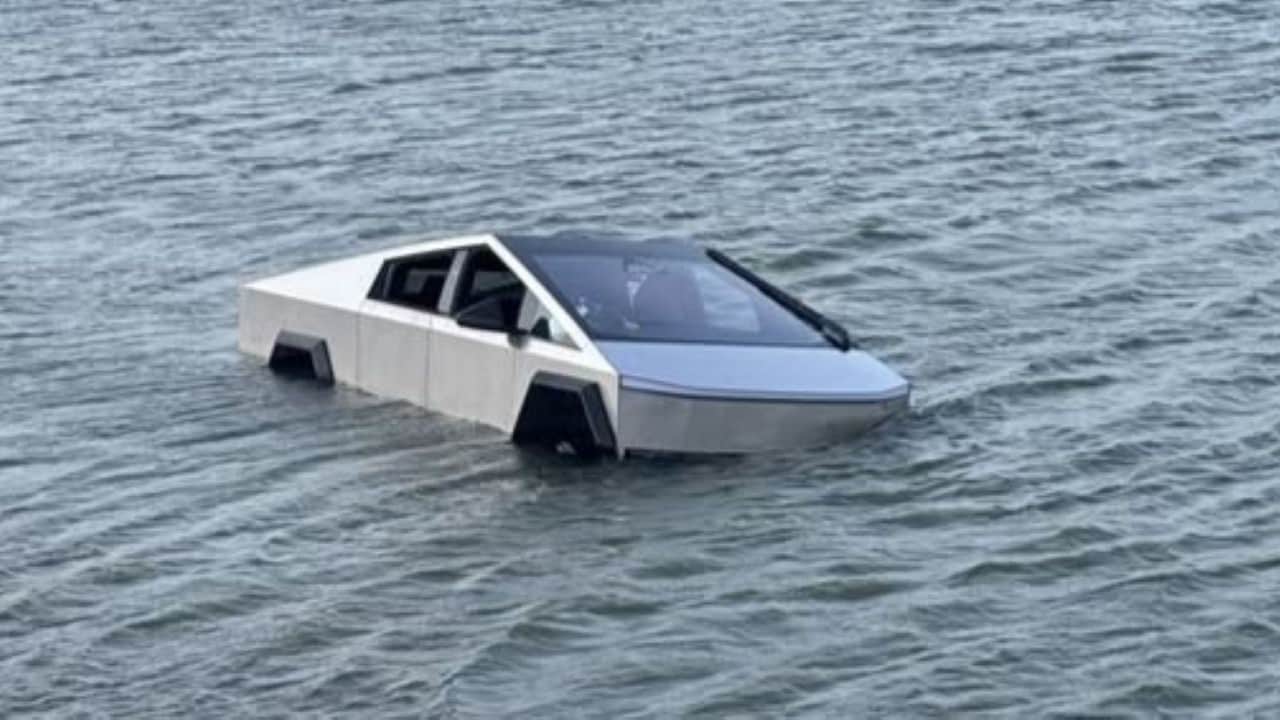
A standard passenger vehicle will float for a few moments before its cabin floods, turning a multi-ton machine into an anchor. When Jimmy Jack McDaniel intentionally drove his Tesla Cybertruck down the Katie’s Woods Park boat ramp into Grapevine Lake, Texas, he was not executing an emergency escape. He was testing a feature called Wade Mode, convinced the stainless-steel behemoth could double as a watercraft. Instead, the vehicle quickly became disabled, took on water, and sank near the shoreline. The Grapevine Fire Department’s Water Rescue Team was forced to winch the vehicle from the mud, and McDaniel was promptly booked into the local jail.
This is not an isolated incident of driver error, but rather the predictable outcome of a massive marketing disconnect.
For years, Tesla Chief Executive Officer Elon Musk publically insisted that the Cybertruck would be waterproof enough to serve briefly as a boat, capable of crossing calm rivers, lakes, and even seas. Yet the actual engineering specifications delivered to consumers tell a radically different story. When the reality of automotive physics collides with tech-evangelist rhetoric, the results are expensive, hazardous, and occasionally criminal.
The Engineering Reality Behind Wade Mode
Wade Mode is an operational setting that alters the physical state of the vehicle to handle temporary, shallow water crossings. It is not an amphibious toggle switch. Understanding how the system operates requires looking past the dashboard UI to the actual mechanical changes occurring under the skin.
When a driver activates Wade Mode, the Cybertruck initiates two primary defense mechanisms. First, the air suspension pumps the vehicle up to its absolute maximum ride height, optimizing ground clearance. Second, the system uses compressed air to pressurize the high-voltage battery pack.
By introducing positive air pressure into the battery enclosure, the vehicle creates a pneumatic barrier. This pressure prevents external water from forcing its way past the rubber seals and into the sensitive electrical cells, where a short circuit would permanently destroy the drivetrain.
The system relies on a hard ceiling of constraints. Tesla’s official documentation restricts Wade Mode to:
- A maximum water depth of 32 inches (815 mm), measured from the bottom of the tire.
- A strict speed limit of 1 to 3 mph.
- A maximum duration of 30 minutes.
When McDaniel drove into Grapevine Lake, he breached every single one of these operational boundaries. Open water does not behave like a shallow gravel-bottom creek. The boat ramp at Katie’s Woods Park drops off into depths that quickly exceed 32 inches, submerging the cabin door sills and overriding the battery pressurization system. Once the water level surpasses the mechanical limits of the seals, hydrostatic pressure wins. The interior floods, the low-voltage electronics short out, and the vehicle dies.
The Costly Illusion of the Amphibious EV
The disconnect between corporate hyperbole and engineering reality is where buyers get trapped. In September 2022, Musk claimed the truck would cross lakes "that aren't too choppy." Later, he floated the idea of an aftermarket modification package involving upgraded cabin door seals to allow the truck to traverse at least 100 meters of open water.
These statements built an illusion of casual amphibious capability. In practice, the laws of buoyancy and traction are unyielding.
A heavy electric pickup truck weighing nearly 7,000 pounds requires an immense volume of displaced water to float. If it does manage to float, it loses all tire traction with the ground. Without an external propeller or specialized tire treads acting as paddles, the vehicle becomes a rudderless block of steel drifting at the mercy of currents. If it does not float, it sinks into the soft, silty mud common to lake bottoms, trapping the wheels and burying the chassis.
The legal and financial ramifications of these stunts are severe. Texas law strictly prohibits motor vehicles from operating along public lake shorelines and closed park sections due to swimmer safety and environmental hazards. McDaniel now faces charges ranging from operating a vehicle in a closed section of a park to lacking a valid boat registration and critical water safety equipment.
Furthermore, owners who attempt to replicate these claims receive no backing from the manufacturer. Tesla’s written new vehicle limited warranty explicitly dictates that water damage is not covered. The owner’s manual places the entire burden of risk on the driver, stating that it is the operator’s personal responsibility to gauge water depth and underwater surface composition before ever dipping a tire into a stream.
A Growing Pattern of Off-Road Miscalculations
The Grapevine Lake rescue is part of a broader, systemic pattern of owners overestimating their vehicles based on tech marketing. Similar incidents have played out across the country, from a Cybertruck getting stranded in the riverbeds of Truckee, California, to another sinking while attempting to launch a jet ski in Ventura Harbor.
Traditional off-road manufacturers like Ford and Land Rover have offered deep-water wading capabilities for decades. A Ford F-150 Raptor or a Land Rover Defender can wade through 32 to 35 inches of water using high-mounted engine air intakes and specialized breathing tubes for the differentials. Crucially, these legacy manufacturers frame water fording as a defensive capability—a tool to clear an obstacle out of necessity, not an invitation to treat a truck like a jet ski.
Tesla’s framing of Wade Mode as a high-tech feature to be "tested" encourages a dangerous trial-and-error mentality among early adopters. When an internal combustion vehicle sucks water into its engine, it hydro-locks and stalls, requiring a mechanical rebuild. When a massive battery pack is submerged in deep freshwater or saltwater, the failure mode can involve catastrophic thermal runaway or a complete electronic lockdown that traps occupants inside the vehicle.
The takeaway for the modern consumer is definitive. No software update or pneumatic battery pressurization can override basic fluid dynamics. Wade Mode exists to help a driver navigate a flooded street or a shallow, firm-bottomed creek crossing during a backcountry trek. The moment an automotive tire leaves a solid, measurable surface and enters open water, the vehicle is no longer operating within its engineering envelope. It is simply sinking.