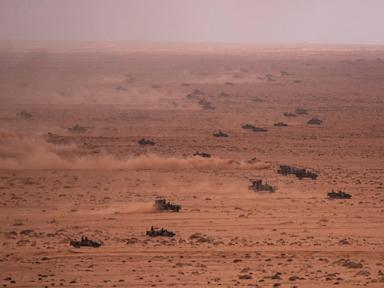
The headlines are sanitizing a tragedy. They speak of "remains recovered" and "missing during exercises" with the detached, clinical tone of a bureaucratic filing. It sounds like a clerical error that was eventually corrected. It is not. The recovery of a U.S. soldier in the Moroccan desert following the African Lion exercises isn't just a somber update to a news cycle; it is a brutal indictment of the military-industrial complex’s obsession with "interoperability" at the expense of its most valuable assets.
We are told these exercises are vital for regional stability. We are told they are routine. Both claims are lies of omission.
The Mirage of Routine Readiness
The Pentagon loves the word "routine." It suggests a controlled environment, a scripted outcome, and a manageable risk profile. But there is nothing routine about dropping thousands of personnel into the Tan-Tan training area—a landscape of shifting sands, extreme thermal fluctuations, and unforgiving topography.
When a soldier goes missing during a high-stakes exercise like African Lion, the failure isn't just at the point of disappearance. It is a systemic collapse. I have sat in the briefing rooms where these "theaters of operation" are mapped out. The focus is almost always on the macro: How do we move a brigade? How does our communication gear sync with the Royal Moroccan Armed Forces? The individual soldier—the "micro" variable—is treated as a constant.
This is the first mistake. You cannot treat a human being as a constant in a terrain that is fundamentally volatile. The "routine" label is a shield used by leadership to avoid the hard questions about why safety protocols—supposedly ironclad in modern warfare—failed to prevent a disappearance in a non-combat environment.
Logistics Is the New Battlefield
The competitor press releases focus on the closure the family might feel. That’s an emotional distraction from the logistical reality. Modern military exercises have become so bloated, so desperate to prove "readiness" to adversaries like Russia or China, that the actual safety infrastructure is stretched thin.
We are obsessed with "force projection." We want the world to see that we can land 7,000 troops from 20 different nations in the middle of nowhere and make them work as one. But while we’re busy projecting force, we’re failing at basic accountability.
- The GPS Fallacy: We assume that in 2026, every soldier is a blue dot on a digital map. They aren't. Signal degradation, battery failure, and "dead zones" in the Moroccan interior are real.
- The Fatigue Factor: Exercises of this scale push soldiers to the point of cognitive failure. A tired brain makes 180° turns when it should be going straight.
- The Search Lag: Why did it take this long? If the technology is as "cutting-edge" as the recruitment ads claim, a missing person in a designated training box should be located in hours, not days.
African Lion and the Cost of Geopolitics
Let’s be honest about why we are in Morocco. This isn’t just about training; it’s about the "Tapestry of Alliances"—wait, scratch that. It’s about buying loyalty. Morocco is a key non-NATO ally. We run these drills to cement that bond. It is a geopolitical transaction.
But when a soldier dies in a transaction, we need to ask if the price of the "strategic partnership" is being paid by the right people. The military brass gets their promotions for a "successful" exercise. The defense contractors get their data on how the new hardware handled the heat. The soldier gets a flag and a mention in a three-paragraph article that will be forgotten by Tuesday.
I’ve seen how these "After Action Reports" are written. They will highlight the "unprecedented cooperation" and the "successful integration of multi-domain tactics." The death will be a footnote, a "lesson learned" about hydration or navigation. It is a disgusting sanitization of a human life lost to the vanity of global posturing.
The Myth of the Controlled Environment
People ask: "How can someone just disappear during a drill?"
The premise of the question is flawed. It assumes the Army has total control over the environment. It doesn't. Training in the Sahara or the Atlas foothills is a simulation of chaos. But we have reached a point where the simulation is so large that it becomes the very chaos it's trying to manage.
The African Lion exercises involve:
- Airborne operations (High risk, low visibility).
- Live-fire maneuvers (High noise, high stress).
- Chemical, biological, and nuclear response drills (Complex gear, restricted movement).
When you stack these layers on top of each other, you create a fog of war in a peace-time setting. In our rush to prove we can handle a global conflict, we are creating "non-combat" environments that are nearly as lethal as the front lines.
Dismantling the "Closure" Narrative
The media loves the word "closure." It suggests the story is over because the remains were found.
For the family, there is no closure. There is only the haunting realization that their loved one died not in defense of a border or a people, but in a giant, expensive dress rehearsal. They died so that a general could check a box on a readiness report.
If we want to actually honor the fallen, we need to stop the "routine" lies. We need to admit that we are over-extending our personnel for the sake of optics. We are asking 19-year-olds to navigate the most hostile terrain on Earth with equipment that is often more "lowest bidder" than "state of the art."
The Actionable Truth
We don't need more "interoperability." We need more accountability.
- Mandatory Geo-Fencing: Every individual soldier in a high-risk terrain exercise must be equipped with redundant, low-orbit satellite tracking. No excuses. If we can track a FedEx package to the porch, we can track a Ranger in the desert.
- Scale Down the Spectacle: If an exercise is too large to safely monitor every participant, it is too large to be effective. Massive drills are for the cameras; small-unit drills are for the skills.
- End the "No-Fault" Culture: When a soldier goes missing during training, it should be treated with the same investigative rigor as a plane crash. Someone authorized the movement. Someone checked the manifest. Someone failed.
The recovery of these remains shouldn't be the end of the story. It should be the beginning of a massive, uncomfortable inquiry into why we keep trading lives for "strategic presence" in countries most Americans couldn't find on a map.
Stop calling it a tragedy. Call it what it is: a preventable failure of a system that cares more about the "theatre" of war than the humans forced to perform in it.
The desert doesn't care about your alliances. It only cares about the heat, the wind, and the mistakes you make. Our leadership would do well to remember that before they schedule the next "routine" exercise.
The mission didn't fail because a soldier got lost. The mission failed the moment we decided that this level of risk was an acceptable cost for a PR win in North Africa.
Fix the tracking, scale back the ego, or stop sending them.