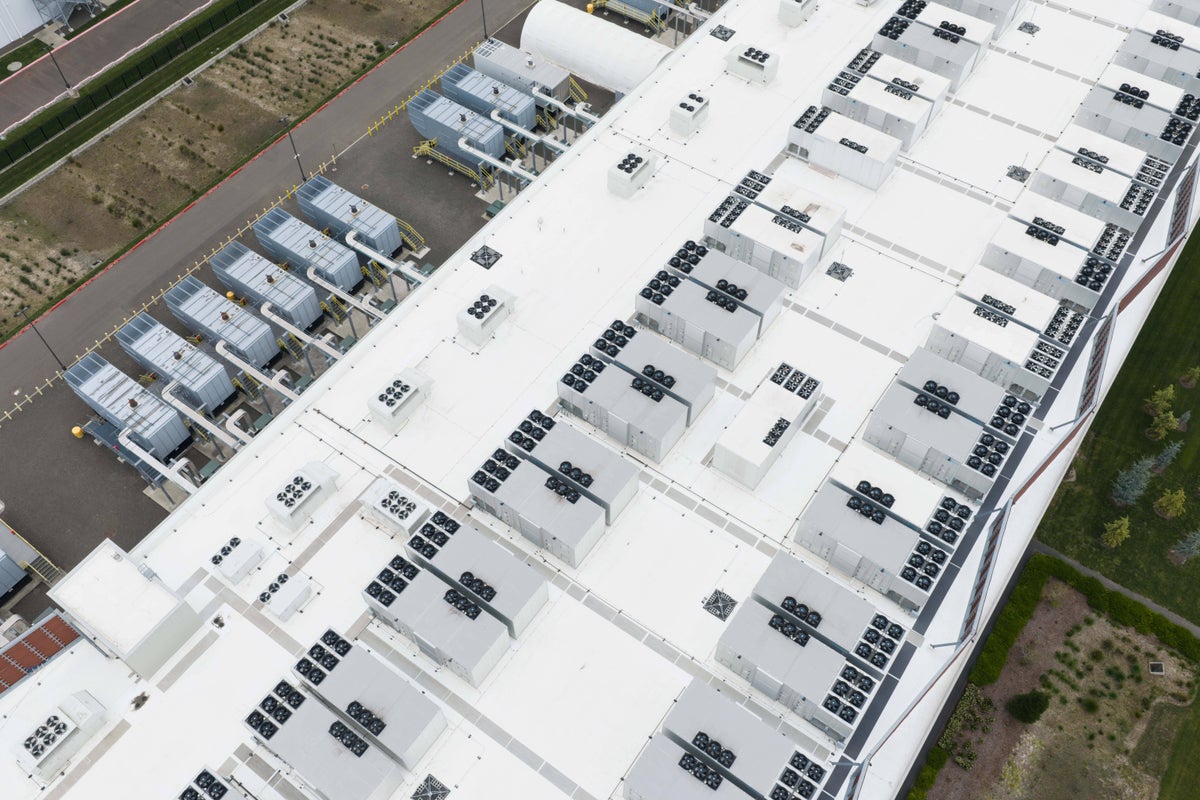
You can't build a trillion-dollar artificial intelligence empire on an empty stomach, and right now, America's tech giants are starving for electricity.
The Federal Energy Regulatory Commission (FERC) just threw a massive lifeline to Silicon Valley. In a unanimous vote, federal regulators ordered six regional grid operators to fast-track grid connections for massive, energy-hungry AI data centers. The decision directly backs a push by the Trump administration and Energy Secretary Chris Wright to eliminate the multi-year bureaucratic bottlenecks holding back tech infrastructure.
But don't assume this is just a boring win for corporate tech compliance. This federal intervention represents a historic shift in how power is allocated in America. It puts federal mandate directly at odds with furious local communities, state regulators, and utility companies that feel they're losing control of their own backyards.
If you own a home, flip a light switch, or pay an electric bill, you have skin in this game. The race for AI dominance is about to re-engineer the American power grid, and the financial ripple effects will land right on your doorstep.
The Breaking Point of an Aging Grid
The fundamental problem isn't that tech companies don't want to build data centers. It's that they can't plug them in.
In major tech hubs like Northern Virginia or Oregon, data center developers routinely face wait times of three to five years just to connect a new facility to high-voltage transmission lines. The current system was built for a slow-growth world where electricity demand remained flat for decades.
AI changed everything. Training a single advanced large language model requires clusters of tens of thousands of specialized chips working simultaneously. These computing warehouses don't just use power like an office building; they consume as much energy as medium-sized cities. According to data from the Electric Power Research Institute, data centers currently swallow about 5% of all U.S. electricity. By 2035, that number could easily triple.
Fearing that America will fall behind China in the geopolitical AI race, federal regulators decided they couldn't wait around for regional grid operators to sort through their endless backlogs. Under the new FERC order, grid operators covering two-thirds of the nation's population must establish "timely and orderly" fast-track lanes for these massive energy users. Standing still is no longer an option.
The Furious Local Backlash Across the States
While tech executives are celebrating, a massive political storm is brewing at the state level. Local residents and state legislators are terrified that the sudden influx of giant computing hubs will drain local resources, spike utility costs, and cause localized blackouts.
The data center pushback isn't a minor local grievance; it's a nationwide revolt.
- New York state legislators recently passed the Responsible Data Center Development Act, aiming a one-year moratorium on permits for facilities requiring 20 megawatts or more.
- Illinois lawmakers introduced the POWER Act to force developers to prove their water and energy footprints won't compromise public access.
- Fourteen states have introduced legislation over the past year to explicitly ban or severely restrict data center development.
A Gallup poll from earlier this year revealed that seven out of ten Americans oppose building AI data centers in their local areas, with nearly half strongly opposed. People don't want to live next to massive cooling fans that scream 24/7, nor do they want a 100-megawatt data center guzzling up to 530,000 gallons of water per day just to keep its servers from melting.
FERC insists that its new fast-track rule leaves states in control of retail electric rates and local conditions. But by forcing regional grids to prioritize these tech giants, federal regulators are effectively boxing states into a corner.
The High Cost of the Ratepayer Protection Pledge
To calm public anger over rising electricity prices, the Trump administration rolled out a framework known as the Ratepayer Protection Pledge. Hyperscalers and AI heavyweights—including Microsoft, Google, Meta, Amazon, OpenAI, and xAI—have signed on.
The core promise seems simple: Tech companies, not ordinary citizens, must foot the bill for the massive grid upgrades needed to connect these facilities. Under the FERC order, if an AI data center requires a billion-dollar substation upgrade to plug into the grid, that company pays the full cost.
Furthermore, the pledge locks these tech giants into unique, long-term rate structures with local utilities. They must pay for the new power capacity brought online to service them whether they actually use the electricity or not. It sounds like a bulletproof shield for the average consumer, but there's a catch.
While tech firms might pay for the physical wires and substations connecting their buildings, they can't magically create new electricity out of thin air. The construction of new power plants to generate the actual electrons is lagging far behind the speed of data center construction. When power supply tightens across an entire regional grid, wholesale electricity prices spike for everyone. Tech companies might build the driveway, but we're all paying for the traffic jam on the main highway.
How Tech Giants Are Becoming Their Own Utilities
Faced with a brittle public grid and local political warfare, some tech leaders are attempting to bypass the traditional power system entirely.
Tech developers are increasingly looking at co-locating data centers directly next to existing power generation sources, such as nuclear plants, or utilizing the federal government's push to open up underutilized public lands. Under a July 2025 executive order, the Trump administration directed federal agencies to clear out space on Department of Energy, military, and Environmental Protection Agency brownfield sites specifically for data center projects exceeding 100 megawatts. Four major Department of Energy locations, including the Idaho National Laboratory and the Savannah River Site in South Carolina, have already been earmarked for development.
The administration has even floated the idea of allowing these massive tech facilities to build their own independent, on-site power plants. The vision is for these high-IQ computer warehouses to run on self-contained electricity grids, detached from local communities, with the ability to sell their excess power back into the public system during emergencies or peak summer heatwaves.
It sounds highly efficient in theory. In practice, it threatens to turn the world's wealthiest tech corporations into unregulated, private utility monopolies that hold immense leverage over regional energy markets.
What You Should Do Next
The federal government has made its choice clear: America's energy policy will prioritize artificial intelligence infrastructure to secure global technological dominance. If you want to protect your wallet and your home from the fallout of this massive energy transition, you need to be proactive.
Monitor your local utility's regulatory filings
Don't wait for your monthly bill to double before you pay attention. Check the public docket of your state's Public Utilities Commission (PUC) or Public Service Commission. Look for upcoming rate cases where local utilities are asking to increase base delivery charges to accommodate "system reliability" upgrades. Participate in public comment windows to demand that data center developers absorb those systemic costs.
Audit your home energy vulnerability
As data centers crowd the regional grids managed by operators like PJM or MISO, localized strain will increase the risk of brownouts during peak summer and winter months. Consider investing in home backup systems—like solar-plus-storage or smart home panels—that can isolate your household from grid instability.
Pivot your investment portfolio toward energy infrastructure
The data center boom is creating an insatiable, multi-decade demand for physical energy hardware. Instead of gambling purely on volatile AI software stocks, look toward the companies building the physical foundation: independent power producers, advanced nuclear tech developers, grid component manufacturers, and electrical engineering firms. The pick-and-shovel plays of the AI revolution aren't software apps; they're the companies keeping the lights on.
The race to scale artificial intelligence has officially moved out of the digital sandbox and into the physical world of steel, copper, and raw electrical power. Federal regulators just speed up the clock, and the true cost of this transition will be determined in your local town halls and utility bills over the next few years.
For a deeper dive into how this grid transition is playing out on the ground, check out this detailed breakdown of the Trump administration's strategy for data center power generation, which explains the vision for allowing these computing facilities to operate independently from local community grids.