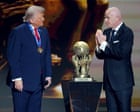
The Naive Fantasy of Neutral Football
The moral outrage surrounding Gianni Infantino and FIFA’s proposed peace prize is a masterclass in mainstream media shortsightedness. Commentators are wringing their hands, declaring that honoring figures like Donald Trump threatens to "politicize" the global game.
That narrative is completely wrong.
Football did not suddenly become political when Gianni Infantino started rubbing shoulders with world leaders in Mar-a-Lago or Washington. FIFA has been a geopolitical actor since its founding in 1904. The hysterical demand for Infantino to "depoliticize" the sport reveals a fundamental ignorance of how global sports governance actually operates.
I have spent decades watching sports executives navigate the murky intersection of international diplomacy, corporate sovereign wealth, and multi-billion-dollar broadcast rights. The idea that sports can exist in a pure, apolitical vacuum is a comforting fairytale for casual fans. For anyone running a global governing body, it is an operational impossibility.
+-----------------------------------------------------------------------+
|                   THE HYPOCRISY OF "APOLITICAL" SPORT                 |
+-----------------------------------------------------------------------+
| MYTH                               | REALITY                          |
+------------------------------------+----------------------------------+
| FIFA is a neutral sporting body.   | FIFA functions like an unofficial |
|                                    | NGO with broader reach than the  |
|                                    | United Nations.                  |
+------------------------------------+----------------------------------+
| Awards should only recognize       | Every major sporting accolade    |
| athletic performance.              | serves soft-power objectives.    |
+------------------------------------+----------------------------------+
| Keeping politics out saves sport.  | Pretending sport is apolitical   |
|                                    | enables backroom dealmaking.     |
+------------------------------------+----------------------------------+
FIFA Is an Unofficial State Department
Let us dismantle the core premise of the critics. They argue that creating a FIFA Peace Prize—and potentially handing it to a polarizing figure like Trump—corrupts the purity of the World Cup.
What purity?
FIFA commands more member associations than the United Nations. When 211 national federations vote on host locations, they are not evaluating stadium architecture in a vacuum; they are engaging in bilateral diplomacy, trade concessions, and foreign policy maneuvering.
Consider the historical record:
- 1934 Italy: Benito Mussolini utilized the World Cup as an explicit fascist propaganda vehicle.
- 1978 Argentina: The military junta used the tournament to project domestic stability while dissidents disappeared blocks away from the stadium.
- 2018 Russia & 2022 Qatar: These host selections were explicit exercises in state-backed soft power, energy deals, and international positioning.
To suggest that a peace award suddenly introduces politics into Zurich is absurd. Infantino is not breaking a sacred code of neutrality. He is simply codifying what FIFA presidents have done behind closed doors for a century: leveraging the world's most popular sport to secure tax exemptions, infrastructure guarantees, and head-of-state access.
The Cold Logic of Infantino's Strategy
Critics view Infantino's overtures to American political leadership as a reckless personal gamble or an embarrassing blunder. In reality, it is a cold, calculated business decision.
The United States is hosting the expanded 48-team World Cup alongside Canada and Mexico. The commercial success of this tournament is critical to FIFA's long-term revenue targets. Navigating American regulatory frameworks, security apparatuses, and municipal tax structures requires direct lines of communication to the highest levels of power.
Imagine a scenario where the head of a multi-billion-dollar global enterprise refuses to engage with the leadership of his primary growth market because sports journalists might write scathing op-eds. That executive would be fired by his board before nightfall.
Infantino is not looking for moral validation from columnists. He is securing operational guarantees for a tournament projected to generate over $10 billion in revenue. The peace prize concept, whether ultimately scrapped or rebranded, was never about world peace. It was about diplomatic currency.
               [ FIFA Global Revenue Engine ]
                             │
       ┌─────────────────────┴─────────────────────┐
       ▼                                           ▼
[ Commercial/Broadcast ]                   [ Political Access ]
       │                                           │
       ├─► Domestic Markets                        ├─► Visa / Security Clearances
       ├─► Corporate Sponsors                      ├─► Tax Exemptions
       └─► Streaming Rights                        └─► Stadium Infrastructure
Address the Real Questions: Why the Outrage Is Misdirected
Football fans and journalists are asking the wrong questions about FIFA governance. Here is how we need to reframe the debate.
"Should FIFA scrap the peace prize entirely?"
This question misses the point. Scrapping the physical award changes nothing about FIFA's structural dependencies on world leaders. Whether there is a physical trophy or not, FIFA will continue to align itself with political power structures whenever financial or logistical interests demand it. The prize is just an aesthetic wrapper on existing geopolitical reality.
"Doesn't aligning with polarizing politicians damage the FIFA brand?"
Only in Western newsrooms. FIFA's target audience is global. The commercial growth of football is accelerating across North Africa, the Middle East, Southeast Asia, and South America—regions where Western media narratives about political correctness carry minimal weight. Corporate sponsors like Adidas, Coca-Cola, and Visa do not pull out over political photo-ops; they pull out if viewer numbers collapse. History proves those numbers only go up.
"How should sports fans evaluate these diplomatic moves?"
Stop expecting moral leadership from a sporting cartel. Treat FIFA as what it actually is: a transnational commercial enterprise that trades access to billions of eyeballs for global infrastructure access. Once you drop the illusion that sports administration is a moral calling, the cynicism stops being surprising and starts being predictable.
The Downside of Brutal Realism
Admitting that football is inherently political comes with clear risks.
When sports governing bodies drop the pretense of neutrality, they lose their defense against state control. If FIFA openly trades political favors for hosting rights or commercial concessions, it legitimizes every authoritarian regime that wants to use football for domestic distraction or international reputation washing.
Furthermore, it risks alienating the core fanbase in traditional markets. European and North American consumers still value the ideal of fair play and clean governance, even if it is a structural fiction. Pushing the cynicism too far risks eroding consumer trust in mature, high-spending broadcast markets.
Yet pretending the problem doesn't exist is far more dangerous than acknowledging the reality.
The Uncomfortable Truth
The outcry over Infantino's diplomatic maneuvers is not about protecting the integrity of football. It is about maintaining a collective delusion.
Media outlets want a clean, simple story: greedy sports bureaucrat gets duped by politicians. But the real story is much darker and far more interesting. Infantino understands precisely what FIFA is—a global state without borders—and he is operating accordingly.
If you want sports to be free of political influence, you have to dismantle the financial model that makes modern international sports possible. You have to strip away the broadcast rights, scale down the stadiums, and accept a localized, lower-stakes game.
Until fans and journalists are ready to make that trade, stop complaining when the administrators of a multi-billion-dollar global enterprise act like political operatives.
They are just playing the game by the actual rules.


