The metal of a plane seat is not designed for sleep. It is designed for utility, for short bursts of transit, for the average traveler to endure a few hours of cramped discomfort before spilling out into an air-conditioned terminal. But when the seat becomes your entire world—when your wrists are ratcheted to your waist and your ankles are locked to a floor bolt—that metal becomes an instrument of slow, grinding exhaustion.
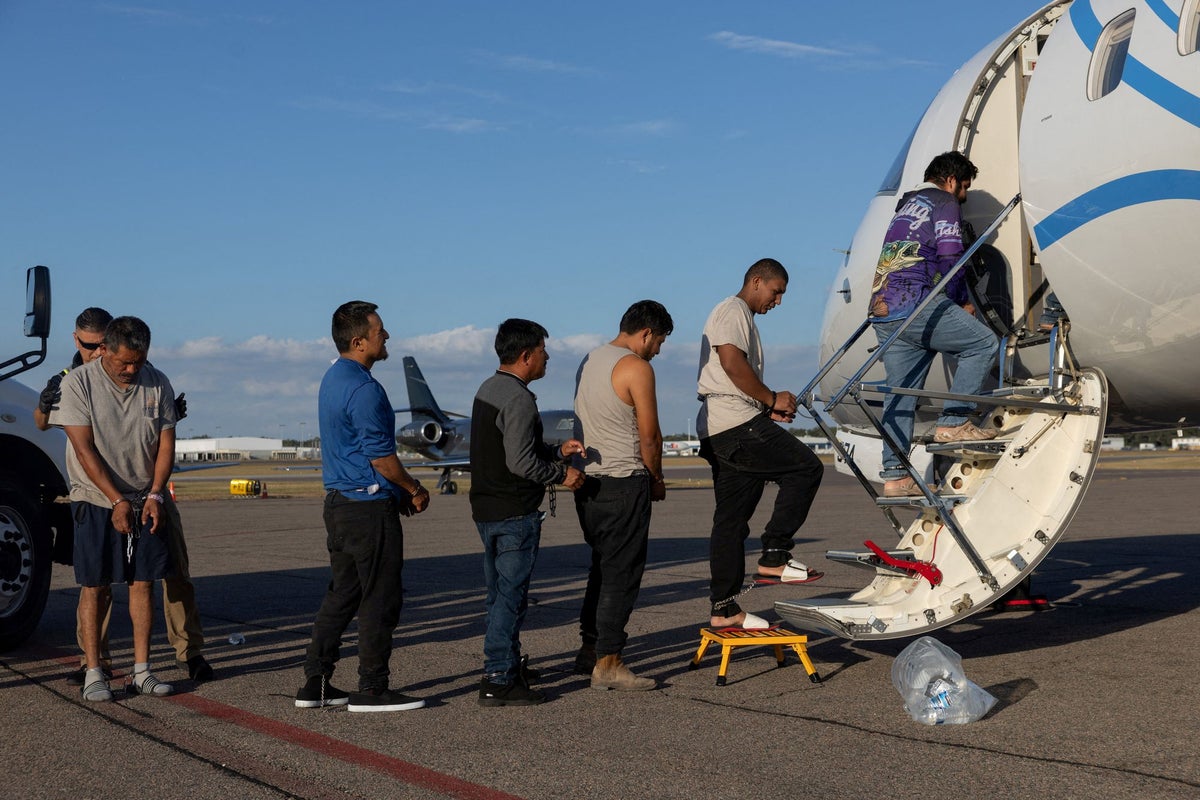
Imagine a man named Elias. He is a composite of the dozens of stories emerging from a recent, record-breaking surge in federal deportation logistics, but his physical reality is documented fact. Elias has been awake for twenty hours before he even sees the tarmac. When he is finally ushered onto the chartered Boeing 737, he isn't greeted by a flight attendant or a safety briefing. He is met by a five-point restraint system.
He sits. They click. The nylon straps bite into his shoulders.
This was not a flight to a single destination. It was the beginning of a fifty-one-hour odyssey that crisscrossed the map like a needle stitching together the borders of six different nations. For two days and three nights, Elias and dozens of others remained fixed in place, witnesses to a marathon of aerial logistics that the world below rarely sees.
The Mechanics of the Surge
The numbers behind this operation are staggering. Federal records indicate that December marked a peak in the intensity of "removal flights." To meet the demand of a system under pressure, the government has increasingly relied on "multi-drop" missions. These are not simple point-A-to-point-B journeys. They are complex, circular routes designed to maximize the "yield" of a single tank of fuel and a single crew rotation.
On this specific mission, the plane functioned as a bus in the sky. It touched down in six different countries across Central and South America. At each stop, a handful of people were unbuckled, marched down the stairs into the humid air of a country they might not have seen in a decade, and then the door hissed shut.
For those remaining on board, the engines never truly seemed to stop. The cabin air stayed recycled and dry. The lights remained a harsh, fluorescent hum.
The logic is purely mathematical. It is cheaper to keep forty people shackled in a plane for fifty hours than it is to coordinate six separate flights with six separate security details. In the ledger of federal spending, the human cost of a fifty-one-hour harness is an invisible variable. It doesn't show up on a spreadsheet.
The Body Under Restraint
What happens to a human body when it is denied the ability to move for two days?
The blood begins to pool in the lower extremities. The joints stiffen until every micro-adjustment of the spine feels like glass grinding against glass. Because the detainees are restrained at the waist and wrists, even the simplest acts of survival—eating a sandwich wrapped in plastic, drinking water from a thin cup, or rubbing a tired eye—become feats of coordination.
The most basic dignity is the first thing to go. When a person in a five-point harness needs to use the restroom, they cannot simply stand up. They must wait for an officer to notice. They must be unshackled, escorted, watched, and then re-shackled. For many, the prospect of that public ritual is so humiliating that they simply stop drinking water. They choose dehydration over the shame of the aisle.
By hour thirty, the psychological walls begin to crumble. The cabin becomes a sensory vacuum. There is no sun or moon, only the interior glow of the 737 and the rhythmic thrum of the turbofans. You are suspended in a state of permanent "now," unable to pace, unable to stretch, unable to do anything but stare at the headrest in front of you.
The Logistics of the Invisible
This isn't an isolated incident or a fluke of scheduling. It is the new architecture of enforcement. To achieve the record numbers reported in recent months, the government has streamlined the process into a high-volume industry.
Consider the "ICE Air" network. It operates out of a series of hubs, often using private hangars far from the prying eyes of commercial travelers. While families in the main terminal are worrying about carry-on weights and gate changes, a few hundred yards away, a different kind of boarding is taking place.
- The Manifest: A list of names, nationalities, and criminal histories (or lack thereof).
- The Guard Ratio: A strict number of private security contractors per detainee to ensure the "safety" of the flight.
- The Turnaround: The time it takes to offload humans and take on fuel before the next border.
The efficiency is chilling. By combining six countries into one 51-hour loop, the agency can claim a victory in "resource management." They are clearing the books. They are emptying the holding cells.
But the "resource" being managed is a father who hasn't seen his children in three years. It is a young woman fleeing a situation she cannot name without shaking. It is Elias, whose shoulders are now permanently slumped from the weight of the nylon webbing.
A Sky Full of Ghosts
There is a specific kind of silence that haunts these flights. It isn't the silence of peace; it’s the silence of profound shock. Most of the people on that 51-hour journey had no idea where they were in the sequence. They didn't know if they were the first drop-off or the last. Each time the wheels touched the tarmac, a surge of adrenaline would hit—is this it?—only to be replaced by the crushing weight of the seatbelt click when the plane took off again.
The report highlighting this record month of deportations points to a system that is running at red-line capacity. When systems run at that speed, the "human" is the first thing to be sacrificed. We treat the logistics of human movement like we treat the logistics of Amazon packages. We want the tracking number to say "Delivered," and we don't much care about the turbulence in between.
As the plane finally emptied its last passenger and headed back toward the United States to reload, the cabin was finally empty. The straps hung limp against the seats. The crumbs of cheap crackers littered the floor.
The flight was a success. The data showed a record number of removals. The fuel was spent, the mission was logged, and the 51-hour clock reset to zero.
Somewhere in a city he no longer recognizes, Elias is trying to walk. His legs are heavy, his gait is unsteady, and his skin still feels the phantom pressure of the harness. He looks at the sky and watches a silver speck of a plane disappear into the clouds, wondering who is currently strapped into the seat he just left.
The metal is cold. The straps are tight. The engines are starting again.