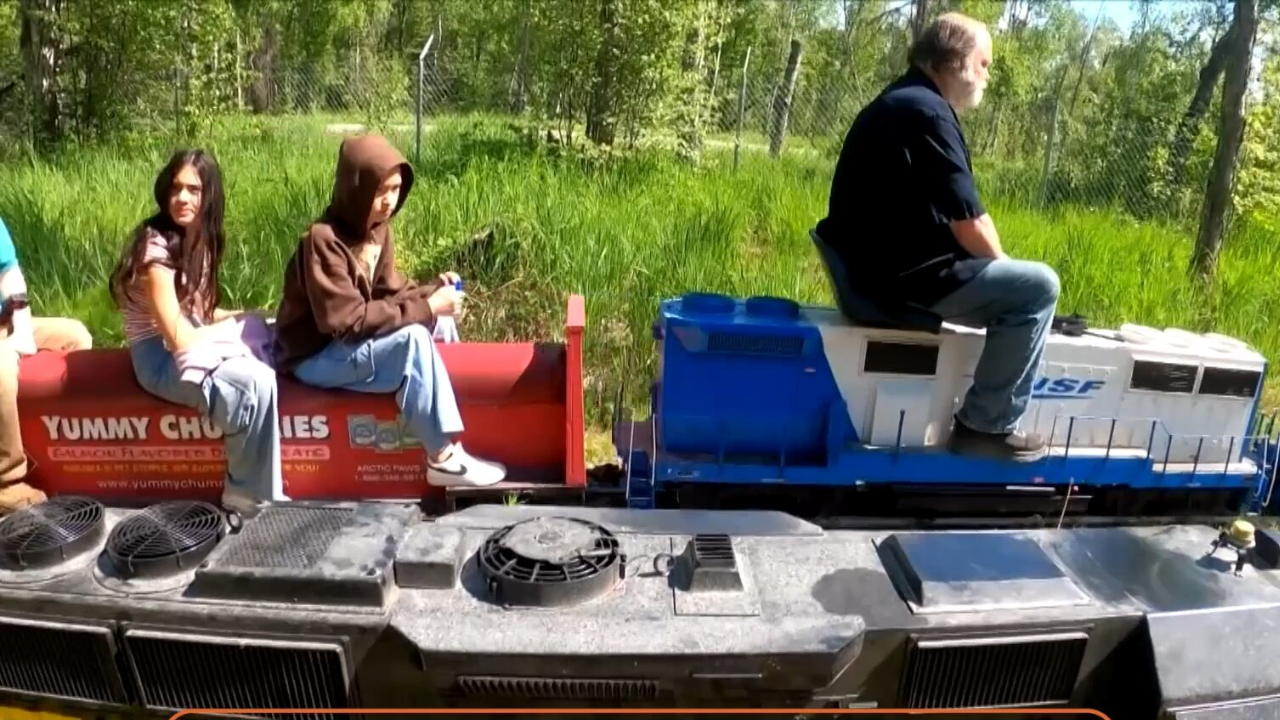
Steel. Cold, unyielding, indifferent steel.
Most people look at a piece of angle iron and see a fence post, a structural beam, or scrap metal waiting for a smelter. When Jack Klingbeil looked at a pile of salvaged steel in 1969, he saw a bridge between his calloused hands and the fleeting years of his children’s youth. Also making headlines lately: Stop Buying Giant Skeletons Because Extreme Halloween Decorating Is Ruining Neighborhoods.
If you have ever stood in a hardware store aisle on a Saturday morning, holding a half-built toy that refuses to snap together while your child tugs impatiently at your sleeve, you know the quiet panic of modern parenthood. Time moves like a freight train with cut brakes. You blink, and the training wheels are off. You blink again, and they are packing boxes for college. Most of us try to slow down that clock with store-bought distractions—plastic trinkets that shatter by Tuesday, or glowing screens that pull us into separate rooms even when we sit on the same couch.
Jack chose a radically different weapon against the passage of time. He chose a welding torch, a lathe, and a backyard in New Zealand. Further insights on this are explored by The Spruce.
The Architecture of a Father's Obsession
To understand what happened in that yard, you first have to understand the sheer absurdity of building a miniature railway from scratch. We are not talking about a plastic oval snapped together beneath a Christmas tree. We are talking about a ridable, heavy-gauge railroad—the kind of engineering project that makes sensible adults shake their heads and mutter about zoning laws and chiropractic bills.
In 1969, Jack Klingbeil began laying track not to launch a tourist destination, and certainly not to turn a profit. He did it because he had kids, and he wanted to build them a world they could physically climb inside.
Think about the physics of that commitment. To build a functional miniature railway—typically constructed on a 5-inch or 7.25-inch gauge—you cannot simply shrink a full-sized locomotive with a magic wand. Water behaves differently in miniature boilers; friction steals momentum faster; human weight sits disproportionately high above narrow rails. Every curve requires precise banking. Every switch demands millimeter-accurate tolerances so a tiny flanged wheel doesn't jump the iron and dump a giggling six-year-old into the hydrangeas.
Imagine a hypothetical Saturday in that first year. Let’s call him Mark, a neighbor peering over the back fence, coffee mug in hand, watching Jack wrestle a length of cold-rolled steel into alignment. Mark asks the obvious question: Why not just buy them bicycles?
Bicycles go anywhere. A railway goes somewhere specific. It requires a station, a destination, a shared path. When you lay track in your own backyard, you are literally carving a permanent groove into your family’s daily life. You are guaranteeing that, at least for a few hours every weekend, everyone is traveling in the exact same direction.
When a Private Hobby Outgrows the Fence
Hobbies have a sneaky way of developing gravity. At first, it was just Jack, his children, and the rhythmic clack-clack of small steel wheels rolling over backyard ties. Then came the neighborhood kids, drawn by the unmistakable scent of hot lubricating oil, coal smoke, and electrical ozone drifting over the hedges.
Word travels fast when a man builds a train in his yard.
Soon, friends brought their own children. Cousins arrived on Sunday afternoons. Strangers slowed their cars on the street outside, craning their necks to catch a glimpse of a miniature locomotive rounding a bend between the fruit trees. What started as an intimate gift for a handful of kids slowly morphed into a magnet for an entire community.
I have spent years reporting on grassroots attractions and community builders, and I have seen this exact inflection point destroy lesser projects. There is a terrifying threshold every passionate creator eventually crosses: the moment your private sanctuary becomes a public expectation.
Suddenly, safety isn't just a father's instinct; it is a liability concern. Track maintenance stops being a relaxing Sunday chore and becomes an obligation to dozens of waiting families. The rolling stock—those painstakingly machined locomotives and passenger cars—takes a beating when loaded with wave after wave of excited passengers. Most people, faced with that pressure, lock the gate. They put up a "Private Property" sign, pull the tarps over the engines, and retreat back into the quiet safety of their original plan.
Jack didn't lock the gate. He laid more track.
The Invisible Mechanics of Wonder
Why does a miniature railway hold such a hypnotic grip on human beings, regardless of whether they are four years old or eighty-four?
Psychologists often talk about "flow states"—those rare pockets of existence where self-consciousness vanishes and we are completely absorbed in the immediate physical world. A ridable train induces an instant, collective flow state. You cannot check your email while straddling a miniature wooden bench behind a live-steam or electric locomotive. You are too busy leaning into the turns, ducking under low-hanging branches, and watching the ground blur inches beneath your boots.
Consider what happens when a child rides a full-sized train versus a miniature one. On a commuter train, a child is a passive piece of cargo, swallowed by giant seats, staring through thick glass at a world moving too fast to comprehend. On a backyard railway, the scale is flipped. The child is a giant straddling a machine they can understand. They can see the connecting rods pumping. They can hear the click of the rail joints directly beneath them. They feel the subtle lurch when the locomotive takes up the slack in the couplings.
It is tactile truth in an increasingly synthetic world.
Over the decades, Jack’s railway expanded far beyond its humble 1969 origins. Bridges were engineered. Tunnels were dug and reinforced. Signaling systems, station platforms, and turntables appeared, turning a simple loop into a legitimate, functioning transport network in miniature. Each addition represented hundreds of invisible hours in the workshop—nights spent turning brass fittings on a lathe, weekends spent mixing concrete for bridge abutments, mornings spent troubleshooting stubborn valves before the first visitors arrived.
The Weight of Half a Century
By the time a project survives for fifty years, it stops being an attraction and becomes an heirloom.
Think about the sheer span of time between 1969 and the modern era. In 1969, humans had just walked on the moon for the first time. Rotary phones were bolted to kitchen walls. Personal computers were the size of moving vans and lived exclusively in university basements. Over the next five decades, entire industries rose, dominated the globe, and vanished into obsolescence. Vinyl gave way to cassettes, CDs, MP3s, and invisible streams. Letters became faxes, emails, and vanishing text messages.
Yet through every technological earthquake, Jack Klingbeil’s trains kept running on the same physical principle: iron wheels on iron rails, pulled forward by patient human ingenuity.
Grandparents who had ridden those tiny carriages as children in the 1970s began returning with their own grandchildren. That is the quiet, staggering magic of physical permanence. You cannot hand your grandchild a thirty-year-old video game file and watch their eyes light up the same way. Digital memories decay into obsolete formats. Physical spaces—places built with sweat, grease, and stubborn devotion—anchor generations together. When a grandfather sits behind his granddaughter on the same miniature bench he rode forty years earlier, time folds in on itself. The gap between their lives disappears for the duration of a three-minute loop around the garden.
Of course, keeping a fifty-year-old railway alive is anything but effortless. Rust never sleeps. Wooden sleepers rot in the damp earth. Bearings wear down, batteries die, and boiler tubes corrode. Every single spring requires tearing down components, scraping away grime, and rebuilding what time has tried to reclaim.
There is an unspoken vulnerability in maintaining something like this as the decades pile up. The builder grows older alongside the machine. Knees ache a little more when crouching beside a derailment. Lifting a heavy locomotive onto the steaming bays requires more leverage, more planning, and eventually, more help from the very generation that grew up riding the rails.
What We Actually Build When We Build for Others
We live in an era obsessed with scalability. Startup founders, career coaches, and productivity gurus constantly preach the gospel of efficiency: Don't do anything that doesn't scale. Automate the friction. Outsource the heavy lifting.
Jack Klingbeil’s railway is a glorious, defiant middle finger to the gospel of scalability.
Nothing about hand-building a miniature railroad scales. You cannot copy-paste a welded steel chassis. You cannot download a freshly ballasted curve. Every foot of that track had to be measured, cut, spiked, and leveled by hand. The inefficiency was the entire point. Because it was hard, it meant something. Because it took decades, it earned a soul.
Most of us will never weld a locomotive frame or lay four hundred meters of steel rail across our lawns. We might not have the acreage, the machine tools, or the mechanical intuition. Yet every single one of us faces the exact same choice Jack faced back in 1969.
We all have a finite number of weekends before the people we love grow up, move away, or drift into the quiet busyness of their own lives. We can spend those weekends consuming things that other people made—buying tickets to disposable entertainment, scrolling through infinite feeds, waiting for someone else to manufacture our memories for us. Or we can pick up our own version of a welding torch. We can build something stubborn, physical, and enduring in our own backyards—whether that is a sprawling wooden treehouse, a community garden, a Friday night dinner tradition that never gets canceled, or a miniature railway winding through the trees.
The secret Jack discovered over half a century ago isn't hidden in the gear ratios of his locomotives or the metallurgy of his rails. It is found in the simple, radical act of deciding that your family's joy is worth fifty years of grease under your fingernails.
Long after the final whistle blows and the shed doors are latched for the night, the steel rails remain cool and gleaming in the grass, waiting patiently for the next pair of small boots to step aboard.