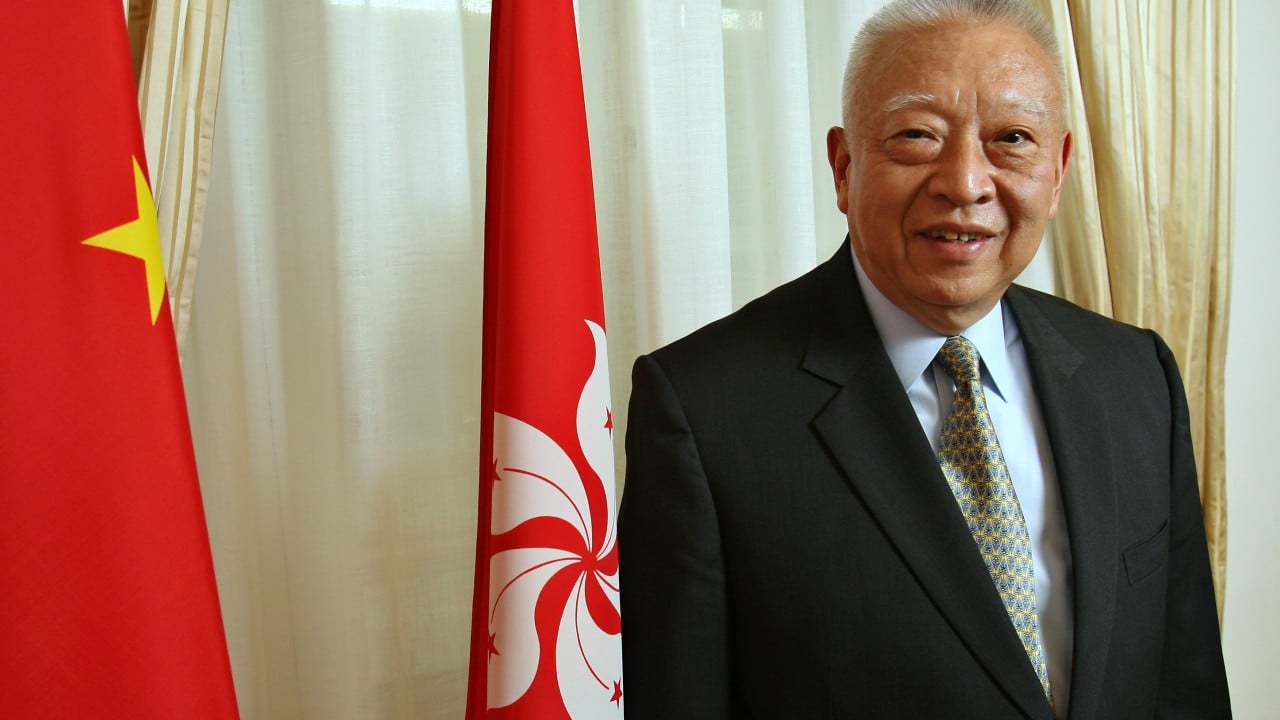
The marble of the hall is cold, but the silence inside is heavier.
Funerals for statesmen do not merely mark the end of a single life; they are carefully orchestrated architecture designed to measure the weight of an era. When a city shifts its gaze toward a final farewell, every gesture, every lowered flag, and every name printed on a black-bordered program carries a silent language. It tells you who held power, who survived the turbulence, and who gets to write the epitaph.
Consider the assembly gathered for the state funeral of Tung Chee-hwa, the first Chief Executive of Hong Kong.
At the center of this solemn choreography stands an 87-member funeral committee. That number is not accidental. In the intricate geometry of elite politics, numbers are statements. Eighty-seven people—drawn from the upper echelons of mainland governance, local tycoons, and veteran political actors—form a human shield of consensus. They are there to signal continuity, stability, and an unbroken line of political legitimacy.
To understand why an 87-member committee matters, you have to remember what Tung Chee-hwa represented when he took the helm in July 1997.
Picture the handover night. Rain slicked the harbor. British flags came down for the last time while the red flag of China rose against a humid sky. Millions watched with a knot in their stomachs, wondering what an unprecedented experiment—one country, two systems—would actually look like. Tung, a soft-spoken shipping tycoon with a gentle demeanor and an immense burden, stepped into the storm. He was chosen not because he was a fiery politician, but because he was a bridge between two worlds: Western commerce and Beijing’s political orbit.
History is rarely kind to bridges. They take the brunt of the traffic from both sides.
During his tenure, Tung faced crises that tested the resilience of a society caught between shifting tectonic plates. There was the Asian financial crisis that threatened to sink the city's economy, followed years later by the terrifying shadow of SARS, and massive social protests that laid bare the deep anxieties of a population navigating an uncertain identity. By the time he stepped down in 2005, citing health reasons, he was a man worn smooth by the relentless friction of history.
Yet, looking at the high-ranking officials who now lead the committee for his final rites, a different story emerges. It is a story of rehabilitation and institutional memory.
Political fortunes in Beijing’s orbit have long arcs. Figures who stumble or face fierce opposition are rarely discarded forever if their foundational loyalty remains unquestioned. Tung’s transition from a beleaguered executive to a respected elder statesman—serving as Vice Chairman of the Chinese People's Political Consultative Conference—was a testament to that long game. He became a symbol of a particular era: the cautious, hopeful, yet deeply anxious dawn of the post-colonial transition.
When top officials step forward to lead his funeral committee, they are performing a ritual older than written law. They are honoring the man, certainly, but they are also honoring the institution of governance itself. They are telling the public, and the world watching from afar, that service to the state—however fraught, however difficult—is ultimately remembered and redeemed by the collective power of the party and the nation.
The names on that roster read like a directory of modern political gravity. Senior leaders from Beijing stand shoulder-to-shoulder with Hong Kong’s financial elite and veteran civil servants. In a system where optics are everything, this cross-section of power proves that Tung’s legacy has been safely enshrined in the official narrative of national rejuvenation.
Step back for a moment and look past the titles and the committee rosters. Imagine standing outside the funeral hall as the limousines roll past.
The air smells of wet asphalt and blooming Bauhinia flowers. Photographers adjust their lenses. Passersby pause, some out of genuine respect for a man who tried to steer a ship through a hurricane, others out of quiet curiosity about what the shifting political winds mean for tomorrow.
Tung Chee-hwa’s story is the story of Hong Kong itself over the last three decades: heavy with expectation, bruised by conflict, resilient against the odds, and bound to a destiny that few could fully predict when the flags changed color back in '97.
The 87 members of that committee will bow their heads in unison. The cameras will flash. The eulogies will echo off the stone walls, speaking of dedication, patriotism, and historical responsibility.
And then, the dignitaries will disperse into the evening traffic, leaving behind the marble, the silence, and the ghosts of a turbulent past, while the city below them keeps moving, relentlessly forward, into the dark.