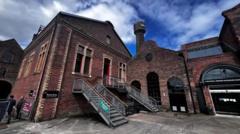
The air in Newtongrange usually tastes of damp earth and woodsmoke, a lingering ghost of the industry that once built this corner of Midlothian. For decades, the Lady Victoria Colliery was the heartbeat of the village. It was a place of soot, sweat, and the relentless mechanical thrum of the winding engine. When the mines closed in 1981, that heartbeat stopped. The cages sat still. The chimneys stopped belching. The ground, once a source of wealth and back-breaking labor, became a silent monument to a departed era.
Now, the National Mining Museum Scotland sits on that same patch of earth. Most visitors come to see the rusted tools and hear the echoes of their grandfathers. They walk through the dark tunnels of memory. But underneath their boots, something is shifting. The earth is waking up again, though not in the way the old miners would recognize.
We are watching a transformation of purpose. The very site that once symbolized the carbon-heavy past is being redesigned as a green energy hub. It isn't just a cosmetic upgrade or a few solar panels on a gift shop roof. It is a fundamental reimagining of what "heritage" means.
The Heat in the Shadows
Imagine standing in a gallery of the museum, surrounded by the heavy iron machinery of the 19th century. To a casual observer, these are relics. But to the engineers now descending on the site, the museum is the gateway to a massive, untapped battery.
The strategy hinges on mine water geothermal energy. When coal mines are abandoned, they don’t just stay empty. They flood. Deep underground, billions of gallons of water sit in the labyrinthine tunnels carved out by generations of Scots. Because of the natural heat of the Earth’s crust, this water stays warm. It isn't boiling, but it is consistent. While the Scottish winter bites at the surface, the water below remains a steady, reliable temperature.
The plan involves drilling down to tap into this subterranean reservoir. Heat pumps then extract that warmth, boosting it to temperatures capable of heating homes and businesses. It is a poetic reversal. The same holes we dug to pull out the fuel that warmed the world are now being used to capture the heat of the planet itself.
The stakes are higher than a simple utility bill. Scotland faces a brutal tension between its industrial history and its climate future. By turning a museum into a powerhouse, the project proves that we don't have to erase our history to survive the coming century. We can build on top of it.
A Village Between Two Worlds
Consider a resident of Newtongrange. Let’s call him Callum. Callum’s father worked the Lady Victoria. He remembers the soot on the windowsills and the pride of the "Black Diamond." To Callum, the transition to renewables often feels like a foreign language—full of abstract percentages and global targets that don't put bread on the table.
But when the museum—the literal center of his community’s identity—begins to provide heat to local buildings, the abstract becomes tangible. This isn't a corporate wind farm owned by a multi-national firm three hundred miles offshore. This is the local mine, still providing. Still working.
The hub will feature a mix of technologies. Beyond the geothermal potential, there are plans for advanced solar arrays and battery storage systems. The goal is to create a microgrid that can sustain itself and perhaps even contribute back to the wider community. It turns the museum from a passive observer of history into an active participant in the future.
The Engineering of Redemption
The technical challenge is immense. You cannot simply drop a pump into a hundred-year-old shaft and hope for the best. The water chemistry in old mines is notoriously complex, often acidic and laden with minerals that can corrode equipment in weeks.
Engineers have to navigate the "invisible geography" of the mine. They use old Victorian maps, some hand-drawn on linen, to trace where the tunnels collapsed and where the water flows. It is a marriage of 19th-century grit and 21st-century physics.
The process of "heat exchange" is the magic trick at the center of the story. By circulating a secondary fluid through pipes submerged in the mine water, the heat is transferred without ever mixing the "dirty" mine water with the clean water in our radiators. It is clean. It is quiet. It is infinite.
We often talk about the energy transition as a series of sacrifices. We talk about what we have to give up: coal, oil, gas, the roar of the engine. But at Newtongrange, the story is about what we gain. We gain a way to use our scars. Every mile of tunnel dug in the 1900s is now a thermal asset. The toil of the past becomes the comfort of the present.
Beyond the Museum Walls
The impact ripples outward. This isn't just about heating one building; it's a pilot for a nation. There are thousands of abandoned mines across the UK, many of them sitting directly beneath the towns they once built. If the National Mining Museum can prove that this works—that it is economically viable and technically stable—it unlocks a blueprint for the entire "Rust Belt" of the North.
It changes the narrative of "deindustrialization" from a tragedy into a transition.
For years, the story of coal towns has been one of decline. We’ve seen the shops boarded up and the young people leave for the cities. By placing a high-tech energy hub in the heart of a mining museum, we are telling a different story. We are saying that these places still matter. They are not just graveyards of industry. They are the laboratories of the new world.
The project also serves as an educational lighthouse. Children on school trips won't just see how their ancestors lived in the dark; they will see how their generation will live in the light. They can watch the data screens showing the heat flowing from the earth. They can touch the pipes. The "invisible stakes" of the climate crisis become visible, manageable, and even hopeful.
The Weight of the Earth
There is a certain irony in the silence of geothermal energy. Coal mining was loud. It was a world of whistles, clanking chains, and the roar of the furnaces. This new energy makes no sound. It is a slow, steady pulse.
Some might worry that by modernizing these sites, we lose the "soul" of the history. But the soul of Newtongrange was never about the coal itself. It was about the people who provided for their families by working with the earth. That spirit remains. The work has just changed shape.
The ground beneath us is heavy with more than just rock and water. It is heavy with the legacy of everyone who ever swung a pickaxe in the dark. As the pumps begin to hum and the first surges of heat rise through the old shafts, it feels less like a new beginning and more like a long-overdue conversation between the past and the future.
The museum stands as a sentinel. On one side, the black-and-white photos of men with coal-smudged faces. On the other, the gleaming copper and steel of the heat exchange. In the middle, a community finding its breath again.
The fire hasn't gone out. We just learned how to find it without burning the world down.
The cages remain at the Lady Victoria, skeletal and still against the Scottish sky. They don't need to descend anymore. The treasure is already rising to meet us.