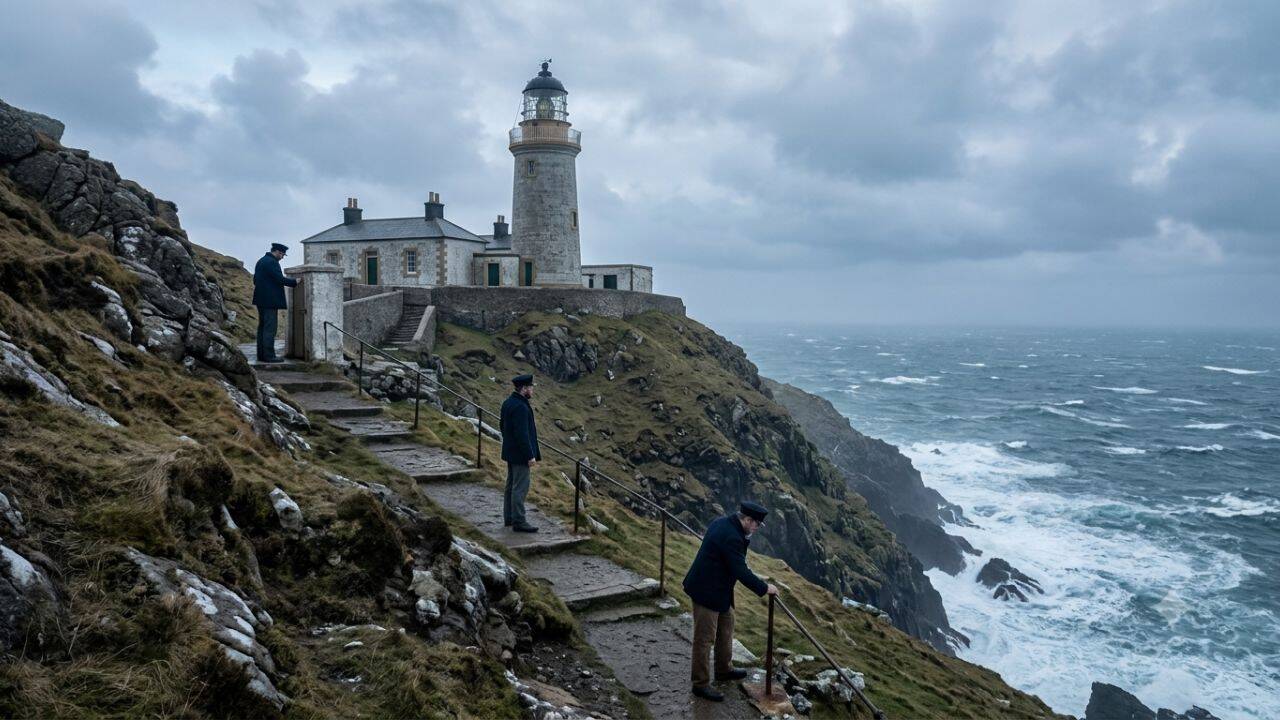
In December 1900, the Flannan Isles lighthouse off the rugged west coast of Scotland went completely dark, setting off a century-old maritime puzzle. When the relief ship Hesperus finally docked at Eilean Mòr on Boxing Day, it found a fully functional station abandoned by its three-man crew. Principal keeper James Ducat, second assistant Thomas Marshall, and occasional keeper Donald MacArthur had vanished without a trace. No bodies were ever recovered, no distress signals were sent, and the official investigation by the Northern Lighthouse Board left behind an unsettling vacuum of answers that quickly invited wild folklore.
Popular retellings prefer the supernatural. Ghost ships, phantom birds, foreign abductions, and sudden homicidal madness have all been blamed for the empty station. Strip away the century of theatrical embellishment, however, and a much colder, more mechanical tragedy emerges from the logbooks and physical wreckage left behind on the cliffs. Learn more on a connected subject: this related article.
The Scene Inside Eilean Mòr
The physical evidence discovered by relief keeper Joseph Moore told an immediate story of abrupt departure. Inside the kitchen, a chair lay overturned near a table with an unconsumed meal. The clocks had stopped. The fire in the hearth had gone cold days prior.
Most telling was the wardrobe. Two sets of heavy oilskins and sea boots were missing, but a third set remained hanging inside. This pointed directly to a split deployment. Two men had dressed for heavy weather to inspect or secure outdoor equipment, while the third remained inside until an emergency forced him out unequipped. More analysis by Reuters highlights related perspectives on the subject.
The logbook entries stopped abruptly on December 13, though chalk notes indicated routine operations continued through the morning of December 15. After that date, the light remained unlit, a failure first noted by the passing steamer SS Archtor late on the night of the 15th.
The Brutal Reality of the West Landing
To understand the disappearance, investigators had to look far below the cliff top toward the West Landing, where heavy infrastructure had taken a beating from the North Atlantic.
Heavy iron railings had been bent and twisted. A supply crate stored more than one hundred feet above sea level had been ripped from its moorings, and massive boulders weighing upwards of a ton had been displaced. These forces could not be explained by ordinary winter weather.
Robert Muirhead, superintendent of the Northern Lighthouse Board, concluded that the men had been swept away by rogue waves while trying to secure equipment at the landing. Critics often point out that experienced lighthouse keepers should have known better than to approach the water during a heavy swell. Yet this critique misunderstands the psychological pressure of isolation and the absolute necessity of maintaining supply lines on an isolated rock. If a vital storage box containing provisions or crane rigging broke loose, waiting out the weather was simply not an option.
The Mechanics of a Rogue Wave
The North Atlantic in winter operates under brutal hydrodynamic rules. Sudden swells, amplified by underwater topography and intersecting storm fronts, can generate freak waves that dwarf ordinary surf.
A hypothetical scenario mirrors the physical evidence with chilling precision: Two keepers descended to the landing to secure the smashed supply box. Encountering rising water or a sudden surge, they found themselves in mortal peril. Inside the warm kitchen, the third keeper looked out toward the landing, saw his colleagues trapped or washed into the surf, and sprinted out the door without taking the time to pull on his heavy oilskins and sea boots.
Seconds later, a massive wall of water slammed into the rock face, far higher than normal high tide, washing all three men into the freezing depths. Without witnesses or modern communication devices, their final moments dissolved into the grey foam of the Hebrides.
The mystery endures not because the facts are inexplicable, but because human nature rebels against accidental death. We prefer a grand conspiracy or a supernatural intervention to the quiet, indifferent cruelty of an Atlantic storm. The Flannan Isles remain a stark reminder of the limits of human control against the raw, unmanaged mechanics of the natural world.
Missing Lighthouse Keepers Mystery - Why They Were Never Found
This video provides an overview of the historical facts and enduring theories surrounding the disappearance of the three lighthouse keepers in 1900.