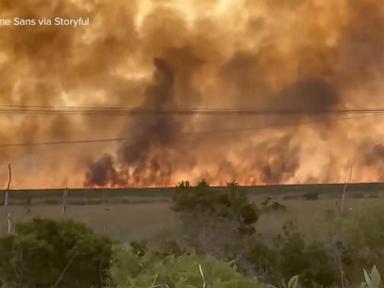
The Everglades are currently a tinderbox. As of mid-May 2026, over 11,000 acres of the Florida Everglades are scorched, with a stubborn plume of "blackout" smoke choking the life out of U.S. 27 and I-75. While the Florida Forest Service battles to hold a 50% containment line on the Max Road Miramar Fire, the reality on the ground is far grimmer than a localized brush fire. The state is locked in a stranglehold of 100% drought coverage, a statistical anomaly that has transformed the Sunshine State into a primary national fire front.
The fire is not merely an act of God. It is the predictable consequence of a "flash drought" colliding with decades of aggressive urban encroachment. When the sawgrass dries to the consistency of parchment, a single spark—whether from a lightning strike or a hot tailpipe—creates a subterranean burn in the muck that can smolder for weeks, defying traditional aerial suppression.
The Geography of a Predicted Disaster
Florida’s current crisis is the culmination of a "missing" 2025 hurricane season. While residents usually dread the arrival of tropical cyclones, those storms provide the deep-tissue hydration required to keep the water table high. Without them, by March 2026, over 70% of the state had descended into extreme drought.
The statistics are jarring. So far this year, nationwide wildfires have consumed 1.88 million acres—nearly double the 10-year average. Florida is currently hosting five major uncontained blazes, including the South Canal Fire in Taylor County and the Cow Creek Fire in Levy County. These aren't just remote forest events; they are "built-environment" disasters.
In the Holly Lake community of Pembroke Pines, the Max Road Miramar Fire briefly trapped residents as flames jumped dirt access roads. This is the new Florida reality: luxury subdivisions and rural trailers alike are now sitting on the edge of the Wildland-Urban Interface (WUI). We have built our homes in the middle of a landscape that evolved to burn every three to seven years. When you suppress natural fire cycles for decades to protect property, you don't stop the fire; you just bank the fuel for a larger, more violent inheritance.
The Insurance Implosion
The smoke drifting into Miramar and Weston carries more than just particulate matter; it carries the scent of a collapsing insurance market. Florida is already the most expensive state in the nation for homeowners' coverage, with 15-20% of residents now "going bare"—foregoing insurance because they are priced out or deemed uninsurable.
Wildfires are the "silent" risk in Florida, often overshadowed by hurricanes in the public consciousness. However, actuarial models are beginning to pivot. The cost of reinsurance is skyrocketing because fires in the WUI are no longer rare anomalies. When a fire like the one in Collier County earlier this spring forces evacuations in Naples, the potential for a single event to wipe out billions in real estate value becomes a mathematical certainty.
Insurers of last resort, like Citizens Property Insurance, are becoming the only option for many, yet even these state-backed entities are feeling the heat. If the current trajectory of "above-normal significant fire potential" continues through July as predicted, we are looking at a permanent shift in how Florida property is valued.
Technology Against the Flame
Suppression tactics are evolving, but they are playing catch-up with the changing climate. The Florida Forest Service is now deploying Nano Banana 2 visual modeling to predict fire behavior in real-time, yet even the most advanced AI cannot solve a lack of water.
Current Active Fronts
| Fire Name | County | Acreage | Status |
|---|---|---|---|
| Max Road Miramar | Broward/Miami-Dade | 11,000+ | 50% Contained |
| South Canal | Taylor | 1,600 | 10% Contained |
| Cow Creek | Levy | 2,364 | 60% Contained |
| Sargent | Baker/Columbia | 2,523 | 81% Contained |
The tactical shift now focuses on defensible space. Firefighters are no longer just "putting out fires"; they are triaging structures. If a home doesn't have a 30-foot buffer of non-combustible material, it is often bypassed to save a neighbor’s house that is better prepared. It’s a cold, hard calculation made in the heat of the moment.
The Looming Summer Trap
The forecast offers no easy exit. While light humidity and scattered storms are expected this week, they bring the threat of "dry lightning"—strikes that occur with too little rain to extinguish the resulting ignitions. Furthermore, the National Interagency Fire Center warns that the significant fire potential will expand into the Gulf Coast and Lower Mississippi Valley by July.
We are entering a period where the "fire season" has no boundaries. The brush fires near Florida City that periodically shut down the link to the Florida Keys are a warning shot. For a state dependent on tourism and a steady influx of new residents, a landscape that is perpetually on fire is a fundamental threat to the Florida Dream.
The immediate action for those in the path of the smoke is clear: recirculate your air, clear your gutters, and recognize that the sawgrass is no longer just scenery. It is fuel.