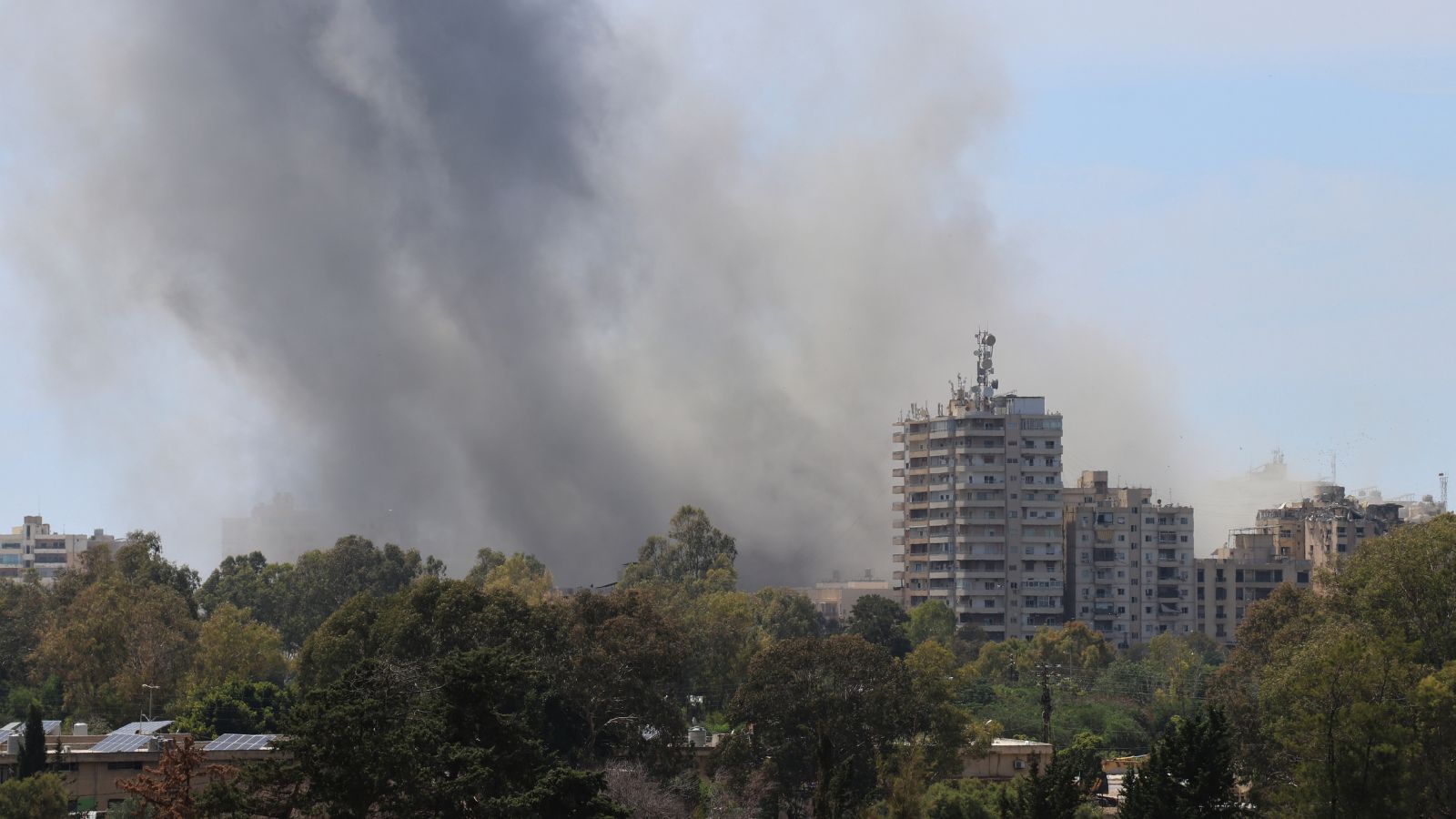
The headlines want you to believe we are on the precipice of World War III. A US drone goes down. The Islamic Revolutionary Guard Corps (IRGC) beats its chest. The Pentagon retaliates with "precision strikes" on Iranian-linked facilities in Syria or Iraq. The live blogs light up with red banners, military experts dusting off their maps, and talking heads predicting a regional conflagration.
It is a gripping narrative. It is also completely wrong.
What the mainstream media covers as an escalating, unpredictable war is actually a highly choreographed, mutually beneficial theater production. The US, Iran, and Israel are not stumbling blindly into a catastrophic regional war. They are playing strictly defined roles in a controlled kinetic ritual.
If you are watching the live updates to see who "wins," you are missing the point entirely. The escalation is the point. The maintenance of tension is the strategy.
The Choreography of the Controlled Burn
Mainstream military analysts treat every drone strike and retaliatory bombing as an isolated provocation that threatens to tip the region into total chaos. This assumes both sides are irrational actors playing a game of chicken.
They aren't. They are playing chess with a rulebook both sides have quietly agreed to for decades.
Consider the mechanics of the standard US-Iran engagement cycle:
- An Iranian proxy fires a low-tech rocket or loitering munition at a base with US personnel.
- The attack is calibrated to cause minimal casualties but maximum news coverage.
- The US issues a stern warning, followed by a delayed strike on an ammunition depot or an empty command center.
- Both sides declare victory and retreat to their corners until the next cycle.
This is not war. This is geopolitical signaling disguised as combat.
I have spent years analyzing regional defense budgets and procurement pipelines. Real escalation looks like massive logistical troop movements, systemic cyber warfare against critical civilian infrastructure, and the mobilization of deep-strike ballistic assets without warning. What we see instead are telegraph strikes. Iran frequently signals its intentions through Swiss intermediaries hours before a launch. The US explicitly states what it targeted and, crucially, what it avoided targeting to ensure the Iranian regime faces no existential threat.
The consensus view screams that deterrence has failed. The reality is that deterrence is working perfectly—it is just being used to maintain a profitable, stable instability rather than peace.
The Mutual Benefits of Perpetual Tension
To understand why this cycle never ends, look at who benefits from the theater. Hint: It is everyone currently firing the missiles.
Tehran's Domestic Safety Valve
The Iranian regime faces compounding economic crises, widespread domestic dissent, and a restive young population that rejects the clerical status quo. Nothing cures internal fracturing quite like an external enemy. Every US strike allows the IRGC to wrap itself in the flag of anti-imperialism, crack down on domestic dissidents under the guise of national security, and justify the prioritization of the military budget over basic economic relief. Iran does not want a real war with the US; it would lose decisively. It wants the spectacle of standing up to the US.
Washington's Defense Bureaucracy and Regional Pivot
For the United States, the perpetual Iranian threat is the ultimate justification for maintaining a massive forward-deployed footprint in the Middle East without actually committing to a resource-heavy ground war. It keeps the defense industrial base humming, justifies billions in arms sales to Gulf allies, and provides a convenient geopolitical anchor. The moment Iran ceases to be a credible threat is the moment Congress demands a genuine withdrawal from the region—something the foreign policy establishment is terrified of executing.
Israel's Strategic Monopolization
For Israel, the Iranian threat is a powerful unifying force and an invaluable diplomatic leverage point. It ensures bipartisan American support regardless of which political party holds power in Jerusalem or Washington. It also keeps the focus of the international community squarely on state-level threats, obscuring the far more complicated, intractable political realities of local territorial disputes.
Dismantling the "People Also Ask" Illusions
The public asks the wrong questions because the media feeds them flawed premises. Let's dismantle the three most common assumptions cluttering the news cycle right now.
1. "Will this spark a direct US-Iran war?"
No. A direct war requires a desire to change the status quo. Neither Washington nor Tehran wants that. A full-scale war would collapse the Iranian regime, creating a massive power vacuum that the US has no appetite to manage after the disasters of Iraq and Afghanistan. For Iran, an all-out war means the immediate destruction of its naval assets and economic infrastructure. Both sides know exactly where the red lines are. The current strikes are happening well within the safe zone of deniable, proxy-level friction.
2. "Does the IRGC actually have the capability to defeat US forces?"
The IRGC possesses asymmetrical capabilities—specifically swarm drones, anti-ship missiles, and proxy networks like Hezbollah—that can inflict serious pain and disrupt global shipping lanes through the Strait of Hormuz. But inflicting pain is not the same as winning a war. In a sustained, unconstrained conventional conflict, the US military possesses overwhelming logistical, technological, and kinetic superiority. The IRGC’s strategy is not victory; it is cost-imposition. They want to make the cost of American presence high enough to debate, but not high enough to trigger total annihilation.
3. "Are the current US strikes effective at stopping drone attacks?"
If the goal is to reduce the number of drones fired to zero, the strikes are a total failure. But that isn't the goal. The strikes are designed to manage the volume of attacks, keeping them at an acceptable baseline. It is a cynical calculus: allow a certain level of friction to occur, respond predictably to satisfy the domestic press and political rivals, and keep the regional balance of power exactly where it is.
The Real Danger Everyone is Ignoring
The true risk in the Middle East is not a planned escalation. The danger is a tactical mathematical error.
When you play a high-stakes game of chicken long enough, someone eventually miscalculates. A drone that was supposed to hit an empty courtyard gets blown off course by the wind and strikes a crowded barracks. A air defense system malfunctions and shoots down a civilian airliner. A rogue commander on the ground decides to show initiative and fires without clearance from Tehran or Washington.
[Choreographed Provocation] ---> [Predictable Retaliation] ---> [Status Quo Maintained]
                                       |
                                       v
                        (The Real Risk: Tactical Error)
                                       |
                                       v
                         [Unintended Macro-Conflict]
The system relies on perfect execution of imperfect signaling. As both sides use increasingly autonomous systems—AI-driven drone swarms, automated counter-rocket interception, and algorithmic electronic warfare—the window for human intervention shrinks. We aren't risking a war of intent. We are risking a war of bad data.
Stop Reading the Live Updates
If you want to understand the geopolitical reality of the Middle East, close the live-update tabs. Stop counting the number of rockets fired into the desert or tracking the movement of a single aircraft carrier.
Look instead at the oil markets, which barely register these strikes because commodity traders know the conflict is controlled. Look at the long-term diplomatic backchannels that remain open even while the missiles are flying. Look at the defense budget allocations that quietly cruise through legislatures while the public is distracted by the fireworks.
The current conflict is not a prelude to an explosion. It is the steady state. The crisis is not coming. The crisis is already working exactly as intended.