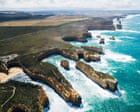
The salt spray off the Southern Ocean doesn’t just sting your eyes. It tastes like ancient history. Most people standing on the limestone cliffs of Port Campbell see a postcard. They see the Twelve Apostles as static sentinels, giant yellow-gold pillars of rock frozen in a permanent standoff with the turquoise surf. We have been told for generations that these are young icons, fleeting accidents of erosion that rose from the sea just yesterday in geological terms.
We were wrong. You might also find this connected coverage useful: Stop Blaming the Tourists Because Yellowstone Has a Wildlife Infrastructure Problem.
The ground beneath your boots is far more stubborn than we imagined. New research has peeled back the layers of the Victorian coastline to reveal that the foundations of these pillars aren't just a few thousand years old. They have been waiting in the dark for 14 million years.
To understand why this matters, you have to stop looking at the Apostles as rocks and start seeing them as survivors. As extensively documented in latest articles by Lonely Planet, the effects are significant.
The Ghost in the Limestone
Imagine a diver named Elias. He is a hypothetical composite of the researchers who spent months mapping the seafloor, but let’s give him a face. Elias isn’t looking at the sunset. He’s looking at the bathymetry—the hidden topography of the ocean floor. In the old version of the story, the Apostles were formed roughly 6,000 years ago as the cliffs retreated under the relentless assault of the waves. The narrative was simple: the ocean eats the land, the land crumbles into stacks, and eventually, the stacks fall down.
But Elias and his team found something that shouldn’t be there.
Deep below the waterline, preserved in the cold, high-energy environment of the shelf, sit the "drowned" cousins of the Apostles. There are five of them, hidden under sixty meters of water. They aren't jagged or fresh. They are ancient. By using sonar mapping and analyzing the sediment, geologists from the University of Melbourne realized that the limestone base of this entire formation dates back to the Middle Miocene.
$14,000,000$ years.
That number is difficult for the human brain to process. It means these formations were beginning their journey when the ancestors of modern apes were just starting to experiment with walking upright in Africa. While the world shifted, iced over, and thawed, these pillars remained anchored.
A Slow Dance with the Abyss
The ocean is a patient sculptor. The traditional view of the Twelve Apostles—there are actually only eight left standing, though the name remains a marketing masterstroke—was that they were a temporary fluke of the Holocene epoch. We thought they were fragile. We treated them like a sandcastle built at low tide, destined to vanish before the sun went down.
The reality is a much longer, more complex choreography. The limestone here is composed of the compressed remains of billions of tiny marine organisms. These shells settled on the sea floor millions of years ago, creating a massive cake of calcium carbonate. What the latest sonar data suggests is that the "birth" of these stacks wasn't a singular event. It was a cycle of drowning and resurrection.
During the Ice Ages, the sea levels dropped. The shelf was exposed. The wind whipped across the plains, carving the soft stone. Then the ice melted. The water rushed back in, swallowing the pillars and preserving them in a watery tomb where the air couldn't erode them further.
Consider the sheer endurance required for a pillar of stone to survive a rise in sea level. Usually, the "transgressive" sea (the rising water) acts like a giant bulldozer. It levels everything in its path. Yet, these submerged Apostles stayed upright. They defied the physics of the surge. This discovery changes the stakes of Australian geology. It suggests that our coastline is far more resilient—and far older—than the textbooks ever dared to print.
The Human Scale of Deep Time
Why does it feel different to stand on the lookout now, knowing the 14-million-year secret?
Most travelers arrive in a rush. They park the rental car, walk the bitumen path, snap a selfie, and leave within twenty minutes. They see a crumbling monument. They see the "London Arch" which collapsed in 1990, leaving two terrified tourists stranded on the new island, and they think of the coast as a place of impending loss.
But when you realize the base of that rock has endured since the Miocene, the perspective shifts. You aren't looking at a tragedy in progress. You are looking at a masterpiece of persistence.
The invisible stakes are found in our own sense of permanence. We live our lives in decades. We plan for the next five years, maybe ten. We worry about the "instability" of our world. Then we look at a pillar of limestone that has seen the sea rise and fall dozens of times, survived tectonic shifts, and outlasted entire species.
It is a humbling realization. The Apostles aren't just "tourist attractions." They are the teeth of the continent.
The Mystery of the Missing Stacks
There is a gap in the logic that researchers had to bridge. If the limestone is 14 million years old, why aren't there thousands of stacks? Why only these specific clusters?
The answer lies in the specific chemistry of the Victorian coast. The Southern Ocean is one of the most violent bodies of water on Earth. It has an "uninterrupted fetch," meaning waves can travel thousands of kilometers from Antarctica without hitting a single piece of land until they slam into Port Campbell.
This violence is actually a preservative.
By mapping the sea floor, scientists found that the underwater stacks were protected by the very depth of the water. Once the sea rose high enough, the waves passed over them rather than crashing against them. They were tucked into bed. The stacks we see today are simply the latest generation to emerge from the sheets.
It is a metaphor for survival: sometimes, to endure the storm, you have to be willing to be submerged by it.
The researchers used a technique called multi-beam sonar. It works by sending a fan of sound waves toward the ocean floor. By measuring the time it takes for the sound to bounce back, they can create a 3D map of the terrain.
$d = \frac{v \cdot t}{2}$
In this equation, $d$ is the depth, $v$ is the velocity of sound in water, and $t$ is the time. Through this simple calculation, repeated millions of times, the "ghosts" of the past appeared on the monitors. The data didn't show random rocks. It showed organized, vertical pillars that mirrored the Apostles exactly.
The Weight of the Air
There is a certain vulnerability in admitting that we didn't know our own backyard. We walked these cliffs for a century thinking we understood the timeline. We were arrogant enough to think that because we saw a stack fall in 2005, we understood the lifecycle of the entire range.
Nature operates on a frequency we can barely hear.
Standing on the edge of the cliff today, the wind is a physical weight. It tries to push you back from the ledge. Below, the water is a churning cauldron of white foam and deep indigo. You realize that the "Twelve Apostles" is a misnomer not just because of the count, but because of the status. They aren't disciples; they are the elders.
The sea isn't destroying them. It is participating in them.
The 14-million-year timeline invites us to stop mourning the rocks that fall. In the grand narrative of the Shipwreck Coast, a collapse is just a frame in a very long movie. The foundations remain. The submerged five—those hidden, drowned Apostles—are proof that even when something disappears from our sight, it doesn't mean it has ceased to exist. It is just waiting for the next change in the tide.
The sun begins to dip. The limestone turns from a dull cream to a fiery, burning orange. The tourists are heading back to their buses, checking their photos, complaining about the chill. They think they’ve seen the sight.
But they haven't looked deep enough. They haven't felt the vibration of the Miocene beneath their heels. They don't know that they are standing on a bridge that spans fourteen million years of solitude.
The ocean roars again, a sound like a thousand drums. It is the sound of a sculptor who is nowhere near finished with its work.