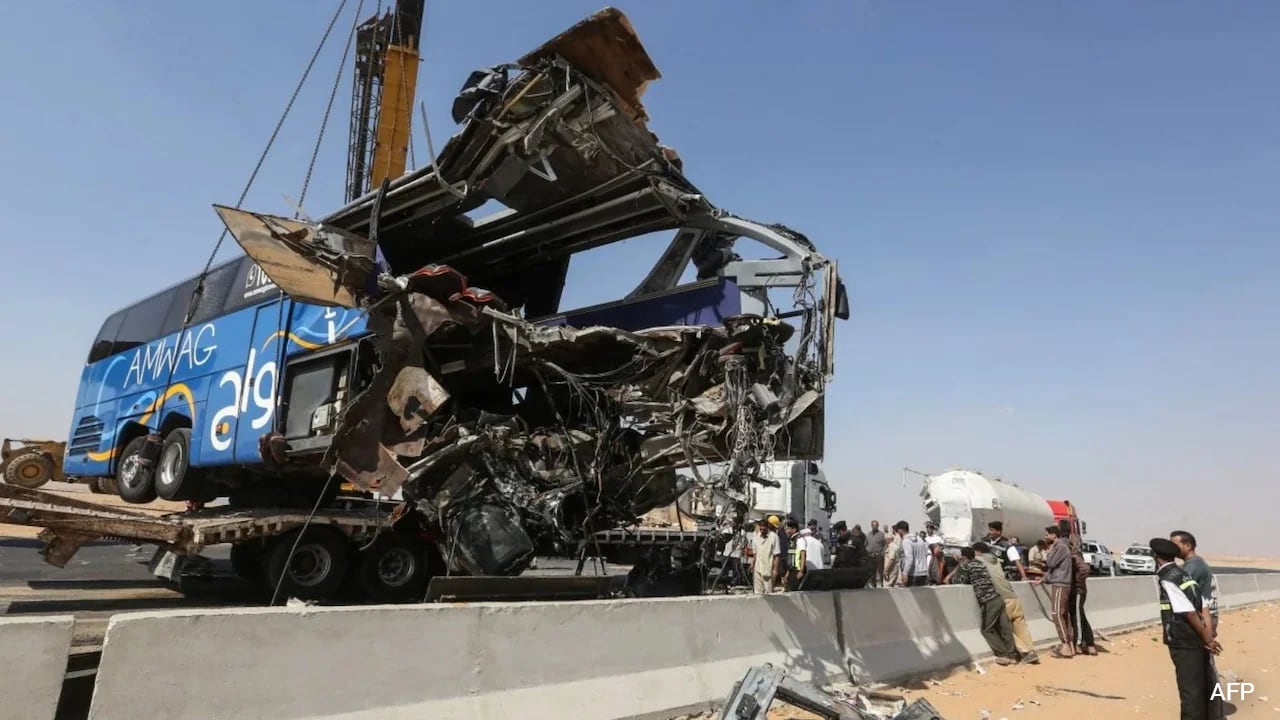
Dawn breaks over the desert with a pale, dusty gold that turns asphalt into a long silver ribbon.
For travelers bound for ancient temples, Red Sea resorts, or desert outposts in Egypt, the highway is a promise of arrival. You buy a ticket, fold a map or watch a blue dot crawl across a glowing screen, and trust that the distance between where you stand and where you want to be is simply a matter of hours. Yet a crash involving a large truck and a tour bus—leaving thirteen dead and thirty-four injured, according to the headline—rips that ordinary trust apart in less than a second. If you liked this piece, you should look at: this related article.
Numbers shrink grief. Thirteen lives lost. Thirty-four bodies broken, bruised, or pulled from twisted metal. A wire service reduces a cataclysm on open road to a single sentence before moving on to the next dispatch. When we read a tally like that over morning coffee, our brains file it away under tragedy, far away, and reach for another sip.
That distance is dangerous. For another look on this development, refer to the recent update from The New York Times.
To understand why a collision between a heavy freight truck and a passenger coach carries such lethal weight, you have to look at what happens when mass meets speed on a long, open stretch of pavement. A fully loaded heavy truck is an enormous wall of steel and cargo. A tour bus is a tall, glass-sided cabin holding dozens of people who are sitting upright, often unrestrained or loosely seated, looking out at sand and sky rather than bracing for impact.
When those two worlds collide, physics does not care about itineraries.
Hypothetical scenario: Picture a passenger sitting near the center of the coach—let's call him Tariq, a composite figure drawn from the real human realities of long-haul road travel rather than a verified individual from this specific crash. Half an hour earlier, he was debating whether to nap against the window or finish a chapter of a book. The air conditioning hummed steadily. Outside, heat shimmered off the shoulder. Everything felt slow, predictable, almost timeless. Then comes the shriek of rubber, the sickening crunch of steel folding inward, and the sudden, violent realization that the horizon has tilted sideways.
In a fraction of a second, a vacation or a work trip turns into triage on hot sand.
I have stood beside highways after major collisions—not in Egypt, though the smell of diesel, scorched brake dust, and warm metal is universal. Heat rises off the tarmac even in cool air. Sirens sound thin and far off before they grow loud enough to rattle your teeth. What stays with you longest is not the wreckage itself, though twisted frames and shattered glass are hard enough to forget. It is the quiet details: a single sneaker sitting upright on the shoulder, a half-empty water bottle rolling slowly in the dirt, strangers holding hands on a guardrail while waiting for ambulances to navigate miles of open road.
Road safety experts often talk about kinetic energy, stopping distances, and visibility, and those terms are useful—provided we translate them into human terms. Think of a heavy truck like a bowling ball rolling down a lane at high speed, and a tour bus like a stack of pins arranged on a rolling cart. Even if the bus driver reacts within a split second, heavy vehicles need vast stretches of road to shed speed, especially when fatigue, glare, blind spots, or mechanical wear enter the picture. On desert and intercity corridors, where long straightaways invite high speeds and sudden merges or stalled vehicles can appear out of nowhere, the margin for error is razor-thin.
It is easy, from afar, to look at a crash in Egypt and assign a single neat label: reckless driving, poor road conditions, aging vehicles, or bad luck.
Reality is rarely that tidy.
Long-distance highways across Egypt connect vital economic arteries, coastal gateways, and cultural landmarks across vast, challenging terrain. Heavy freight trucks keep supply chains moving—carrying construction materials, food, fuel, and goods that towns and cities depend on every single day. At the same time, tour buses carry domestic travelers, families visiting relatives, and international visitors moving between destinations that are often separated by hundreds of kilometers. Both vehicles are essential to how the country moves. When their paths cross violently, the collision exposes friction points that affect everyone on the road: driver fatigue on grueling shifts, mixed traffic speeds, nighttime or dawn glare, emergency response distances, and the sheer vulnerability of passenger cabins struck by heavy commercial rigs.
I will be honest: writing about fatal crashes makes me uneasy. Every time I sit down to analyze a tragedy I did not witness firsthand, I worry about getting the tone wrong—sounding too clinical on one hand, or melodramatic on the other. None of us can feel the exact shock of the thirty-four injured passengers waking up in hospital wards, nor the hollow silence in thirteen households trying to make sense of a phone call that changed everything. Uncertainty is part of reading breaking news, too. Early reports give casualty counts first; full investigations into exact causes, speed, lane positions, and mechanical factors take time.
Still, waiting for every last forensic detail should not stop us from paying attention to what is already unmistakable.
Why Heavy Freight and Passenger Buses Collide So Violently
Consider what happens on a long stretch of highway when a driver has been behind the wheel for hours.
Fatigue does not always look like a driver nodding off with eyes shut. Often, it looks like micro-lapses in attention—a two-second stare at a dashboard light, a misjudged gap when passing, a delayed reaction when traffic ahead slows unexpectedly. At highway speed, two seconds covers a staggering amount of ground. If a heavy truck is involved, the momentum behind that vehicle turns a minor miscalculation into a catastrophe.
Passengers on a tour bus are in a uniquely exposed position. Unlike a compact car surrounded by a crumple zone and airbags tailored to a small cabin, a coach sits high off the ground with large windows and rows of seats arranged across a long body. A severe impact from a heavy truck can shear through structure, throw passengers across the aisle, or trap people in seats bent out of shape. Even survivors among the thirty-four injured face a grueling road ahead: fractures, concussions, internal trauma, surgeries, lost wages, and fear that lingers long after physical bruises fade.
Metaphor: Think of a highway network like the circulatory system of a living body. Freight trucks are like red blood cells carrying oxygen and nutrients to distant tissues; passenger buses carry people—the pulse and movement of daily life and travel. Most days, flow continues smoothly. Occasionally, a clot or rupture happens—a crash at high speed—and the shockwave ripples far beyond the point of impact.
History shows us a recognizable pattern across countries with booming transport networks and long intercity routes. Whenever road infrastructure expands faster than uniform enforcement, rest-stop habits, vehicle maintenance standards, or defensive driving culture, high-severity collisions spike. It is not unique to one nation or one stretch of asphalt. Wherever heavy commercial traffic shares fast corridors with passenger transport, the stakes of a single mistake climb dramatically.
When travelers book a seat on a coach, they rarely think about braking physics or commercial transport regulations. They think about legroom, air conditioning, arrival times, and seeing something new. That trust is completely human. Nobody wants to step onto a bus feeling like they are entering a war zone. Yet acknowledging risk is not the same as living in fear; it is how people make smarter choices and demand safer systems.
What Travelers and Families Actually Face After a Crash
For the thirty-four people injured and the families of the thirteen killed, the headline is the beginning of an ordeal, not the end of it.
Emergency responders racing toward a desert or highway crash scene face brutal logistics. Distances can be long. Traffic backs up. Wounded passengers need rapid stabilization and transfer to hospitals equipped for multi-trauma care. Once at the hospital, chaotic early hours give way to exhausting days: identifying patients, coordinating with family members who may live hours away or in another country, managing medical bills and insurance paperwork, and confronting grief without a script.
If you are planning road travel in Egypt—or anywhere with long intercity highways—what should you actually do with news like this?
Panic helps no one. Canceling every trip out of dread usually isn't realistic or necessary. Practical caution, on the other hand, quietly shifts the odds in your favor.
- Choose reputable operators and daytime travel when possible. Long stretches of open road are harder to read in low light, glare, or deep night fatigue. Daylight improves visibility for everyone on the highway.
- Buckle up if seatbelts are available. Many coaches have worn or unused belts, and people sometimes skip them on short hops, yet restraints remain one of the simplest defenses against being thrown during a sudden swerve or impact.
- Sit thoughtfully and stay alert. Avoid sleeping through every mile if a driver seems erratic, speeding excessively, or tailgating heavy trucks. Speaking up calmly or switching operators if something feels off is never rude when your safety is on the line.
- Keep essentials accessible. Keep identification, emergency contacts, phone battery power, and basic medications in a small bag within reach rather than buried overhead or underneath.
None of these habits guarantees safety against a massive truck colliding with a tour bus. Nothing in life offers absolute immunity. What they do is replace passive wishfulness with quiet readiness.
The Invisible Weight Behind Every Headline
There is a reason a story like 13 Killed, 34 Injured After Large Truck Crashes Into Tour Bus In Egypt keeps resurfacing in global news feeds, even when the exact city or route blurs for casual readers.
Because we all move through the world on wheels.
Every time you step onto a bus, hail a ride, merge onto an expressway, or watch a semi-truck roar past your window, you are participating in a massive social contract. You trust strangers you have never met—drivers, mechanics, dispatchers, road crews, fellow motorists—to hold up their end of a bargain that keeps everyone alive until dusk.
Most days, that bargain holds. Millions of miles are driven safely. Buses pull into stations on time. Trucks unload their cargo. Families reunite.
Then comes a morning when the bargain breaks on open road. Thirteen people do not make it to where they were going. Thirty-four others carry scars—visible and invisible—from a few seconds of violent metal and noise.
When we strip away the dry cadence of wire reports and look closely at the human reality inside them, a crash stops being a statistic. It becomes a reminder of how thin the line is between an ordinary journey and an irreversible loss, and why safer roads, rested drivers, sound vehicles, and attentive travelers matter every single mile.
Out on the open highway, heat still rises off the blacktop, freight keeps rolling toward distant cities, and another bus pulls away from the curb carrying people full of plans—hoping the road ahead stays wide, clear, and merciful.


