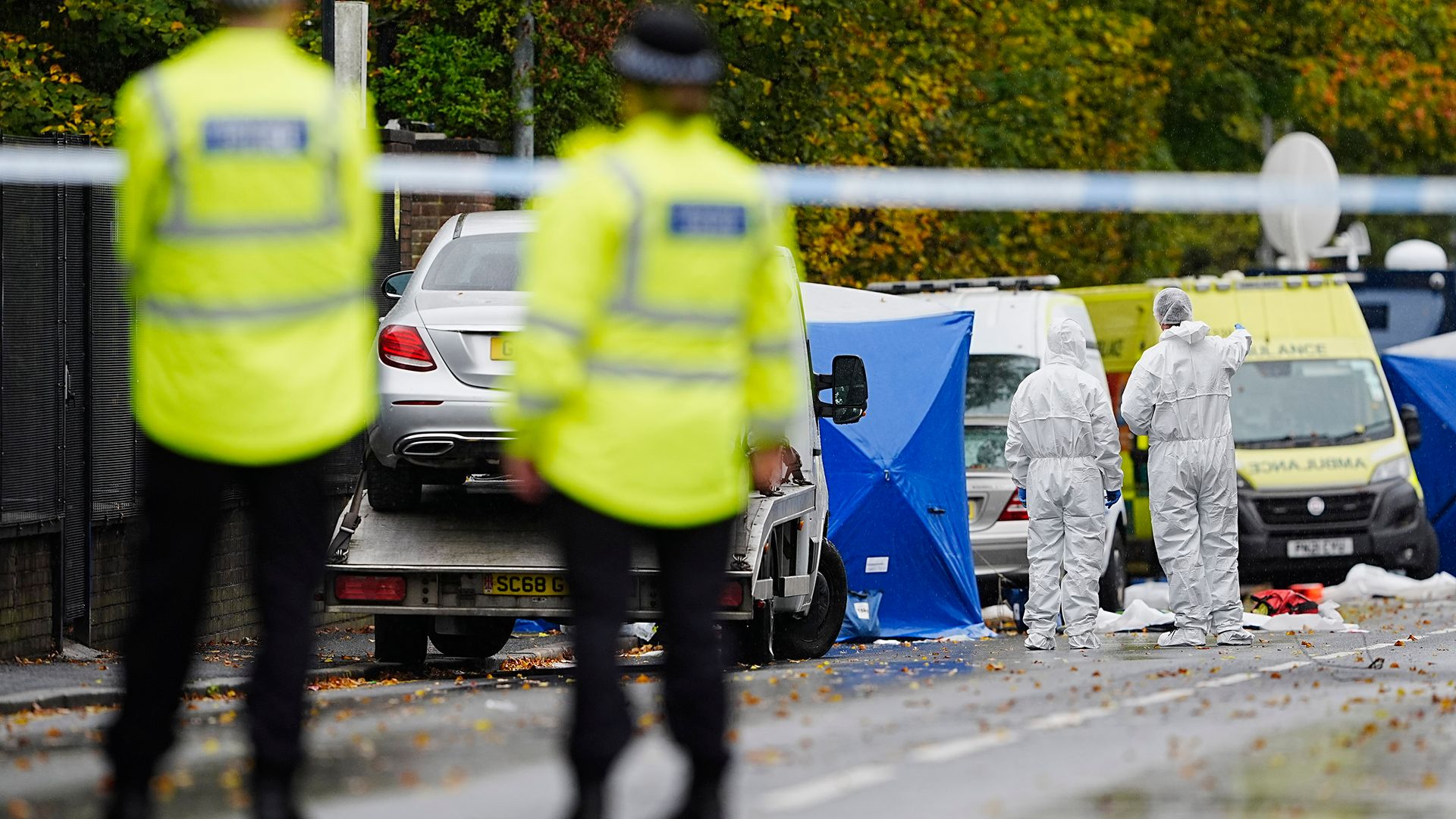
The rain in Greater Manchester does not fall; it hangs. It drifts sideways, a cold, heavy mist that blurs the sharp edges of the brick terraces and turns the tarmac of Bury New Road into a slick, reflective ribbon. On any given Friday evening, just as the sun dips below the Pennines, this stretch of road undergoes a quiet transformation. The roar of commuter traffic fades, replaced by the hurried, rhythmic scuff of leather shoes on wet pavement.
Men in dark coats and velvet hats walk briskly, their heads bowed against the chill. Women push strollers, their voices rising in soft, melodic cadences of Hebrew and English. They are walking toward the light spilling from tall, arched windows. For generations, the synagogue has been more than a building of stone and stained glass. It is an anchor. Inside, the air smells of beeswax, old books, and the rich, comforting scent of braided challah bread. It is a sanctuary where the chaos of the modern world is supposed to stop at the threshold.
But on a recent Tuesday, that sanctuary shattered.
The disruption did not come from a sudden act of nature, but from the deliberate malice of a human being. A brick shattered a window. Graffiti, jagged and hateful, defaced the sacred walls. Smoke, acrid and terrifying, choked the entryway. In a matter of minutes, a place built on the foundation of peace became a crime scene. Blue and red lights strobed against the damp brickwork, casting long, distorting shadows down the alleyways.
The immediate aftermath of such an event follows a predictable, clinical script. The police issue a statement. The local news runs a two-hundred-word blurb filled with passive verbs: An investigation has been launched. A perimeter has been established. A suspect has been detained.
To the casual reader scrolling through a phone on the morning tram, it is just another headline. A minor disturbance. A statistic.
But statistics do not bleed. They do not tremble. They do not have to look their children in the eye and explain why someone hates them before they even know their name.
The Weight of the Unseen Threat
To understand what actually happened in Manchester, you have to leave the police briefings behind and sit in the living room of someone like David.
David is a hypothetical composite of the dozens of community members who stood behind the yellow police tape that night, but his fear is entirely real. He is forty-two, a schoolteacher, and a man who has lived within a mile of the synagogue his entire life. His grandfather came to this city in the 1930s, fleeing a Europe that was curdling into nightmare. For David, the synagogue is the physical manifestation of his family’s survival.
When the news of the attack spread through a flurry of WhatsApp messages, David did not feel anger. He felt a cold, familiar weight drop into the pit of his stomach.
Consider the psychological anatomy of a hate crime. When a burglar breaks into a shop, the crime is transactional. The thief wants the cash register; the shopkeeper loses money. It is traumatic, yes, but the boundaries of the violation are clear.
A targeted attack on a place of worship is entirely different. It is a message wrapped in violence. The brick thrown through the window is not meant to destroy the glass; it is meant to destroy the sense of safety of every single person who identifies with that building. It says, We know where you gather. We know who you are. You are not safe here.
The real damage of the Manchester attack did not require a demolition crew. It was measured in the sudden, sharp intake of breath from an elderly Holocaust survivor who thought those days were forever behind her. It was measured in the quiet decision of a mother to keep her children home from the youth group that weekend. The perpetrator used a blunt instrument, but the injury was surgical, slicing through the invisible threads of trust that hold a neighborhood together.
The Machinery of Justice Shuts Down the Clock
For forty-eight hours, the community existed in a state of suspended animation. Every footsteps outside a door sounded louder. Every passing car seemed to linger just a second too long at the corner. The air was thick with rumors, the digital grapevine magnifying the terror as it always does.
Then came the breakthrough.
Greater Manchester Police, working alongside specialized hate-crime investigators and counter-terrorism units, closed in on a residential address. The arrest was fast. A thirty-four-year-old man was taken into custody, suspected of arson, criminal damage, and racially aggravated public order offenses.
The legal machinery began to grind forward, but the arrest itself offers a fascinating look into how modern law enforcement handles ideological violence. In the past, a local precinct might have treated a smashed synagogue window as simple vandalism—a case of drunken hooliganism or teenage delinquency. Not anymore.
Today, the response is massive, coordinated, and intelligence-driven. Forensics teams scoured the pavement for DNA. Cyber units tracked local digital forums to see if the attacker had broadcast his intentions or if he was working as part of a larger, organized cell. The state apparatus moved with a singular purpose: to signal that an attack on one minority is an attack on the civic fabric of the entire nation.
But police cells and court dockets can only do so much. They can lock a body away, but they cannot cure the rot that led that body to carry a brick to a house of God in the first place.
The Illusion of Distance
It is tempting for those outside the community to look at the Manchester arrest and feel a sense of closure. The bad actor has been caught. The system worked. We can all return to our routines.
That comfort is an illusion.
The modern rise in antisemitic and xenophobic incidents is not a series of isolated lightning strikes. It is a rising tide, fed by rivers of digital radicalization that run straight into our homes. The man arrested in Manchester did not invent his hatred in a vacuum. He likely fed on a steady diet of algorithms designed to maximize outrage, stepping down a rabbit hole of conspiracy theories that transformed his ordinary, perhaps frustrated life into a crusade against a scapegoat.
This is where the collective responsibility lies. We live in an era where the distance between a hateful comment online and a shattered window on Bury New Road is terrifyingly short. The internet has democratized radicalization, allowing lonely, angry individuals to find validation for their darkest impulses in the corners of the web, then bring that darkness into the physical world.
When we tolerate the casual dehumanization of any group in our public discourse, we are laying the kindling. We cannot be surprised when someone finally shows up with a match.
What Remains When the Lights Fade
On the Friday following the arrest, the yellow police tape was gone. The broken window had been replaced by a clean, clear pane of glass, though if you looked closely at the frame, you could still see the raw, splintered wood where the impact had occurred.
The sun went down. The rain, inevitable as ever, began to slick the pavement of Bury New Road.
David walked down the street, holding his son’s hand. His grip was tighter than usual. His eyes scanned the passing cars, the shadowed doorways, the faces of strangers. The innocence of his routine was gone, replaced by a hyper-vigilance that is the true, lingering tax of hatred.
Yet, as they reached the steps of the synagogue, something extraordinary happened.
They were not alone. Neighbors from the surrounding streets—people who did not share their faith, people who wore different clothes and spoke different languages—were standing on the sidewalk. Some held small candles that flickered against the damp wind. Others simply nodded as the congregants passed. There were no grand speeches, no political banners. Just a quiet, stubborn physical presence.
They stood there as a human wall, a declaration that the sanctuary would hold.
David and his son stepped inside. The heavy wooden doors closed behind them, shutting out the rumble of the Manchester traffic and the chill of the rain. The prayers began, their ancient, rhythmic cadence rising toward the rafters, slightly louder than the week before, defiant against the silence that fear tried to impose.