Municipalities seeking to regulate political speech on leased land face a structural bottleneck when local land-use bylaws conflict with constitutional protections for third-party political advertising. This friction is demonstrated by the ongoing jurisdictional dispute in Taber, Alberta, where a digital billboard commissioned by the registered third-party advertising group Pathway to Independence remains active despite a municipal eviction deadline. The conflict exposes the operational limits of municipal enforcement mechanisms when applied to ideological messaging during an active provincial referendum campaign.
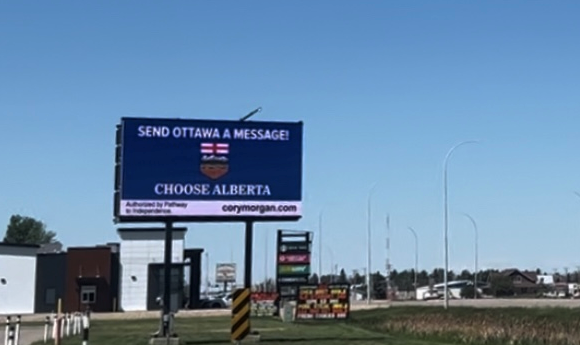
The dispute centers on a three-meter by six-meter digital sign situated on land owned by the Town of Taber and leased to a private billboard operator. Purchased for approximately $1,100 by advertiser Cory Morgan to run through June 2026, the advertisement displays the Alberta provincial shield alongside the text: "Send Ottawa a Message! Choose Alberta." This messaging aligns with advocacy surrounding the upcoming October 19 provincial referendum regarding Alberta’s constitutional status within Canada. Following citizen complaints and localized economic vulnerabilities—specifically public threats to boycott the municipality's primary agricultural export, Taber corn—the municipal administration attempted to terminate the specific broadcast by invoking the lease agreement's terms.
The Legal and Contractual Frameworks of Municipal Land Use
The operational vector chosen by the Town of Taber relies entirely on property law and administrative licensing, rather than direct statutory prohibitions on speech. On June 3, the municipal Chief Administrative Officer issued a formal directive to the private billboard operator, declaring the political advertisement a "nuisance" and asserting that its content was "inconsistent with the permitted use of the licensed area." The town established a removal deadline of June 13, threatening to exercise lease remedies, including total termination of the commercial license agreement.
This administrative strategy relies on a specific cost function: the municipality calculates that the risk of terminating a commercial lease is lower than the political and economic costs of ongoing community polarization and potential retail boycotts. However, this execution strategy encounters immediate structural resistance due to the architecture of Canadian administrative law.
- The Private-Public Property Dichotomy: While a private landowner possesses broad discretion to dictate content on their property, a municipality remains a government actor bound by the Canadian Charter of Rights and Freedoms, even when acting as a commercial landlord.
- The Nuisance Threshold: Defining political advocacy as a "nuisance" under standard municipal land-use bylaws requires meeting a rigorous evidentiary standard of physical or systemic disruption. Ideological disagreement or reputational risk to local agriculture rarely satisfies this threshold in formal judicial reviews.
- Third-Party Compliance: Because the advertiser is formally registered with Elections Alberta, the messaging operates under provincial electoral frameworks, superseding local administrative preferences.
The Streisand Effect and Asymmetric Campaign Dynamics
The administrative effort to suppress the advertisement altered the economic scale of the campaign. Political suppression mechanisms frequently yield an inverse result to their stated objective by lowering the acquisition cost of public attention.
Prior to the municipal intervention, the advertisement functioned as a localized, fixed-asset campaign with linear reach restricted to the Highway 3 transit corridor. The issuance of the removal directive transformed the physical asset into a high-yield digital narrative. This operational shift created two distinct outcomes for the advertiser.
First, the controversy expanded fundraising capabilities. The media coverage generated by the enforcement deadline acted as a proof-of-concept for the advertiser's donor base, validating the efficacy of the expenditure and accelerating capital inflows.
Second, it enabled infrastructure diversification. The advertiser utilized the newly acquired capital to purchase two additional, smaller advertising placements within the same municipality, alongside a planned deployment in Dunmore. By executing a decentralized placement strategy on private land holdings, the advertiser removed the municipality's primary leverage point: ownership of the underlying real estate.
Economic and Agricultural Vulnerabilities in Municipal Governance
The rapid escalation of the administrative response highlights a critical vulnerability in small-scale municipal economies. For a community like Taber, brand equity is deeply intertwined with a single seasonal agricultural commodity. The introduction of highly polarizing constitutional rhetoric creates a direct threat to downstream retail demand.
[Political Advertisement on Publicly Leased Land]
                       │
                       ▼
         [Public Polarization & Backlash]
                       │
                       ▼
       [Threatened Consumer Boycott of Crop]
                       │
                       ▼
     [Municipal Intervention via Lease Clauses]
The municipality's initial public positioning sought to decouple the civic brand from the political movement, stating that the sign did not represent or speak for the town council or the broader community. When passive disclaimers failed to mitigate consumer backlash, the administration felt compelled to utilize its leverage as a lessor. The bottleneck in this approach is that it forces the local government to arbitrate political expression, abandoning its neutral administrative mandate and inadvertently escalating the issue into a provincial debate on free expression.
Structural Realities of Third-Party Advertising Enforcement
The sign remains operational past the June 13 deadline because the commercial billboard operator faces a complex liability matrix. Compliance with the municipality's directive protects the land lease but exposes the operator to breach-of-contract litigation from the advertiser, who paid for a fixed broadcast window ending late June. Conversely, maintaining the advertisement preserves the immediate commercial contract but jeopardizes the long-term land tenure.
The tactical resolution of this impasse will depend on whether the municipality pursues immediate physical eviction or seeks an injunction. If the town chooses to prematurely terminate the commercial lease, it risks a protracted legal challenge regarding the misuse of administrative power to censor registered political advertisers.
The optimal strategic play for municipal administrations facing similar third-party political campaigns on public land is to establish strict, content-neutral pre-clearance criteria within the core text of all commercial lease agreements prior to execution. Attempting to retroactively classify standard political speech as a property nuisance during an active election or referendum cycle introduces profound legal risks and guarantees the amplification of the exact messaging the municipality intended to manage.