The tactical interception of four Iranian one-way attack uncrewed aerial vehicles (UAVs) by United States Central Command (CENTCOM) forces over the Strait of Hormuz, followed by immediate retaliatory strikes on Iranian coastal radar installations, reveals a fundamental flaw in contemporary deterrence theory. While standard geopolitical reporting frames these events as isolated violations of a fragile ceasefire, a structural analysis proves otherwise. These engagements are the predictable output of an asymmetric cost-imbalance loop, where low-cost autonomous vectors force high-cost kinetic escalations, systematically undermining maritime stability.
Understanding this operational reality requires moving past political rhetoric and analyzing the hard mechanics of the escalation cycle, the architectural vulnerabilities of the Strait of Hormuz, and the economic math governing modern littoral warfare.
The Asymmetric Cost Function of Littoral Denial
The core driver of the ongoing instability is a severe imbalance in the expenditure-to-destruction ratio between state-sponsored autonomous platforms and established naval defense systems. This friction can be calculated through a basic cost function:
$$C_{\text{system}} = C_{\text{vector}} - (C_{\text{effector}} \times R_{\text{exchange}})$$
Where $C_{\text{vector}}$ represents the manufacturing and operational cost of the offensive drone, $C_{\text{effector}}$ represents the cost of the air-defense missile used to neutralize it, and $R_{\text{exchange}}$ is the quantitative ratio of interceptors required per target.
In the June 5 engagement, Iran deployed one-way attack drones. These platforms typically leverage commercial off-the-shelf components, basic GPS guidance systems, and small internal combustion engines. The estimated production cost per unit ranges from $20,000 to $50,000.
To neutralize these four threats, U.S. naval assets or land-based air defense batteries deploy surface-to-air missile systems, such as the RIM-162 Evolved SeaSparrow Missile (ESSM) or RIM-66 Standard Missile-2 (SM-2). Each of these interceptors carries a unit cost between $1 million and $2.5 million. Because standard engagement doctrine dictates a "shoot-look-shoot" or a two-missile salvo per incoming target to ensure a high probability of kill ($P_k$), the economic math of the defense becomes highly unfavorable.
- Offensive Investment: ~$160,000 (four low-tier UAVs)
- Defensive Expenditure: ~$8,000,000 to $16,000,000 (air-defense interceptors)
This 1:100 cost asymmetry creates an unsustainable defensive burden for long-term deployment. Tehran relies on this dynamic not to achieve outright military victory, but to enforce a high-friction attrition strategy that drains Western precision-guided munition stockpiles.
Degradation Mechanics: The Target Selection Behind U.S. Reprisal Strikes
Following the successful shootdown of the four UAVs, CENTCOM executed immediate kinetic strikes against Iranian coastal surveillance radar sites in Goruk and on Qeshm Island. This response was not an arbitrary choice of targets; it was a deliberate counter-intelligence operation designed to degrade Iran's maritime domain awareness (MDA).
The mechanics of a drone strike in restricted waters like the Strait of Hormuz depend entirely on an kill chain that requires active sensor tracking. Coastal surveillance radars provide the initial localization data needed to program the inertial navigation systems of low-tier drones before launch. By eliminating these specific nodes, the U.S. military directly interrupted the Iranian targeting loop through two distinct mechanisms:
1. Blind Spots in the Littoral Vector
Without land-based radar telemetry, Iranian forces cannot accurately update the mid-course guidance of low-RCS (radar cross-section) targets against moving maritime vessels. This forces them to rely on less reliable commercial transponder data or visual spotting, drastically reducing the operational efficacy of subsequent drone salvos.
2. Early Warning Denial
Coastal radars act as the eyes of local anti-ship missile batteries. Destroying the facilities at Goruk and Qeshm Island deprives the Islamic Revolutionary Guard Corps (IRGC) of real-time tracking on U.S. Navy surface combatants, limiting Iran's ability to launch surprise retaliatory anti-ship cruise missile (ASCM) strikes.
The vulnerability of this response strategy lies in its escalatory nature. While neutralizing a radar site reduces immediate operational risk for shipping, striking sovereign Iranian territory expands the geographic scope of the conflict, directly threatening the tenuous bilateral ceasefire.
The Shipping Bottleneck and the Failure of Port Blockades
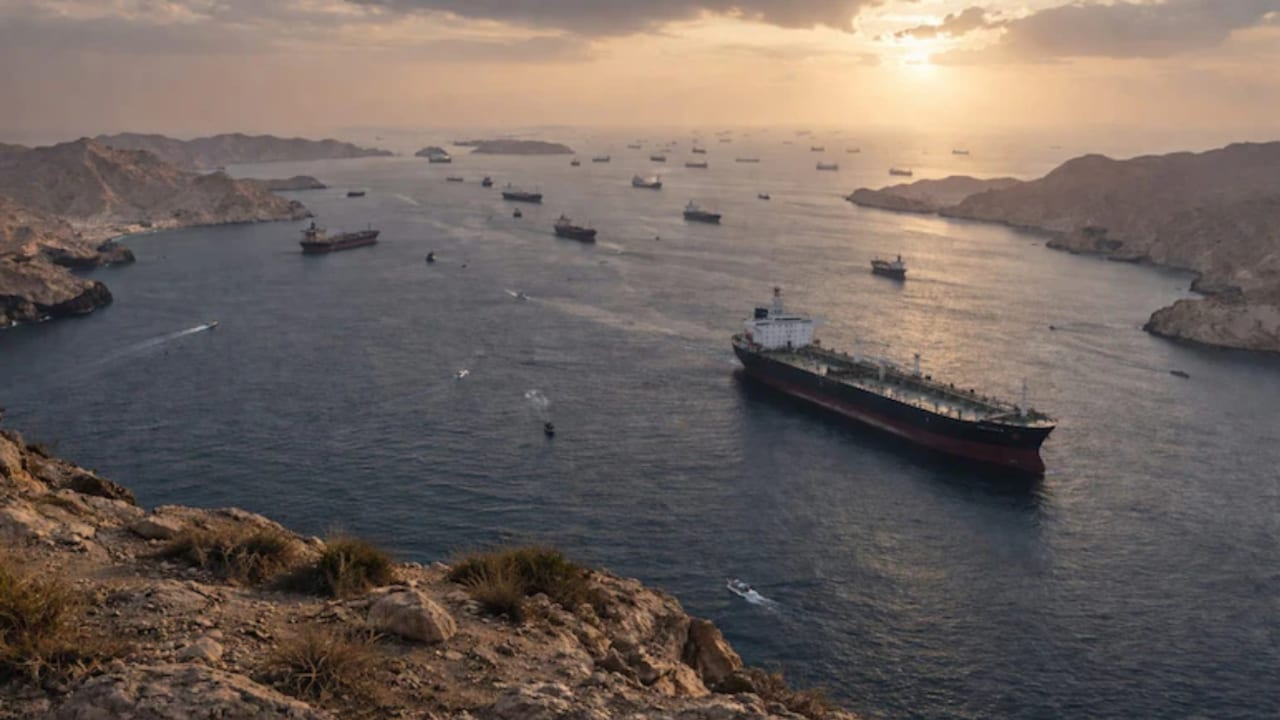
The underlying strategic objective of the U.S. naval presence is the enforcement of an export blockade on Iranian ports. This action was initiated to counter Tehran's attempts to choke off the Strait of Hormuz—a maritime transit corridor responsible for the daily passage of roughly 20% of the world's petroleum liquids.
However, classical naval blockades face structural limitations when applied to modern asymmetric conflicts in confined waters:
- The Proximity Threat: The Strait of Hormuz is only 21 nautical miles wide at its narrowest point, with the shipping lanes consisting of two two-mile-wide channels separated by a two-mile buffer zone. This extreme geographical constriction means that commercial shipping remains permanently within range of land-based mobile missile launchers, fast attack craft, and loitering munitions, regardless of how effectively civilian ports are blockaded.
- The Insurance Premium Spiral: A blockade does not need to physically sink every ship to halt trade. Kinetic exchanges like the June 5 drone shootdown cause maritime insurance underwriters to immediately increase War Risk premiums. When these premiums spike, commercial shipping lines self-select out of the route, effectively achieving Iran's goal of economic disruption without requiring a single successful hull strike.
- Sanction Evasion Resilience: Despite aggressive U.S. actions, including the recent boarding of an Iranian-linked sanctioned tanker in the Indian Ocean, a complete economic shutdown is structurally impossible due to the "Ghost Fleet" network. These vessels mask their identities via disabled Automatic Identification Systems (AIS), ship-to-ship transfers in international waters, and flags of convenience, keeping oil revenue flowing to Tehran despite Western naval containment.
The Strategic Reality: Why the 60-Day Ceasefire Extension is Unraveling
The latest escalation occurs against the backdrop of a tentative, U.S.-brokered agreement to extend the active ceasefire by 60 days. This diplomatic effort is failing because both parties are operating under incompatible strategic priorities.
The U.S. executive branch is caught in a political bottleneck. With domestic energy prices rising and critical midterm congressional elections approaching, the administration requires immediate stabilization of the Persian Gulf to drive down global fuel and fertilizer costs. However, Washington's insistence on unilateral revisions to the draft treaty regarding Iran's nuclear enrichment and its remaining 22% ballistic missile stockpile prevents a diplomatic resolution.
Simultaneously, the geopolitical conflict cannot be isolated to the Persian Gulf. The regional architecture is bound by a multi-front linkage doctrine. Iran refuses to formalize any long-term maritime truce unless the agreement explicitly encompasses a cessation of hostilities in Southern Lebanon. With Israeli forces actively clearing territory south of the Litani River and engaging Hezbollah militants, the local conflict is hardcoded to remain active.
Because Iran can project power through proxy networks and cheap autonomous technology across multiple theaters—as evidenced by the devastating drone strike on Kuwait International Airport earlier this week—Tehran faces no functional incentive to accept a restrictive, isolated maritime agreement.
Prescriptive Operational Framework for Regional Maritime Security
To break out of this reactive escalation loop, naval forces must pivot from high-cost kinetic interception to an architecture focused on cost-imposition and passive resilience. Relying on multi-million dollar air defense missiles to fight off waves of mass-produced drones will eventually lead to defensive failure.
First, naval deployment must prioritize the integration of directed-energy weapons (DEWs) and high-power microwave (HPM) systems onto surface combatants. These technologies shift the cost function back in favor of the defender, dropping the cost-per-shot from millions of dollars to the mere price of the fuel required to generate the electrical pulse.
Second, the shipping corridor must transition to an active, escorted convoy system utilizing electronic warfare (EW) umbrellas. Instead of physically destroying every incoming drone, naval assets should focus on wide-area GPS spoofing and radio-frequency jamming to break the command-and-control links of incoming UAVs, causing them to crash harmlessly into the sea.
Finally, diplomatic efforts must abandon the flawed premise that a maritime ceasefire can exist independently of broader regional conflicts. Until negotiations address the synchronized realities of the Lebanese theater, the economic blockades, and the proxy networks simultaneously, the Strait of Hormuz will remain highly volatile. Western forces must prepare for an extended period of high-frequency, low-intensity kinetic friction.