Canada’s vast polar frontier spans forty percent of the country’s total landmass and boasts a staggering coastline, yet it remains one of the most glaring military vulnerabilities in the Western Hemisphere. Beneath the melting ice sits an arena of intense geopolitical friction where state adversaries test response times, probe early-warning radar installations, and eye vast, untapped mineral reserves. For decades, Ottawa treated the Far North through the comfortable lens of geography, assuming that punishing sub-zero temperatures and multi-year pack ice served as an impenetrable natural barrier. That geographic insurance policy has officially expired.
Climate change is rewriting the polar map at an alarming pace. As shipping lanes open and year-round maritime access inches closer to reality, the security calculus shifts from theoretical deterrence to active management. Foreign state actors do not need to fire a shot to compromise sovereignty; they simply need to operate with impunity in waters and airspace where Canada lacks the sustained logistical footprint to project force. You might also find this connected article interesting: The Structural Risk Calculus of Geopolitical Infrastructure Vulnerability.
The structural decay of northern defense runs deeper than budget shortlines. It stems from a historic mismatch between territorial ambition and operational reality. Consider a hypothetical scenario where a foreign-flagged research vessel or an unidentified sub-surface drone drops off-grid monitoring arrays near the Northwest Passage. Responding to that intrusion requires more than diplomatic notes. It demands heavy icebreakers, constant air surveillance, and rapid-reaction ground forces capable of operating thousands of kilometers away from deep-water ports or paved runways.
Instead,
Canada is Defenseless in the Arctic and Everyone Knows It As highlighted in latest reports by USA Today, the effects are significant.
news
category
Canada is currently failing to secure its Arctic territory against rising geopolitical incursions, leaving millions of square kilometers of sovereign ice and open water effectively unmonitored.
The Canadian Armed Forces face an impossible geography. We are talking about a region spanning nearly four million square kilometers, bordered by the longest coastline in the world, marked by extreme weather, and devoid of deep-water ports or dense infrastructure. For decades, Ottawa treated the polar frontier as a frozen abstraction rather than a strategic border. That luxury expired the moment Chinese research vessels and Russian nuclear submarines began treating the Northwest Passage as international commons rather than Canadian internal waters.
The Logistics of Absolute Nothingness
Drive up to Inuvik or Resolute Bay, and the stark reality of northern defense sets in immediately. There are no highways leading to the high polar stations. Every bolt of concrete, every barrel of diesel, and every ration must be flown in on aging transport aircraft or barged in during an agonizingly short window when the sea ice breaks.
The military logistics chain is stretched to the breaking point. When a patrol aircraft breaks down in Yellowknife, technicians often wait weeks for specialized parts flown from southern maintenance hubs. The distance alone acts as a hostile actor.
Operating in sub-zero temperatures requires equipment designed specifically for thermal extremes. Yet, standard-issue gear frequently fails when thermometers drop below minus forty degrees Celsius. Weapons jam, electronics shatter from brittle fracture, and hydraulic fluids freeze solid.
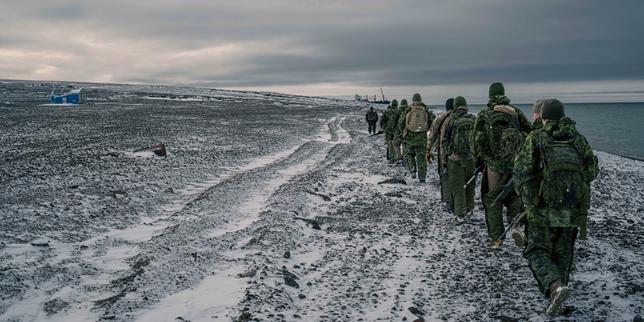
The Canadian Rangers, a vital sub-component of the primary reserve, provide invaluable eyes and ears on the ground. These local indigenous volunteers possess generational knowledge of survival and navigation. However, expecting lightly armed local militias to act as a primary deterrent against state-sponsored incursions is a dangerous geopolitical fantasy. They can report a footprint on the snow, but they cannot stop a modern surface combatant or intercept a hypersonic glide vehicle.
The Blind Spots in the Sky and Under the Sea
For years, the North Warning System has acted as the primary radar shield for North America. Built during the Cold War to detect Soviet bombers flying over the pole, it is obsolete. It relies on aging technology that struggles to track modern stealth cruise missiles and low-flying drones.
Modernizing these sensor arrays has stalled through successive bureaucratic administrations. Every budget cycle brings grand announcements of NORAD upgrades, followed by years of procurement delays, cost overruns, and canceled contracts. Meanwhile, Moscow and Beijing expand their persistent surveillance capabilities across the polar basin.
Under the surface, the situation is even more precarious. Canada operates a fleet of four Victoria-class diesel-electric submarines purchased second-hand from the Royal Navy decades ago. These vessels are plagued by maintenance backlogs. They spend more time in dry dock than they do patrolling the waters they were bought to protect.
A diesel-electric submarine lacks the range and endurance required to operate effectively beneath permanent pack ice without constant surfacing or snorkeling, which exposes them to detection. To patrol the Arctic year-round, a navy needs nuclear propulsion. Canada has neither the submarines nor the political courage to acquire them, despite mounting pressure from Washington.
The Myth of Bilateral Protection
Ottawa has long relied on the comfortable assumption that the United States military will automatically secure North America's northern flank. This dependency is eroding. Washington views the polar region through the lens of great power competition with China and Russia. American strategic planners are growing impatient with Canada's persistent underfunding of its military commitments.
When American warships transit the Northwest Passage without seeking permission, they do so to assert freedom of navigation rights that directly challenge Canada's claim of sovereignty over those waters. By failing to police the region ourselves, we invite our closest ally to do it for us, thereby eroding the very sovereignty we claim to defend.
The strategy of polite diplomatic assertion has run its course. Beijing is heavily investing in polar research stations, heavy icebreakers, and dual-use infrastructure that can easily pivot to military intelligence gathering. Moscow has reopened Soviet-era bases along its northern coast, stationing specialized Arctic brigades and coastal defense missile systems within striking distance of North American shores.
The Cost of Inaction
Rebuilding a credible northern defense requires hard choices. It demands billions of dollars diverted from social programs and southern infrastructure projects into heavy icebreakers, satellite constellations, forward operating bases, and uncrewed underwater vehicle networks.
The federal government must stop treating northern security as a seasonal photo opportunity for cabinet ministers. Until Ottawa commits to a permanent, heavy-metal military footprint in the high latitudes, the defense of the Arctic will remain what it is today: an expensive illusion whispered about in parliamentary committee rooms while foreign powers quietly map the approaches to our undefended backyard.