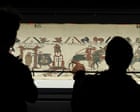
Walk into a museum in Normandy or London and you'll spot something bizarre. Crowds of twenty-somethings are lining up for hours to stare at a 70-meter strip of embroidered linen from the 11th century.
They aren't doing it for extra credit. Young adults are actively choosing a nearly thousand-year-old piece of medieval needlework over opening-weekend tickets to Hollywood's biggest tentpole releases. A survey commissioned around the British Museum's loan discussions and ongoing exhibition hype confirmed what curators have been noticing on the floor for years. Younger demographics are showing higher cultural curiosity and intent to visit this ancient comic strip than they are for many current box-office heavyweights.
It sounds fake. It isn't.
When you actually look at how the Bayeux embroidery works, how it was made, and why it feels so weirdly modern, the hype makes complete sense. Hollywood keeps serving up sterile, CGI-heavy sequels that feel like they were written by a committee. Meanwhile, a Bishop in the 1070s commissioned a raw, brutal, funny, and wildly chaotic piece of visual storytelling that hits the exact same brain receptors as a TikTok scroll or an HBO prestige drama.
What Makes a 1070s Linen Cloth Feel Like Modern Pop Culture
Most people hear "medieval art" and picture stiff, gold-leaf paintings of solemn saints staring blankly into space. That's not what's happening here.
The Bayeux embroidery—technically an embroidery, not a woven textile, though everyone calls it by its traditional name—is essentially a 230-foot-long storyboard. It tells the story of the Norman conquest of England in 1066, culminating in the Battle of Hastings. And it moves fast.
There are no long blocks of boring text. Instead, you get 58 distinct scenes packed with over 600 human figures, hundreds of horses, dozens of ships, and a running commentary of weird little animals in the top and bottom borders. It reads like a graphic novel. Honestly, if you unrolled it in a modern animation studio today, directors would recognize it immediately as a masterclass in pacing and visual framing.
Look at the famous scene of Halley's Comet appearing in the sky in 1066. King Harold sits slumped on his throne, looking terrified, while ghostly ships appear in the lower border as a visual metaphor for the impending invasion. That's pure cinema. You don't need a Latin degree to feel the dread in that frame.
Then there's the humor. Medieval artists didn't take themselves nearly as seriously as modern history textbooks make them seem. In the borders, you'll find Aesop's fables, naked figures, bizarre mythical creatures, and slapstick moments tucked right beneath scenes of political betrayal. It's the exact mix of high-stakes drama and irreverent side-jokes that drives modern internet culture.
The Original Meme Factory
Before "Bayeux memes" became a literal internet trend—complete with custom meme generators that let you build your own 11th-century panels—the artwork itself was already operating on meme logic.
Think about how internet humor works today. You take a recognizable visual template, slap a short caption on it, and let the exaggerated body language do the heavy lifting. Look at the panels showing William the Conqueror and Harold Godwinson arguing, or the terrified expression of a soldier getting an arrow to the eye. The gestures are huge, theatrical, and immediately readable from ten feet away.
Young visitors aren't looking at this artifact through dusty museum glass with reverence. They're taking photos, zooming in on the weird faces in the margins, and sharing them in group chats. When an artifact naturally lends itself to being screenshotted and memed without losing its historical weight, it crosses over from "homework" into actual pop culture.
Why Hollywood Is Losing the Attention Battle
To understand why young people are flocking to an exhibition about 11th-century Anglo-Norman politics instead of the multiplex, you have to look at what's happening in entertainment right now.
Movie ticket prices aren't cheap. By the time you pay for a seat, parking, and popcorn, you're out forty or fifty bucks for two hours of predictable green-screen action. Gen Z and younger Millennials have grown up saturated in digital effects. When everything on screen is computer-generated, nothing feels heavy. Nothing feels real.
Standing in front of a massive, hand-stitched artifact from 1066 gives you the exact opposite sensation.
You can see the individual wool threads. You can see where the linen was repaired centuries ago. You can see the sheer human labor that went into stitching millions of tiny needle marks by candlelight. In an era where AI-generated slop and synthetic media flood every feed, physical authenticity has become the ultimate luxury good. Young people crave things that actually exist in the real world—things with texture, history, and human fingerprints all over them.
Shared Cultural Moments vs. Algorithmic Isolation
Streaming platforms fractured pop culture into a million tiny micro-niches. You might watch a show on Netflix that your best friend has never even heard of. Going to the movies used to be the default shared experience, especially for younger crowds, but franchise fatigue has hollowed that out.
Major museum exhibitions have stepped into that vacuum. When a rare historical piece goes on tour—like the landmark agreement between France and the UK to bring the Bayeux masterpiece to the British Museum in London—it becomes a genuine, time-limited event. You can't stream it at home on your couch. You have to show up in person, stand in the room with hundreds of other people, and experience it together.
Museums have also gotten much smarter about how they present these artifacts. Gone are the days of whispering guards and tiny, unreadable placards. Modern exhibitions use dynamic lighting, spatial audio, and interactive digital overlays that let visitors inspect microscopic details without crowding the glass. They treat history like a blockbuster production, and young audiences are responding with their wallets.
What Most People Get Wrong About the Embroidery
If you're planning to see it—or just want to sound like you know what you're talking about when it comes up—there are a few massive misconceptions you should drop right away.
First, it wasn't made by Queen Matilda. For centuries, romantic Victorian historians claimed William the Conqueror's wife and her ladies-in-waiting stitched the whole thing in a fit of devotion. Historians have largely debunked that. The current consensus among scholars is that it was commissioned by Bishop Odo of Bayeux, William's half-brother, who appears prominently in several scenes looking suspiciously heroic. And the actual needlework? Almost certainly done by professional Anglo-Saxon embroiderers in Canterbury, England, who were famous across Europe for their skill.
Second, it's political propaganda, not an objective history book. Bishop Odo had a clear agenda. He wanted to prove that Harold Godwinson swore a sacred oath to support William's claim to the English throne, broke that oath, and got what he deserved at Hastings. Every frame is carefully staged to make the Normans look disciplined and righteous while painting Harold as a tragic oath-breaker. Recognizing the spin makes looking at it ten times more interesting. You're basically watching the 11th-century equivalent of a state-sponsored documentary.
Third, the ending is missing. The cloth currently ends abruptly with the English troops fleeing the battlefield at Hastings. Almost every historian agrees that at least one or two final panels were lost or damaged over the centuries. Most likely, the original finale showed William being crowned King of England at Westminster Abbey on Christmas Day 1066—creating a symmetrical bookend to the opening scene of King Edward the Confessor on his throne.
The Brutal Details You'll Spot Up Close
If you only ever see photos of the embroidery in history books, you miss the wildest parts. Curators and art historians often point out that the real magic happens when you walk the length of it at eye level.
Look closely at the Battle of Hastings sequence near the end. The sheer chaos of medieval warfare is rendered in stark, graphic detail:
- Horses tumbling head-over-heels in mid-air as they collide with shield walls, drawn with a sense of kinetic energy that feels way ahead of its time.
- Severed limbs and decapitated bodies littering the lower border once the fighting reaches its peak, showing that the artists didn't sanitize the violence for polite company.
- Bishop Odo swinging a club instead of a sword—supposedly because clergy weren't allowed to shed blood, though bashing someone with a wooden mace isn't exactly pacifism.
- Scavengers stripping armor off dead soldiers in the margins while the battle still rages directly above them.
It's gritty, unfiltered, and completely unvarnished. When young audiences compare that raw energy to a sanitized PG-13 action flick, it's no shock which one leaves a stronger impression.
How to Experience It Without the Tourist Trap Headaches
Whether you're heading to Normandy to see it at the Musée de la Tapisserie de Bayeux or catching it during its historic UK exhibition run at the British Museum, showing up unprepared is a rookie mistake. Because of the surge in younger visitors and viral social media attention, tickets sell out weeks—sometimes months—in advance.
Do these four things before you go:
- Book the earliest morning slot available. Mid-day crowds turn the viewing gallery into a slow-moving conveyor belt. Getting in during the first 30 minutes of the day lets you actually pause at your favorite panels without someone breathing down your neck.
- Download a high-resolution digital companion beforehand. The official Bayeux Museum website offers a full, zoomable digital panorama of the entire cloth. Spend 15 minutes scrolling through the Latin inscriptions and border details the night before so you know which specific scenes you want to hunt for in person.
- Skip the basic audio guide if you want deeper context. Standard museum audio tracks move at a fixed pace that rushes you through the best battle scenes. Instead, grab a solid breakdown like Carola Hicks' book The Bayeux Tapestry or listen to a dedicated history podcast episode on the train ride there so you can set your own pace in the gallery.
- Look at the borders first, the main action second. Everyone stares straight at the middle strip. Force yourself to scan the top and bottom margins as you walk—that's where the artists hid the best jokes, fables, and subtle political commentary.
Pop culture trends usually burn out in a few weeks. A 950-year-old strip of wool and linen isn't going anywhere, and right now, it's outdrawing Hollywood at its own game.