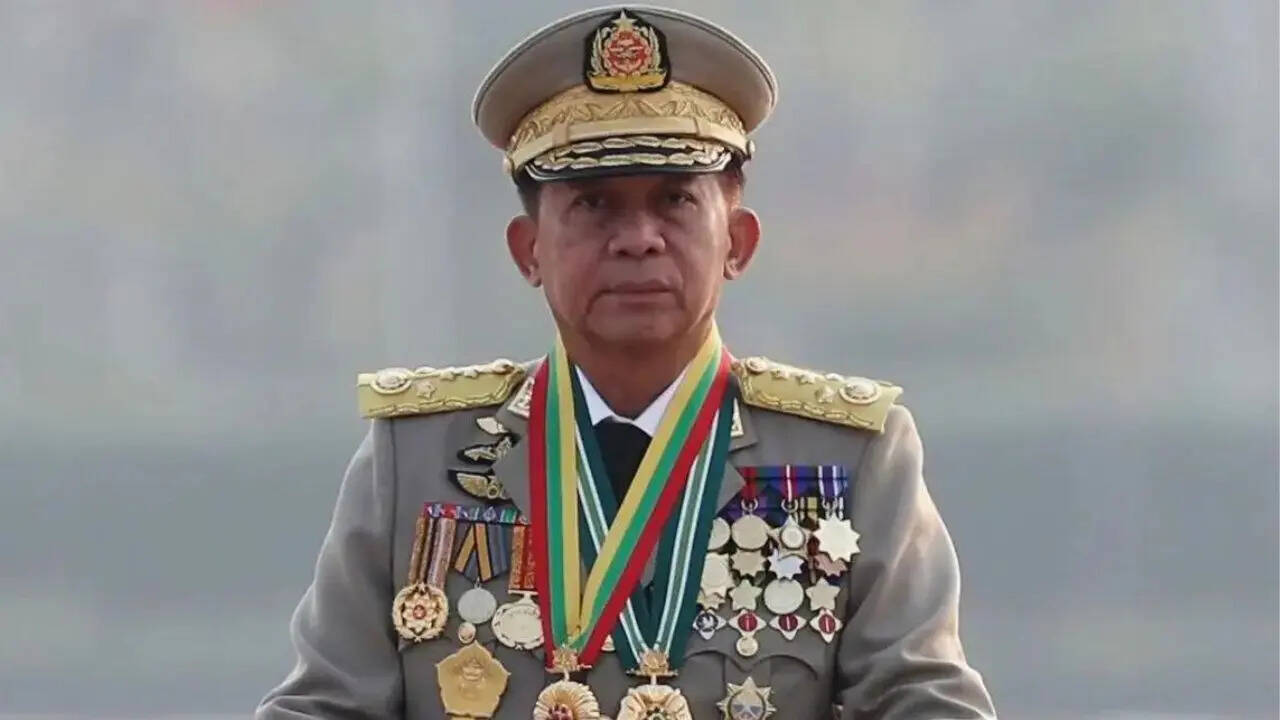
The ink on a peace treaty rarely smells like flowers. Usually, it smells like old paper, sweat, and the desperate hope that the person holding the pen isn't lying. In the gilded halls where regional power is brokered, Min Aung Hlaing—the man who has come to personify the iron grip of Myanmar’s military—is now dipping his pen into a different well. He is speaking of "democracy" and "peace." He is promising a return to what he calls "ASEAN normalcy."
But words are slippery things in a country where the silence is often louder than the gunfire.
To understand what is happening in Naypyidaw, you have to look past the crisp military uniforms and the choreographed handshakes. Imagine a baker in a small village outside Mandalay. Let's call him Zaw. For three years, Zaw hasn't worried about the price of flour as much as he has worried about the sound of a truck engine idling outside his door at midnight. To Zaw, "normalcy" isn't a diplomatic term used in a press release. It is the ability to sleep through the night without a go-bag packed by the bed.
When the new President and Commander-in-Chief stands before the Association of Southeast Asian Nations and vows to restore the status quo, he isn't just making a political statement. He is attempting a grand pivot. He is trying to convince the neighbors that the house is no longer on fire, even as the smoke still stings everyone's eyes.
The Architecture of a Vow
The transition of Min Aung Hlaing into the role of President is a move of calculated geometry. It is an attempt to dress a military junta in the robes of a civilian administration, a transformation intended to soothe the nerves of regional partners like Thailand, Indonesia, and Singapore. These nations are tired. They are exhausted by the refugee flows, the disrupted trade routes, and the constant, nagging moral pressure to "do something" about the crisis on their doorstep.
The General knows this. He understands that if he says the word "democracy" often enough, it begins to sound like a plan rather than a paradox.
The core of his message is simple: stability first, elections later. It is a classic narrative. It suggests that the chaos of the last few years was a fever that had to break, and that he is the only doctor left in the room. But for the millions of people who saw their elected leaders detained and their protests met with live ammunition, the medicine tastes remarkably like poison.
Consider the "Five-Point Consensus" reached with ASEAN years ago. It has sat on a shelf, gathering dust and blood, while the conflict intensified. Now, the sudden shift toward "normalcy" suggests a realization that isolation is a slow-motion collapse. Myanmar cannot survive as a hermit state when its neighbors are sprinting into the digital future. The General is offering a deal: he will provide a version of order that looks enough like democracy to pass a cursory inspection, provided the world stops looking too closely at the basement.
The Invisible Stakes of Southeast Asia
Geopolitics is often discussed as if it were a game of chess played with wooden pieces. In reality, it is a game played with lives. When Myanmar is in turmoil, the ripples hit the shores of the Mekong and the streets of Bangkok.
The "ASEAN Way" has always been one of non-interference. It is a polite agreement to ignore the screaming next door as long as the grass is mown. But the screaming in Myanmar became too loud to ignore. The airwaves are thick with reports of a "new chapter," yet the regional bloc remains skeptical. They have heard these vows before.
What makes this moment different? It is the exhaustion of the resistance and the overextension of the military. Both sides are bleeding. The General’s pivot to a "Presidency" and a promise of peace is a signal to the business elites in the region. It is an invitation to bring the investment back. It is an attempt to decouple the economy from the atrocity.
Think of it as a renovation. The General is painting the front door a bright, welcoming blue. He is planting a few shrubs. He is inviting the neighbors over for tea. But the neighbors are looking at the boarded-up windows on the second floor and wondering if the previous tenants are still locked inside.
The Human Cost of a Pivot
The tragedy of political maneuvering is that it happens at a height where people look like ants. From a helicopter over Naypyidaw, you don't see the fractured families. You don't see the teachers who traded their chalk for rifles. You don't see the students whose dreams of a tech career ended in a jungle outpost.
If Min Aung Hlaing wants peace, he isn't just fighting a war against insurgents; he is fighting a war against memory. To achieve "normalcy," he has to convince a generation of Burmese youth to forget what they saw. He has to convince them that the ballot box he eventually provides—tightly controlled and heavily guarded—is the same one they marched for in 2021.
It is a monumental task. You can't decree a return to normal any more than you can decree a broken vase to be whole again. The shards are too sharp. The glue hasn't been invented yet.
Metaphorically speaking, the General is trying to restart a stalled engine while the passengers are already walking away. He is shouting that the car is fixed, but the wheels are still in the ditch. The "peace" he speaks of is a negative peace—the absence of active resistance—rather than a positive peace built on justice or reconciliation.
The Mirror of History
This isn't the first time a military leader in Myanmar has tried to trade a uniform for a suit. The history of the country is a repeating loop of "discipline-flourishing democracy." It is a cycle of opening up just enough to get the sanctions lifted, then clamping down the moment the people start to believe the rhetoric.
The difference now is the connectivity. In the past, the darkness was absolute. Today, even with internet shutdowns and firewalls, the truth leaks out. The "human element" that the General is trying to manage is no longer a localized problem; it is a global feed.
When he speaks of ASEAN normalcy, he is speaking to a room of leaders who are watching their own social barometers. They know that a fake peace in Myanmar is a ticking time bomb for the region. They know that "democracy" without the participation of the opposition is just a play with a predetermined ending.
The stakes are invisible until they aren't. They are the lost years of a child in a displacement camp. They are the empty chair at a dinner table in Yangon. They are the silent banks and the shuttered shops. These are the things that don't make it into the ASEAN communiqués, but they are the only things that actually matter.
The Long Road to a Real Morning
The General’s vow is a performance. Like all performances, it requires an audience. He needs ASEAN to clap. He needs the West to look away. He needs the people of Myanmar to sit down and be quiet.
But peace isn't a gift given by a President to his subjects. It is a contract. It requires trust, and trust is the one currency that has been completely devalued in the streets of Myanmar. You cannot build a "normal" society on a foundation of fear.
As the diplomatic convoys roll into the capital and the cameras flash, the reality remains on the ground. The reality is Zaw, our hypothetical baker, looking at the news on a cracked smartphone screen. He sees the General in a suit. He hears the words "democracy" and "normalcy" floating through the speakers.
He looks at his go-bag. He looks at the door. He doesn't move it back into the closet just yet.
The sun may be rising over the pagodas of Bagan, but for many, it is still the middle of the night. You can change the title on the door. You can change the language of the speeches. You can promise the world that the storm has passed. But until the people can walk the streets without looking over their shoulders, the "peace" being offered is nothing more than a temporary truce with the truth.
The General is waiting for the world to blink. The people of Myanmar are waiting for the world to see.
Somewhere in the gap between those two things lies the actual future of a nation that has spent far too long learning how to survive in the dark.