Cold rain in Brussels does not fall so much as it settles, seeping through wool coats and soaking into the soles of cheap sneakers until your toes go numb.
Ask Lukas. (He is a composite, though you could find a hundred versions of him standing outside the European Parliament on any gray Tuesday when the defense ministers gather.) Lukas is nineteen, studies civil engineering in Ghent, and carries a thermos of lukewarm black coffee in a backpack patched with duct tape. Last week, he received a letter—not a draft notice, not yet, just an informational questionnaire from the Belgian Ministry of Defense asking about his physical fitness, his technical skills, and his willingness to serve.
He stared at the crisp white paper on his kitchen table while his roommate fried eggs. The paper smelled faintly of toner and institutional certainty.
"My grandfather kept his uniform in a cedar chest," Lukas told me, his fingers tightening around the plastic lid of his thermos as thousands of students, apprentices, and young workers pressed shoulder-to-shoulder down Rue de la Loi behind him. "He wore it once a year on Armistice Day until the wool gave out. When he died, we found the chest full of mothballs and old ration cards. He never talked about the mud. He only talked about the cold."
Across the European Union, a quiet bureaucratic machinery has begun to hum again, after decades of gathering dust in the basement of history. Politicians in Berlin, Paris, Warsaw, and Stockholm speak in the measured, bloodless vocabulary of "readiness," "deterrence," and "strategic autonomy." They point to eastern borders, to shrinking recruitment numbers, to ammunition stockpiles measured in days rather than months. And inevitably, their eyes drift toward the demographic tables—specifically, the rows labeled ages eighteen through twenty-five.
For thirty years, Europe promised its children a different bargain.
The European project was sold to Lukas’s generation not as a fortress, but as a bridge. They grew up on Erasmus exchanges, borderless train rides, and schoolbooks that treated continental warfare as an archaic fever dream cured permanently by trade agreements and shared currency. They were told to learn coding, to study climate modeling, to build startups in Berlin and design wind turbines in Copenhagen. Nobody told them to practice digging trenches in frozen clay.
Then the ground shifted.
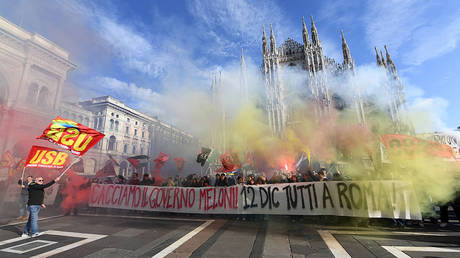
When European youth march against war and conscription—filling avenues from Athens to Berlin, blocking intersections in Rome, waving hand-painted cardboard signs in the drizzle of Brussels—the evening news tends to reduce them to thirty seconds of B-roll. A commentator in a tailored suit remarks on their idealism, perhaps sighs about geopolitical naivete, and cuts to a map showing troop movements along the eastern flank.
That framing misses the entire point.
To understand why tens of thousands of young Europeans are walking out of lecture halls and factories to protest mandatory military service, you have to look past the slogans on their banners and examine the silent, lopsided contract being handed to them without their signature.
The Invisible Bill
Consider how an insurance policy works when the underwriters panic.
For decades, European governments collected what economists politely called the "peace dividend." Following the collapse of the Soviet Union, defense budgets across Western Europe plummeted from roughly three percent of GDP down to barely one percent. Countries abolished mandatory conscription one after another—Belgium in 1994, France in 1996, Spain in 2001, Germany in 2011. The barracks were converted into university dormitories, luxury apartments, and tech incubators. Governments redirected hundreds of billions of euros into pensions, infrastructure, tax cuts, and healthcare for an aging population.
It was a magnificent party. And the people who enjoyed the bulk of it are now in their sixties and seventies, sitting in parliaments and editorial boardrooms, voting overwhelmingly for parties that promise to protect their pensions while simultaneously demanding that nineteen-year-olds report for basic training.
Stop and let that sink in.
The generation that cashed the peace dividend is now handing the overdraft notice to a cohort that cannot yet afford a one-bedroom apartment.
In Germany, Defense Minister Boris Pistorius introduced a new selective military service model requiring every eighteen-year-old male to fill out a mandatory readiness questionnaire, laying the groundwork for a return to full conscription if volunteer numbers fall short. Sweden reinstated conscription in 2017. Latvia brought it back in 2023. Croatia announced plans to reintroduce mandatory basic training starting in 2025. Denmark moved to extend service terms and include women in the draft lottery for the first time. France revived its universal national service program, pouring billions into uniforms and civic-military camps while university budgets strained at the seams.
Politicians frame this as shared sacrifice.
Young people see something else entirely: an intergenerational bait-and-switch.
"They tell us there is no money for affordable student housing," says Elena, a twenty-two-year-old nursing student marching in Athens, her voice hoarse from chanting over the rattle of snare drums. (Elena is real, though I have changed her surname at her request; nursing interns in public hospitals do not get rewarded for political visibility.) "They tell us there is no money to fix the trains, no money to hire doctors, no money to transition off fossil fuels before southern Europe turns into a desert. Then overnight, hundreds of billions of euros appear out of thin air for fighter jets and barracks. And they want us to staff them for pocket change."
Her anger is not abstract. It is mathematical.
Across the EU, youth unemployment hovers stubbornly above fourteen percent—more than double the overall rate—and in countries like Spain and Greece, it remains closer to twenty-five percent. Even those with degrees find themselves trapped in cycles of unpaid internships, temporary contracts, and rents that swallow sixty percent of an entry-level paycheck. Before a young European today even steps foot near a recruitment office, they are already fighting a quiet war of attrition against stagnation, climate anxiety, and a housing market rigged in favor of inheritance.
Now, into that fragile equation, the state drops a demand for twelve months of their youth—and potentially their lives—in defense of an economic order that has locked them out of ownership.
What Happens Inside the Barracks
It is easy to romanticize military service when you have never smelled the inside of a damp canvas tent at four in the morning, or watched an eighteen-year-old from a rural village break down because he cannot understand the safety briefing delivered in a dialect he barely speaks.
I remember visiting a training base outside Vilnius several winters ago, shortly after Lithuania reinstated its draft. The air smelled of diesel exhaust, wet wool, and burnt oatmeal. In the mess hall, a nineteen-year-old conscript named Tomas showed me a laminated photo of his mother’s bakery in Kaunas. He had been three months away from finishing his apprenticeship when his number came up in the lottery. While he spent nine months learning how to disassemble an assault rifle and march through pine forests, his cousin took over his shifts at the bakery. By the time Tomas got out, the position was gone, his savings had evaporated, and he was starting from zero while friends who had secured medical exemptions were already promoted.
Multiply Tomas by fifty thousand.
Economists who study modern conscription—not as a patriotic abstraction, but as a labor-market intervention—consistently find a measurable scar. A landmark study examining European draft cohorts revealed that mandatory military service reduces lifetime earnings, delays entry into higher education, and lowers the probability of completing a university degree, particularly among working-class youth whose families cannot afford to cushion the lost year. Wealthier families, as history has demonstrated in every draft from the American Civil War to modern Europe, inevitably find the exit doors: university deferments, private medical diagnoses, specialized administrative placements far from the front lines.
The burden never falls evenly. It never has.
Even military strategists themselves are quietly divided over whether mass conscription actually makes Europe safer in the twenty-first century. Modern warfare is no longer decided by how many nineteen-year-olds you can hand a rifle to after six weeks of basic drill. It is fought with electronic warfare suites, satellite reconnaissance, autonomous drone swarms, air-defense batteries, and precision artillery that require years of specialized technical mastery.
"If you pull a reluctant twenty-year-old software student out of university and force him to spend nine months polishing boots and doing push-ups, you haven't created a modern soldier," a retired NATO logistics officer told me over coffee in The Hague, speaking candidly on the condition that his name not appear beside active ministry debates. "You have created a resentful clerk who costs money to feed, house, and equip, while draining instructors away from the professional forces who actually know how to operate complex weapons systems."
Yet politicians keep reaching for conscription anyway. Why?
Because conscription is cheap on paper. It allows governments to pad troop headcounts without paying market wages competitive with the private sector. A volunteer army requires decent salaries, housing allowances, healthcare, and respect. A conscript army requires a postage stamp and a threat of fines or prison if you fail to show up.
The Streets Tell a Different Story
Watch the videos circulating from the marches in Berlin, Brussels, Rome, and Madrid, and look closely at the faces in the crowd.
These are not the manicured political youth wings of established parties, practicing speeches for future careers in Brussels consultancies. Look at the hands holding the banners. There are mechanics in grease-stained work jackets alongside philosophy undergraduates, teenage high schoolers skipping afternoon algebra, baristas, warehouse packers, and young mothers pushing strollers along the edge of the police cordon.
In Berlin, outside the Bundestag, they carried a banner thirty meters wide painted in stark black letters: Eure Kriege, unsere Leichen—Your wars, our corpses.
In Athens, students burned mock draft notices outside the parliament building while riot police stood twenty paces back behind polycarbonate shields, shifting their weight from foot to foot in the winter chill.
In Brussels, a group of teenagers sat cross-legged directly on the wet asphalt of the European Quarter, refusing to move until police dragged them one by one toward waiting vans, their faces calm, almost eerily composed.
Mainstream commentary often treats this refusal as cowardice or selfishness. Critics ask, with theatrical exasperation: If you won't defend democracy, who will?
It is a fair question. It deserves an honest, unvarnished answer, even if that answer makes older generations deeply uncomfortable.
Young Europeans are not indifferent to tyranny. Many of the very same students marching against conscription spent the last two years organizing aid convoys, hosting refugees in their cramped shared apartments, raising money for generators and medical kits, and protesting authoritarian crackdowns from Minsk to Tehran. They understand the reality of aggression. They read the news on their phones before they even get out of bed.
What they reject is the fatalism that treats industrialized slaughter as the only imaginable horizon—and the hypocrisy of leaders who spent decades dismantling diplomacy, underfunding civilian peacebuilding, and selling weapons to autocrats, only to demand that nineteen-year-olds pay the ultimate price for the resulting wreckage.
Consider how we handle every other existential threat.
When scientists warn that rising temperatures will render parts of the Mediterranean uninhabitable within Lukas’s lifetime, governments tell young people to be patient, to respect market mechanisms, to wait for gradual transitions over thirty years. No emergency conscription is declared to build solar grids or insulate public housing. No compulsory national service drafts eighteen-year-olds to reforest burned mountainsides or care for elderly citizens dying alone in understaffed nursing homes.
Urgency, it turns out, is selective.
The state only discovers the power to commandeer young bodies when the goal is preparing them for combat.
The Language of Inevitability
History offers a grim warning about what happens when societies begin speaking of war as inevitable.
In the spring of 1914, young men across Vienna, Paris, Berlin, and London did not march against conscription; they cheered at train stations, convinced by newspapers and generals that a brief, decisive clash would clear the air by Christmas. Four years later, an entire generation lay buried in the chalk of Champagne and the mud of Flanders, leaving behind millions of empty chairs at dinner tables and a continent so hollowed out that it stumbled straight into an even worse catastrophe two decades later.
Europe’s founding myth—the entire moral justification for the European Union’s existence—was built on the ashes of those trenches. The solemn vow etched into every monument from Verdun to Normandy was simple: Never again.
Now, barely eighty years later, the vocabulary of 1914 is creeping back into respectable conversation. Politicians warn citizens to prepare "war chests." Health ministries instruct hospitals to plan for mass-casualty surges. Defense ministers speak casually of "pre-war eras" and mandatory youth registries, as if history were a pendulum doomed to swing back toward mass mobilization regardless of human choice.
The young people marching through European capitals are interrupting that trance.
They are asking the questions that polite consensus tries to smother: What diplomatic off-ramps are being ignored while defense contractors post record stock prices? Why are security guarantees discussed exclusively in terms of artillery shells rather than energy independence, cyber resilience, and conflict prevention? And by what moral authority does a parliament send eighteen-year-olds to train for war without giving them a direct vote on the policies that lead there?
Standing in the Rain
Back on Rue de la Loi in Brussels, the march began to disperse as dusk fell early, turning the wet pavement into a mirror of red brake lights and blue police strobes.
Lukas pulled the hood of his jacket over his damp hair and checked his phone. His mother had sent three text messages asking if he had eaten lunch and reminding him to take vitamin D during the gray weeks of November. Beside him, a girl he didn’t know—no older than seventeen, wearing a silver nose ring and a oversized wool scarf—was carefully rolling up a cardboard sign so the paint wouldn't smear in the rain.
"Do you think they'll actually do it?" she asked him, nodding toward the glass towers of the European Commission rising into the low clouds. "Bring back the draft?"
Lukas looked up at the lit windows behind which officials were wrapping up afternoon briefings, packing briefcases, and heading toward warm metro stations and dinner reservations. He thought about the white questionnaire sitting on his kitchen table in Ghent, waiting for him to check boxes about his height, his weight, his willingness to obey orders.
"They'll try," Lukas said quietly, unscrewing his thermos and taking a last swallow of cold coffee. "They always try when they run out of better ideas."
He slung his patched backpack over one shoulder, stepped off the curb into the gathering dark, and walked toward the train station—not in columns, not in cadence, and not for anyone’s flag, just one stubborn pair of soaked sneakers moving at its own pace through the rain.