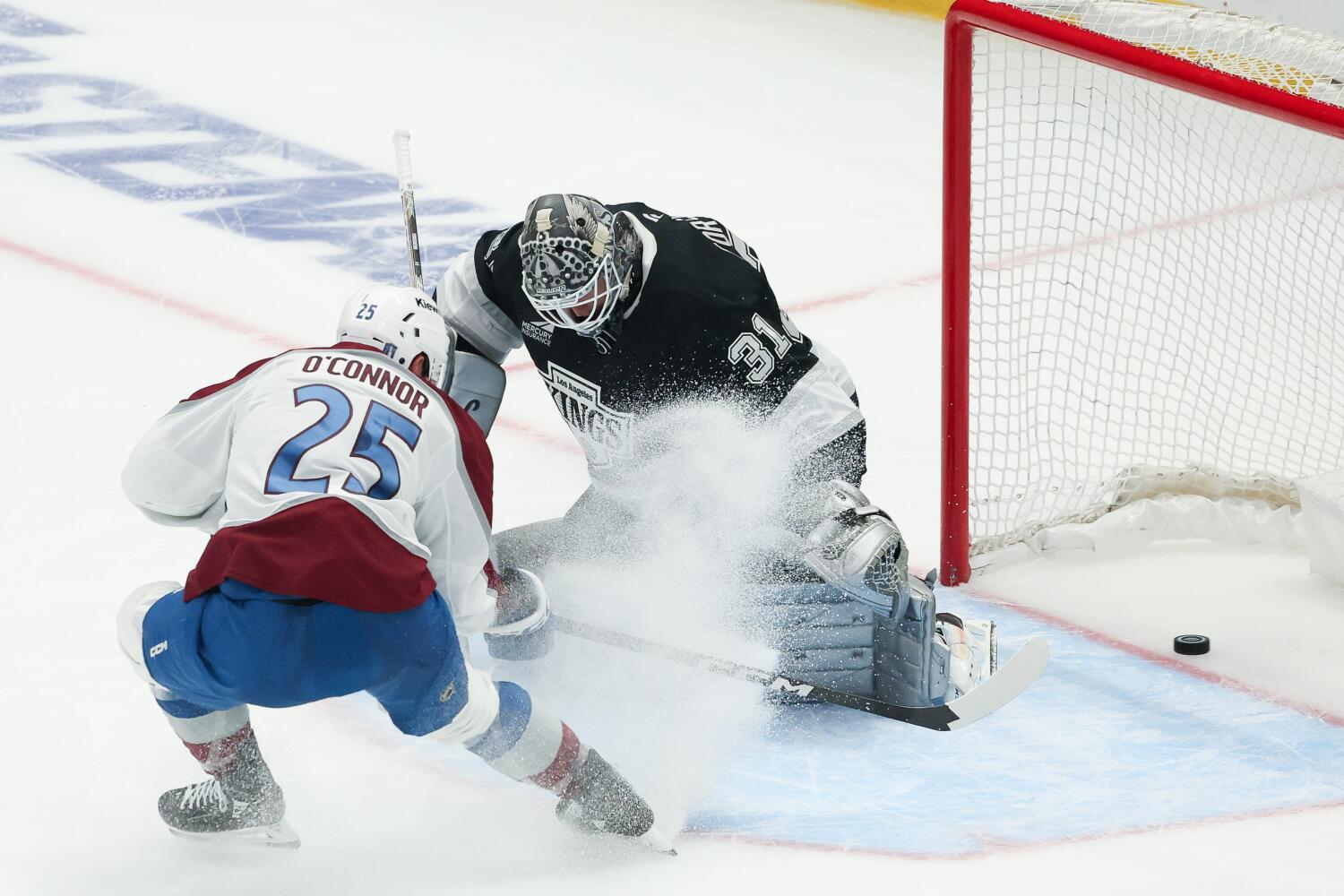
The air inside Crypto.com Arena didn’t just feel cold; it felt thin. It was the kind of atmospheric pressure that builds when eighteen thousand people are collectively holding their breath, waiting for a heartbeat that never quite comes. Down on the ice, the Los Angeles Kings weren’t just playing a hockey game. They were wrestling with a ghost.
The Colorado Avalanche do not play hockey so much as they execute a high-speed clinical trial on the limits of human reaction time. By the time the final horn echoed through the rafters, the scoreboard told a familiar, brutal story. Another loss. A 3-0 series deficit. In the history of the Stanley Cup Playoffs, that specific mathematical margin is less of a hurdle and more of a tombstone.
The Velocity of a Modern Juggernaut
To understand why the Kings look so paralyzed, you have to look at Nathan MacKinnon. He doesn't skate; he vibrates. There is a specific frequency to the Avalanche’s transition game that makes elite defenders look like they are trying to solve a calculus equation while standing in the middle of a hurricane.
Every time a Kings defenseman retrieved a puck in the corner, a white jersey was already there. It wasn't just physical pressure. It was psychological. The Avalanche play with a terrifying sense of inevitability. They have turned the act of scoring into an assembly line process. One pass to the point, a lateral shift, a shot through a screen of bodies, and suddenly the light is red and the crowd is silent.
The Kings, meanwhile, looked like a team trying to find their keys in the dark. They are a squad built on structure, on the "1-3-1" neutral zone trap that is supposed to clog the lanes and frustrate the opponent. But structure only works if the foundation is solid. Against Colorado, that foundation is being eroded by waves of sheer, unadulterated speed.
The Invisible Weight of the Crease
Consider the man in the mask. For the Kings, the goaltending position has become a lonely island. Imagine standing in a six-by-four-foot rectangle while frozen rubber discs are fired at you at ninety miles per hour. Now imagine that every time you stop one, the person meant to help you has already been bypassed by a faster, hungrier skater.
The demoralization doesn't happen all at once. It’s a slow leak. It’s the second goal of the night—a rebound that should have been cleared but instead found the stick of an uncovered Avalanche winger. In that moment, you could see the collective shoulders of the Kings’ bench slump. It wasn't just a goal; it was a reminder. They are chasing a team that they simply cannot catch.
The Avalanche are operating at a level of efficiency where their mistakes are negligible. When Cale Makar touches the puck, the geometry of the rink changes. He opens up lanes that didn't exist three seconds prior. He forces the Kings’ penalty kill to overcommit, stretching their defensive box until it snaps like a dry rubber band.
The Psychology of the Three-Game Hole
What does it feel like to be down 3-0? It feels like trying to swim to the surface of the ocean when you’ve run out of air. You know where the light is, but the distance feels academic. It’s a number so daunting that players usually stop talking about "the series" and start talking about "the next period." It is the only way to stay sane.
There is a myth in sports that professional athletes don't feel the weight of the moment. We like to think they are robots fueled by Gatorade and tactical diagrams. They aren't. They are men who have spent their entire lives working for a four-week window in April and May, only to realize within eight days that the window is being nailed shut.
The locker room after a game like this is a cathedral of silence. The tape is ripped off the shins. The ice bags are strapped to the knees. No one wants to look at the iPad to see what went wrong because they already know. They were a half-step slow. They were a second late. They were human, and they were playing against a machine that had forgotten how to malfunction.
The Technical Erosion of the Kings
The statistics will tell you about power play percentages and shot maps. They will point out that the Kings were actually decent in the face-off circle. But statistics are often just a way to dress up a corpse. The reality is that the Kings' core—the veteran leadership that has hoisted trophies before—looks tired.
Anze Kopitar and Drew Doughty are warriors of a different era. They are masters of the grind, of the heavy-lifting hockey that used to win championships. But the game has evolved into a sprint, and Colorado is the world-record holder. When the Kings try to slow the game down, the Avalanche simply skate around the edges. It is a clash of philosophies where one side has a sword and the other has a drone.
The "commanding lead" the Avalanche hold isn't just about the three wins. It’s about the shot quality. It’s about the fact that even when the Kings managed to put pressure on the Colorado net, Alexandar Georgiev looked bored. He wasn't making "miracle" saves because he didn't have to. The Avalanche defense was so suffocating that most of the Kings' shots were coming from the perimeter—desperation heaves from players who had run out of ideas.
The Human Cost of the Comeback
To win four games in a row against this Colorado team would require something beyond strategy. it would require a breakdown of the laws of physics. It would require the Avalanche to suddenly forget the chemistry they have spent years building.
The fans in Los Angeles know this. You could see it in the way they filed out of the arena with ten minutes left in the third period. It wasn't anger. It was a quiet acceptance. They had seen enough to know that the gap between these two teams isn't a fluke of puck luck or a bad officiating call. It is a canyon.
There is a specific kind of bravery required to show up for Game 4. To put on the armor, to skate out onto the ice in front of a home crowd that is already grieving, and to play as if the score is tied. That is where the "human element" truly lives. It’s not in the winning; it’s in the refusal to be swept.
The Kings are now playing for pride, which is a dangerous motivator but a fragile one. Pride doesn't help you catch Nathan MacKinnon in the neutral zone. Pride doesn't stop a 100-mph slap shot. But it is all they have left in the kit.
The ice will be resurfaced. The jerseys will be laundered. The sun will rise over the Pacific, and for a few hours, the players will try to convince themselves that "one game at a time" isn't just a cliché they tell reporters. They will look at the film, they will see the mistakes, and they will try to find a way to make the Avalanche bleed.
But as the lights dimmed in the arena tonight, the truth remained etched in the cold, white surface. The Avalanche are moving at the speed of light, and the Kings are still looking for the switch.
Three-nothing is more than a score. It is a wall. And tonight, the Kings hit it at full speed.