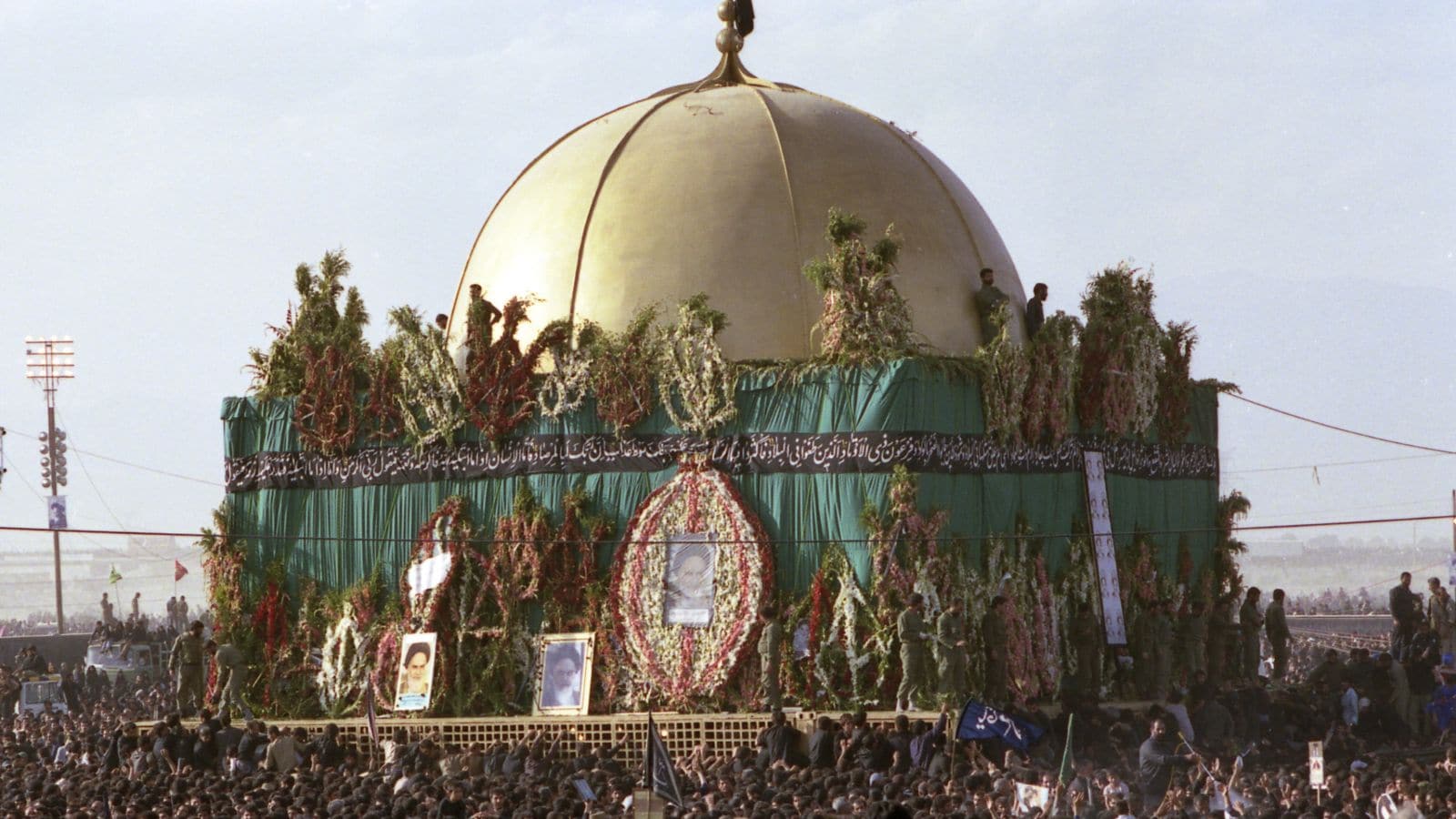
The death of Ayatollah Ali Khamenei in a joint United States–Israeli airstrike on February 28 has triggered a highly calculated, multi-city state funeral from July 4 to July 9. This six-day period of mass mourning functions less as a traditional funerary rite and more as a dynamic mechanism of internal regime consolidation and external geopolitical signaling.
For New Delhi, navigating the invitation to this state event requires balancing historical strategic autonomy against the reality of shifted Middle Eastern dynamics. By evaluating the structural mechanics of the Iranian regime's transition and India’s calibrated diplomatic response, the true strategic stakes become clear.
The Dual-Vector Strategy of Mass Mourning
The Iranian state’s management of the funeral utilizes a dual-vector strategy designed to project systemic stability while managing structural vulnerabilities.
                       ┌──────────────────────────────┐
                       │   Khamenei State Funeral     │
                       └──────────────┬───────────────┘
                                      │
              ┌───────────────────────┴───────────────────────┐
              ▼                                               ▼
┌───────────────────────────┐                   ┌───────────────────────────┐
│     Internal Vector       │                   │     External Vector       │
│  (Systemic Legitimization)│                   │   (Strategic Alignment)   │
└─────────────┬─────────────┘                   └─────────────┬─────────────┘
              │                                               │
              ├─► Public Referendum Mobilization              ├─► "Axis of Resistance" Coalition
              └─► Succession Cloaking & Security              └─► Eurasian Bloc Counterweight
1. The Internal Vector: Systemic Legitimization and Succession Cloaking
The regime uses mass public mobilization as a proxy referendum on the legitimacy of the Islamic Republic. By organizing cross-city processions spanning Tehran, Qom, Mashhad, and shrine cities in Iraq (Najaf and Karbala), the clerical establishment maximizes domestic visibility. The logistical scale—involving 50 percent hotel discounts, diverted transit networks, and the conversion of public infrastructure into temporary housing—is engineered to manufacture an undeniable display of ideological continuity.
Concurrently, the event serves as a critical shield for the transition of power. The Assembly of Experts designated Mojtaba Khamenei, the late leader's son, as the third Supreme Leader. However, Mojtaba was severely injured in the same strike that killed his father. He has remained entirely out of the public eye. His anticipated absence or highly restricted appearance at the funeral is framed by officials as a necessary security protocol to mitigate targeted external threats.
Operationally, this low profile masks a deeper institutional vulnerability: the regime must project absolute continuity under a new leader whose physical condition and immediate capacity to command the Islamic Revolutionary Guard Corps (IRGC) remain unverified.
2. The External Vector: Strategic Alignment and Coalition Testing
The funeral guest list functions as an empirical measure of Iran’s contemporary geopolitical alignment. The attendees fall into two distinct structural tiers:
- The Non-State Strategic Network: High-level delegations from regional proxies, including Hamas, Hezbollah, Palestinian Islamic Jihad, the Houthis, and Iraqi Shia militias. This confirms that despite intense military degradation, the "Axis of Resistance" remains central to Tehran’s deterrence architecture.
- The Eurasian Counterweight: Official delegations from Russia, China, Belarus, North Korea, Qatar, Venezuela, and Central Asian states. This grouping provides the economic and diplomatic insulation necessary to bypass Western sanctions and containment strategies.
Deconstructing India's Diplomatic Calibration
India's participation strategy reflects a calculated approach to risk mitigation and strategic equilibrium. New Delhi has deployed a dual-track delegation that separates state-level functional engagement from partisan political representation.
| Delegate | Primary Entity | Strategic Function |
|---|---|---|
| Pabitra Margherita | Minister of State for External Affairs | Official State Representation; maintains functional bilateral channels. |
| Lt. Gen. Syed Ata Hasnain (Retd.) | Governor of Bihar / Former Military Commander | Deep institutional expertise in West Asian security dynamics; evaluates real-time stability. |
| Salman Khurshid | Former External Affairs Minister (Congress Party) | Track-II political diplomacy; honors direct invitations without committing current government policy. |
This structural composition accomplishes three key objectives for Indian foreign policy:
Equidistance in Continental and Maritime Conflicts
India cannot completely sever ties with Tehran due to long-term connectivity projects, specifically the Chabahar Port development. Chabahar remains India's primary geostrategic gateway to Central Asia and Afghanistan, bypassing Pakistan. A complete diplomatic absence would cede immediate operational and strategic leverage to China, which is actively seeking to expand its footprint in the Persian Gulf.
Mitigation of Washington-Tel Aviv Friction
By sending a Minister of State rather than the Prime Minister or the Cabinet Minister for External Affairs, New Delhi signals to Washington and Tel Aviv that its participation is strictly a matter of diplomatic protocol rather than an endorsement of the Iranian regime's regional posture. This minimizes blowback from Western partners while keeping communications open with Tehran.
Domestic Stability and Cultural Ties
India possesses a significant Shia population with deep, historical religious ties to the holy sites of Qom and Mashhad. The inclusion of high-profile Muslim figures and institutional leaders in the broader engagement matrix ensures that domestic cultural sensitivities are respected without altering the state’s core secular security architecture.
The Strategic Play
New Delhi must treat the post-Khamenei transition as a period of heightened structural instability. India’s immediate operational strategy requires maintaining its presence at the Chabahar Port as a functional commercial hub while pausing major capital expansions until Mojtaba Khamenei’s regime clarifies its internal security posture and finalizes its pending sanctions-relief or ceasefire negotiations with the United States.
Indian intelligence and diplomatic assets must leverage the Track-II channels present at the funeral to assess the degree of IRGC cohesion. The objective is to ensure that India's investments are protected against potential internal power struggles or subsequent external military actions.