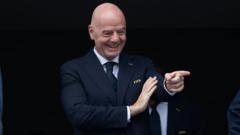
The outrage from European football's governing bodies over US President Donald Trump’s direct intervention with FIFA President Gianni Infantino—which resulted in the unprecedented lifting of forward Folarin Balogun's red-card suspension ahead of a critical World Cup knockout match against Belgium—reveals a structural misunderstanding of modern sports governance. UEFA’s declaration that FIFA has crossed a "red line" and the subsequent petition by fifty European Parliament members to investigate Infantino's political neutrality mistake rhetorical dominance for structural leverage. Infantino will not capitulate to European backlash because the institutional architecture of FIFA has been systematically redesigned to immunize its leadership against European pressure.
To understand why European dissent fails to alter FIFA’s strategic trajectory, the situation must be analyzed through a precise operational framework: the shift from a Eurocentric football hegemony to a diversified, multi-polar political economy. Don't forget to check out our previous post on this related article.
The Structural Inverted Pyramid of FIFA Governance
The primary mechanism insulating Infantino from European discontent is the voting structure of the FIFA Congress. Under the "one member, one vote" principle, the political weight of a nation is completely decoupled from its economic output or competitive pedigree.
- UEFA (Europe): 55 member associations
- CAF (Africa): 54 member associations
- AFC (Asia): 47 member associations
- CONCACAF (North/Central America): 41 member associations
- OFC (Oceania): 11 member associations
- CONMEBOL (South America): 10 member associations
Europe commands just 26% of the voting power within the 211-member congress. A collective European block cannot defeat an incumbent platform if the global south and North American interests align. By explicitly tailoring tournament expansions—such as moving to a 48-team World Cup matrix—and distributing financial forward grants equally across all federations, FIFA leadership has built an impenetrable voting coalition. If you want more about the background of this, The Athletic offers an informative summary.
The institutional cost function of opposing European desires is negligible when offset by the political equity gained in Washington, Riyadh, and Beijing. When 50 MEPs or the Norwegian football federation demand accountability, they are operating within a democratic framework that has zero jurisdictional authority over a Swiss-domiciled private association.
The Commercial Utility of the Host State Autocracy
The mechanics behind the Balogun intervention illustrate a calculated trade-off between sporting integrity and macro-commercial utility. The lifting of a mandatory suspension under the highly ambiguous Article 27 of the FIFA Disciplinary Code represents an optimization strategy that prioritizes domestic market penetration over regulatory consistency.
The economic reality of the 2026 World Cup hinges entirely on sustained US consumer engagement. The loss of the top American goalscorer prior to a round of 16 match in Seattle threatens prime-time broadcast ratings, domestic ticket resale values, and localized sponsorship activations. When President Trump notes that every match is performing like a "Super Bowl" with projected domestic viewership crossing 50 million, he defines the exact metric FIFA seeks to protect.
FIFA's leadership operates on a clear utility function:
$$\text{Utility} = \alpha(\text{Global Commercial Revenue}) + \beta(\text{Political Sovereign Protection}) - \gamma(\text{European Regulatory Friction})$$
Because $\gamma$ (European friction) lacks the capacity to trigger structural sanctions—such as a full UEFA boycott of FIFA competitions—the value of $\gamma$ approaches zero. Conversely, the value of $\beta$ (Sovereign Protection) is exceptionally high. Cultivating deep alignment with the executive branch of the world’s largest economy yields critical structural benefits: federal tax exemptions for competing squads, expedited visa processing, and robust state-backed security infrastructure. Sacrificing a fraction of judicial credibility in a dispute with Belgium is an acceptable marginal cost for securing long-term state cooperation.
The Enforcement Deficit of European Football
UEFA’s leverage is constrained by a classic collective action dilemma. While European leagues and federations generate approximately 75% of global club football revenues, they cannot easily weaponize this financial dominance against FIFA due to internal fragmentation and commercial dependencies.
The primary vulnerability for Europe is the absence of a credible, unified exit strategy. For a European boycott to threaten FIFA's financial solvency, elite players would have to refuse participation in the World Cup. However, players are bound by employment contracts with clubs, who are in turn governed by national associations dependent on FIFA-sanctioned international transfer windows and match calendars.
Furthermore, the commercial ecosystem of European club football is increasingly reliant on non-European capital. With major corporate entities like Saudi Arabia's Aramco signing comprehensive sponsorship deals with FIFA, and private equity from North America heavily embedded in European club structures, any attempt by UEFA to unilaterally disrupt the global football calendar triggers significant litigation risk and capital flight.
The precedent cited by critics—the 2015 downfall of Sepp Blatter—is misconstrued. Blatter’s removal was not achieved via European political letters or UEFA declarations; it was executed through criminal indictments issued by the United States Department of Justice leveraging the US banking system. In the current landscape, where the US executive branch is actively aligned with FIFA leadership and praising its decision-making, the likelihood of a state-led judicial intervention against Zurich is non-existent.
The Multi-Polar Strategic Realignment
The long-term strategy implemented by FIFA relies on creating a diversified portfolio of geopolitical dependencies, effectively neutralizing any singular block's ability to enforce governance reforms.
- The North American Corridor: Securing the commercial frontier via direct access to the White House, driving corporate partnerships, and capturing a massive sports media market.
- The Gulf State Sovereign Wealth Engine: Anchoring long-term capital through infrastructure investments and mega-event hosting, exemplified by Saudi Arabia’s uncontested path to the 2034 World Cup.
- The Global South Electoral Foundation: Maintaining a permanent voting majority in the FIFA Congress by recycling commercial surpluses into local development funds across Africa, Asia, and Oceania.
Within this tripartite matrix, Europe is relegated from the primary architect of global football policy to a highly profitable, but politically contained, entertainment provider. UEFA is trapped in a structural paradox: it must continue to participate in FIFA’s expanded club and international tournaments to capture the global revenues required to sustain its domestic budgets, yet this very participation validates and funds the governance model it critiques.
The optimal strategic response for European football stakeholders is not the issuance of symbolic ethical complaints or parliamentary letters. Instead, European governance must focus on the cold optimization of its domestic legislative powers. If Europe wishes to counter FIFA’s centralization of authority, it must utilize the European Court of Justice and strict regional antitrust laws to decouple the regulation of European club football from FIFA's global mandate. Until Europe moves from rhetorical condemnation to structural, legally binding separation, its backlash remains an anticipated, factored-in cost of doing business in Zurich.


