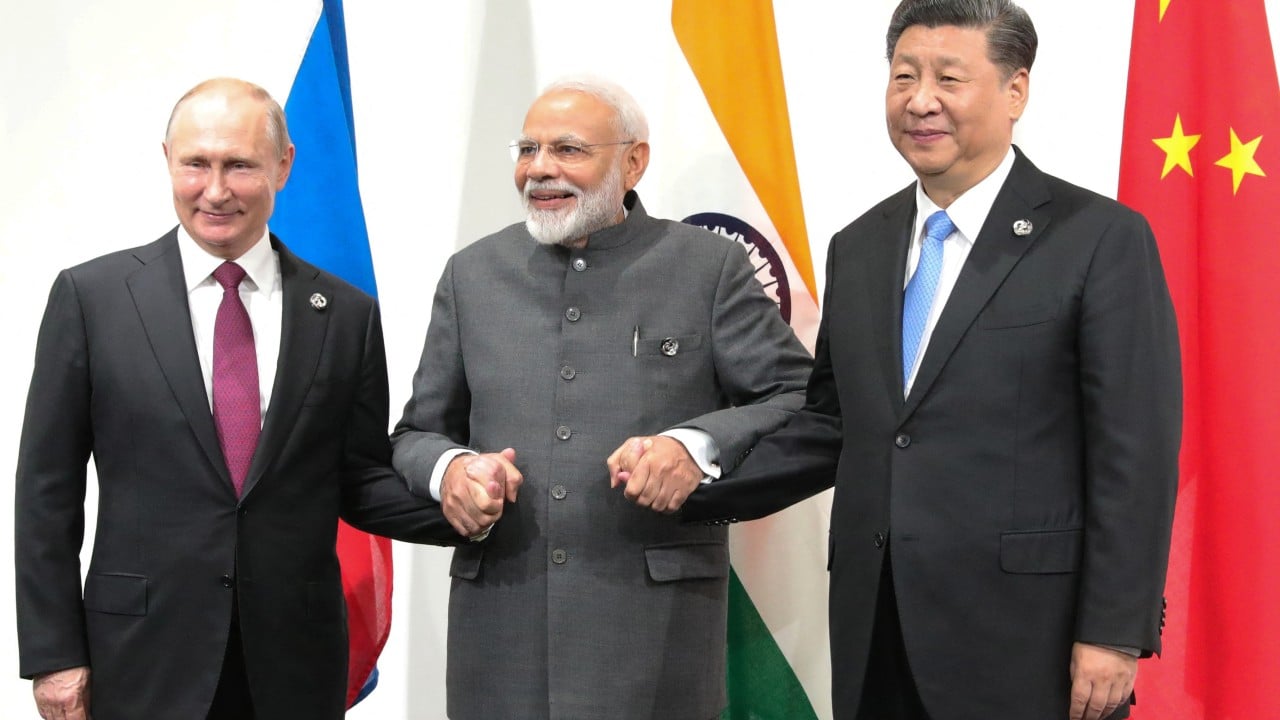
The strategic alignment known as the Russia-India-China (RIC) triangle remains a persistent fixture in diplomatic rhetoric, yet it functions more as a geopolitical mirage than a functional alliance. While some analysts warn against dismissing this trilateral grouping, the reality on the ground tells a completely different story. The structural friction between New Delhi and Beijing, coupled with Moscow’s growing economic dependence on China, renders the trio incapable of presenting a unified front. It is not a rising alternative global order. It is a fragmented forum where deep-seated border disputes and economic imbalances prevent any meaningful security or diplomatic cohesion.
The Structural Fracture at the Heart of the Trio
The fundamental flaw in treating the RIC triangle as a cohesive bloc is the assumption that shared dissatisfaction with Western dominance can override existential bilateral rivalries. It cannot. The border between India and China remains a militarized flashpoint, characterized by periodic skirmishes and massive infrastructure build-ups on both sides.
New Delhi views Beijing’s expansionist maneuvers in the Indo-Pacific and along the Line of Actual Control with deep suspicion. For India, the threat is immediate and physical. For China, India is increasingly viewed through the lens of its strategic partnerships with the West, specifically the Quadrilateral Security Dialogue. This creates an irreconcilable contradiction. Beijing sees the Quad as a containment mechanism, while New Delhi views it as a necessary counterweight to Chinese bullying.
Moscow sits uncomfortably in the middle of this dynamic. Historically, Russia acted as a bridge between the two Asian giants, leveraging its defense relationships with both to maintain regional influence. That leverage is evaporating. As Russia faces prolonged economic isolation from Western markets, its reliance on Chinese state-backed banks, technology, and energy buyers has shifted from a strategic choice to a survival necessity. Consequently, Moscow can no longer act as an honest broker. When forced to choose, Russia’s economic gravity pulls it inexorably toward Beijing, leaving New Delhi to look elsewhere for its long-term security guarantees.
The Illusion of Multipolar Unity
Trilateral communiqués frequently emphasize the need for a multipolar world order, a reformed United Nations, and democratization of international relations. These statements are cheap. They mask a profound divergence in how each capital defines a "multipolar" world.
To Beijing, multipolarity is a transitional phase on the road to a bipolar world dominated by the United States and China, where regional spheres of influence are strictly respected. To New Delhi, multipolarity means a multipolar Asia where India is recognized as an equal power, a status China consistently denies it by blocking India’s permanent seat on the UN Security Council and opposing its membership in the Nuclear Suppliers Group. Russia, meanwhile, desires a return to a nineteenth-century concert of powers where major states dictate terms to smaller neighbors, a vision that clashes directly with India's defense of sovereignty and territorial integrity in its own neighborhood.
Trade Imbalances and Capital Flight
Look at the ledger. Economic data exposes the emptiness of the trilateral rhetoric. True alliances are built on deep, mutually beneficial economic integration. The economic relationships within the RIC grouping are profoundly lopsided and extractive.
+-------------------+----------------------------------+------------------------------------+
| Bilateral Corridor| Primary Trade Drivers            | Core Structural Vulnerability      |
+-------------------+----------------------------------+------------------------------------+
| Russia - China    | Energy, Technology, Yuan Settled | Extreme Russian Dependence on China|
+-------------------+----------------------------------+------------------------------------+
| India - China     | Electronics, Chemicals, Active   | Massive, Unsustainable Trade       |
|                   | Pharmaceutical Ingredients       | Deficit for New Delhi              |
+-------------------+----------------------------------+------------------------------------+
| Russia - India    | Discounted Crude Oil, Defense    | Rupee-Ruble Settlement Failure,    |
|                   | Aerospace Components             | One-Way Energy Flow                |
+-------------------+----------------------------------+------------------------------------+
The trade boom between Russia and India since the imposition of Western sanctions is touted as proof of the triangle's resilience. This is a superficial reading of the numbers. India stepped in to purchase vast quantities of discounted Russian crude oil, saving billions of dollars in energy costs. However, this trade is entirely one-way. Russia exports oil to India but imports very little in return, creating a massive currency accumulation problem.
For a long time, billions of dollars worth of Indian rupees sat stranded in Russian bank accounts because Moscow had no use for the currency and could not easily convert it due to global financial restrictions. Attempts to settle trade in rubles or rupees have repeatedly stalled, forcing recourse to alternative currencies like the UAE dirham or even the Chinese yuan, a development that irritates New Delhi’s financial regulators.
The economic reality between India and China is equally fraught. India’s trade deficit with China remains an acute economic vulnerability. New Delhi has tried to decouple from Chinese supply chains by banning hundreds of Chinese applications, tightening scrutiny on Chinese foreign direct investment, and implementing production-linked incentives to boost domestic manufacturing. Despite these efforts, Indian industry remains heavily dependent on Chinese imports for critical inputs like electronic components, active pharmaceutical ingredients, and solar panels. This is not economic synergy. It is a strategic vulnerability that India is actively working to dismantle.
The Defense Supply Chain Disruption
For decades, military hardware was the glue that bound New Delhi and Moscow together. India was the world’s largest buyer of Russian weapons, a dependency that gave Moscow immense leverage and kept India somewhat insulated from Western pressure. That era is ending.
The war in Ukraine has severely compromised Russia’s defense industrial base. Facing battlefield losses and crippling shortages of advanced components, Russian defense manufacturers have prioritized domestic military needs over foreign export orders. Delivery schedules for critical systems promised to India, including S-400 missile defense batteries and spare parts for Sukhoi fighter jets, have faced prolonged delays.
Furthermore, the performance of certain Russian military technologies on the modern battlefield has forced Indian defense planners to re-evaluate their long-term procurement strategy. India cannot afford to rely on a defense supplier that is struggling to supply its own front lines and whose technology is underperforming against Western countermeasures.
       [ Moscow ]
         /    \
        /      \
Defense/        \ Energy & Political
 Supply/          \ Dependence
      /            \
     v              v
[ New Delhi ] <----> [ Beijing ]
       Strategic Friction &
       Border Disputes
This defense crunch accelerated India’s diversification strategy. New Delhi is rapidly shifting its defense procurement toward France, the United States, and Israel, while aggressively pushing for domestic defense manufacturing through co-development agreements. The transfer of critical technologies, such as the joint manufacturing of GE F414 jet engines in India, signifies a structural shift that cannot be undone by a few trilateral meetings. As India systematically purges Russian hardware from its long-term defense planning, the most tangible pillar of the Russia-India connection crumbles.
Why the Axis Fails to Govern
The true test of any geopolitical grouping is its ability to project power, enforce stability, and govern regional security challenges. When confronted with actual crises in Central and South Asia, the RIC triangle disintegrates into competitive unilateralism.
The Central Asian Scramble
Central Asia represents a geographic zone where the interests of Moscow and Beijing are actively colliding. Historically, Russia viewed the former Soviet republics as its exclusive security backyard under the Collective Security Treaty Organization. China, through its massive infrastructure investments, has systematically eroded Russian dominance.
Beijing is now the primary economic partner for Central Asian states, constructing pipelines, railways, and logistics hubs that bypass Russian territory entirely. While Moscow and Beijing maintain a superficial alignment to keep Western influence out of Central Asia, they are engaged in a quiet, intense competition for long-term influence over the region's energy resources and security architecture. India, recognizing this shift, is attempting to build its own footprint in Central Asia to counter Chinese encirclement, further complicating the trilateral dynamic.
The Afghanistan Conundrum
The collapse of the Western-backed government in Kabul provided a perfect opportunity for a coordinated trilateral response to regional terrorism and instability. Instead, the three capitals pursued fragmented, self-serving policies.
- Beijing prioritized securing mining rights for lithium and copper while seeking assurances that Uyghur militant groups would not operate from Afghan soil.
- Moscow engaged with the Taliban leadership primarily to prevent the export of Islamic radicalism into Central Asia, viewing the situation through a narrow regional stability lens.
- New Delhi, having invested billions in infrastructure and development projects with the previous democratic government, found itself completely marginalized and forced to rebuild its intelligence and diplomatic networks from scratch to counter Pakistani and Chinese influence.
The Indo-Pacific Reality Check
The ultimate proof of the RIC triangle’s obsolescence is the shifting geography of global power. The defining geopolitical arena of the twenty-first century is the Indo-Pacific, a maritime domain where Russia is a marginal actor and China and India are direct competitors.
India’s strategic gaze has turned decisively toward the sea. The Indian Navy is expanding its operations across the Indian Ocean to monitor Chinese submarine activity and secure vital sea lanes of communication. This maritime strategy requires deep logistical, intelligence, and technological cooperation with external powers that possess advanced naval capabilities and a shared interest in checking Chinese expansion. Russia, with its naval forces bogged down in the Black Sea and its Pacific fleet constrained by geography and resources, offers nothing to India in this critical domain.
The institutional framework of the RIC triangle will survive as a diplomatic talking shop. Leaders will continue to meet on the sidelines of larger summits, shake hands, and sign vague declarations about global equity. These rituals should not be mistaken for strategic alignment. The structural contradictions are too deep, the economic imbalances too severe, and the security interests too divergent. The triangle is not a sleeping giant waiting to reshape global politics. It is a historical relic, held together by diplomatic nostalgia and increasingly hollow rhetoric, while the real forces of regional competition tear it apart from the inside.