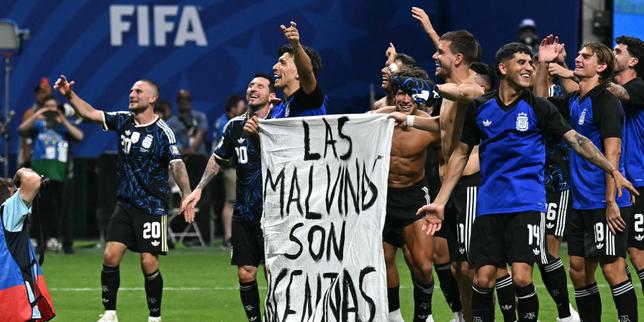
The intersection of international football and sovereign territorial disputes erupted again when members of the Argentine national team displayed a banner claiming sovereignty over the Falkland Islands—known in Spanish as Las Malvinas—following a high-profile international fixture. This calculated display bypassed FIFA’s strict prohibitions against political messaging on the pitch, exploiting structural weaknesses in how global football governs itself. While football's governing body routinely fines associations for fan behavior, its enforcement mechanism falters when national federations internalize geopolitical grievances as part of their cultural identity. The incident exposes an uncomfortable reality: international football is not an escape from geopolitics, but rather an amplification chamber for it.
The banner, which read "Las Malvinas Son Argentinas" (The Malvinas Are Argentine), was not a spontaneous outburst. It represents a recurring, deliberate strategy deployed by the Argentine Football Association (AFA) and its squad to leverage global sporting broadcasts for nationalist messaging. This specific dispute dates back to the 1982 conflict between the United Kingdom and Argentina, but its manifestation on the modern pitch is a contemporary battle for narrative dominance. By choosing a match with high global viewership, the players ensured maximum diplomatic friction with minimum immediate disciplinary fallout. Meanwhile, you can read other developments here: The Beautiful Agony of the Argentine Soul.
The Friction Mechanics behind Pitch Diplomacy
FIFA’s disciplinary code explicitly forbids the display of political, religious, or personal slogans, statements, or images during matches. Yet, the enforcement of these rules remains uneven and highly susceptible to political pressure. When a club team violates these rules, sanctions are swift and financial. When a national team does so, the governing body faces a diplomatic minefield.
National identity in Argentina is inextricably linked to the Malvinas claim. It is written into their constitution. For an Argentine footballer, holding that banner is seen domestically not as a partisan political act, but as a fundamental civic duty. This creates a direct clash with FIFA’s Eurocentric view of neutrality. What Zurich views as a provocative political infraction, Buenos Aires views as an undeniable historical truth. To understand the full picture, we recommend the excellent report by Yahoo Sports.
The tactical execution of these protests reveals a deep understanding of media choreography. Players rarely display such banners during the ninety minutes of active play, where referees can issue immediate yellow or red cards. Instead, they wait for the post-match window or pre-match ceremonies. At this point, the match officials have less immediate control, and the images are already being beamed to millions of households worldwide. The media damage is done before the disciplinary committee can even schedule a hearing.
The Double Standard in Global Sanctions
Football governance operates on a sliding scale of tolerance that varies wildly depending on the geopolitics of the moment.
- The European Precedent: European nations regularly display subtle or overt political stances, often receiving minor fines or quiet warnings if the cause aligns with prevailing Western diplomatic sentiments.
- The South American Reality: CONMEBOL, the South American football confederation, has historically taken a softer stance on territorial and anti-colonial messaging, viewing it as a legitimate expression of regional history.
This divergence leaves FIFA caught between enforcing a rigid, sterile standard of "pure sport" and acknowledging the raw, historical realities of its member associations. When the governing body penalizes South American teams for territorial claims, it faces accusations of neocolonial censorship. When it stays silent, it opens the floodgates for every unresolved border dispute on earth to play out on the grass.
Financial Slaps on the Wrist as the Cost of Doing Business
The current disciplinary framework relies almost exclusively on financial penalties. To a wealthy national federation backed by massive sponsorship deals and television revenue, a five-figure Swiss franc fine is an irrelevance. It is simply a line-item expense for a successful public relations campaign.
Typical Disciplinary Outcomes for Political Displays:
+------------------------+--------------------------+-----------------------+
| Infraction Severity    | Standard FIFA Sanction   | Actual Political Impact|
+------------------------+--------------------------+-----------------------+
| Minor Pitch Banner     | Financial Fine (CHF 10k) | Domestically Popular  |
| Repeated Offenses      | Partial Stadium Closure  | Ignored by Elite Squad|
| Escalated Nationalist  | Points Deduction (Rare)  | Genuine Deterrent     |
+------------------------+--------------------------+-----------------------+
True deterrence requires sporting sanctions. If players faced multi-match bans or if federations risked points deductions in tournament qualification, the calculus would change instantly. Federations would police their own squads aggressively if an international tournament spot were on the line. However, FIFA avoids these harsh penalties because they risk damaging the commercial value of their flagship tournaments. Excluding top-tier talent like Argentina’s elite roster over a political banner harms television ratings and ticket sales.
The Historical Weaponization of the Pitch
This is not a new phenomenon, nor is it isolated to South America. The pitch has always been a proxy battlefield. The 1986 World Cup match between Argentina and England, famous for Diego Maradona’s performances, was entirely framed by the shadow of the South Atlantic conflict fought just four years prior.
When sports administrative bodies pretend that athletes exist in a cultural vacuum, they invite these disruptions. Players are citizens first. They are products of their countries' educational systems, which often emphasize historical grievances. To expect an athlete to switch off that conditioning the moment they step over the white touchline is a fundamental misunderstanding of human psychology.
The real failure lies in the lack of a consistent, transparent standard. FIFA's decision-making process occurs behind closed doors within disciplinary committees that issue brief, formulaic press releases weeks after the event. This lack of transparency allows competing narratives to fester. One side claims victimization by a biased bureaucracy; the other claims a total breakdown of law and order on the pitch.
Sovereignty Claims and the Future of International Sport
As the geopolitical landscape fractures further, these incidents will increase in frequency and intensity. The expansion of global tournaments means more nations with active, unresolved border disputes will share the same stages. The current strategy of reactive, financial policing is unsustainable.
The solution cannot be absolute censorship, nor can it be total anarchy. Acknowledging that sport is political is the first step toward managing it. If governance bodies continue to use outdated rules from a bygone era of sports administration to police modern, hyper-connected athletes, the pitch will inevitably transform from a space of athletic competition into a theater of diplomatic warfare. Federations must be held directly accountable through sporting penalties that carry real consequences on the scoreboard, forcing national associations to decide whether a political statement is worth risking a World Cup trophy.