The dispatch tone is a sound every paramedic, firefighter, and police officer hears in their sleep. It is a sharp, electronic piercing of the quiet, followed by a voice that tries to sound routine. But on a Tuesday afternoon in New Mexico, routine died the moment the first door was kicked open.
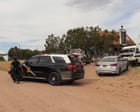
A welfare check. That is what they call it. It sounds gentle, almost neighborly. Usually, it means an elderly resident hasn't picked up their mail, or a family member is worried after a weekend of unanswered phone calls. When emergency crews arrived at the motel just off the old highway, the air was hot, heavy with the high-desert heat that bakes the asphalt until it smells like tar.
They walked into a room where time had already stopped.
Three people were dead. They had not died peacefully. The final moments of an opioid overdose are a violent, desperate struggle for oxygen, a silent panic where the brain forgets how to tell the lungs to move. But the tragedy in that motel room did not stop when the hearts of those three individuals ceased to beat. It was just beginning. It was radiating outward, invisible and toxic, waiting for the people who came to help.
Sirens do not just bring aid. They bring targets.
The Microscopic Threat
Within minutes of crossing the threshold, the air changed.
Consider the mechanics of a modern crisis. We are used to threats we can see. A fire. A weapon. A shattered windshield. Fentanyl bypasses our evolutionary defenses because it is a ghost. A grain of salt weighs about 585 micrograms. A lethal dose of fentanyl is just two thousand micrograms. That means a speck of powder barely visible to the naked eye can shut down a human nervous system in under three minutes.
First responders do not have the luxury of hesitation. They see a body, and they move. They check pulses, they clear airways, they look for signs of life. In that frantic, adrenaline-fueled rush, the air stirs. Microscopic particles lift from a table, a bedsheet, or a discarded piece of foil.
Then, you breathe.
It started with a tingling at the edge of the vision for one paramedic. Then, the chest tightness. If you have ever felt your throat constrict when you are terrified, multiply that by ten. Your heart rate plummets. The world tilts.
One by one, the people who wore the uniforms began to drop.
Eighteen.
Think about that number. That is not a single crew. That is an entire shift’s worth of defense lines obliterated by an invisible vapor. Police officers who had survived high-speed chases and armed confrontations found themselves leaning against the bumpers of their cruisers, gasping for air, their pupils shrinking to pinpricks. Firefighters, trained to walk into burning buildings, were brought to their knees on the gravel parking lot.
The Anatomy of an Exposure
There is a fierce debate in the medical community about how fentanyl affects first responders. Some experts argue that casual skin contact cannot cause an immediate overdose, suggesting that panic and hyperventilation play a massive role. They call it psychogenic illness.
But when you are on the asphalt, watching your partner’s face turn the color of skim milk, the academic debate vanishes. The terror is real. The physiological cascade is real. Whether it is inhaled dust, accidental ingestion via a gloved hand touching a mouth, or the profound psychological trauma of an invisible poison, the result is identical: the emergency response system stalls.
Imagine the dispatch center during those forty-five minutes.
The first ambulance arrives to treat three victims. Minutes later, that ambulance crew radioes for help—not for the victims, but for themselves. A second crew is dispatched. They arrive, step into the hot zone, and they, too, begin to falter. It becomes a chain reaction of vulnerability. The rescuers need rescuing. The safety net is unraveling in real-time, right there on the side of the road, under the blinding New Mexico sun.
This is the hidden tax of the synthetic opioid epidemic. It is no longer isolated to the dark corners, the abandoned houses, or the private tragedies of addiction. It has spilled over into the public square, turning the act of public service into a game of Russian roulette.
The Changing Gear of the First Line
Go back twenty years. A paramedic’s pockets held trauma shears, medical tape, a stethoscope, and maybe a few pairs of latex gloves. Today, those same pockets are heavy with Narcan.
Nasal naloxone was designed to reverse overdoses in patients. Now, responders carry it to save each other. It is a strange, dystopian reality to witness a police officer administer an opioid reversal drug to a fellow officer on the side of an interstate, both of them wearing badges, both of them just trying to do a wellness check.
The equipment has changed because the stakes have mutated.
- Level A Suits: In extreme contamination cases, crews must wear hazmat gear usually reserved for chemical warfare.
- Tactical Decontamination: Washing down boots and uniforms with specialized solutions before returning to the station, ensuring the poison isn't carried home to families.
- The Loss of Touch: Every patient must be treated as a potential chemical hazard, creating a barrier of rubber and plastic between the caregiver and the human being in distress.
This creates a psychological distance. It forces the people we rely on to view every scene not as a place of healing, but as a crime scene laced with bio-weapons. The empathy that draws people into public service is systematically ground down by the sheer necessity of self-preservation.
The Ripple Effect in Small Communities
When eighteen responders go down in a major metropolis, the city bruises but keeps moving. When eighteen responders go down in a community along the New Mexico highway system, the entire infrastructure breaks.
Volunteers have to be called from three counties away. Fire stations sit empty. If a car crash happens five miles down the road while this motel room is being cleared, the response time doubles, triples, or simply doesn't happen. The actions of a few individuals in a closed room create a vacuum that endangers thousands of people who will never even see the motel.
We often talk about the death toll of synthetic drugs in terms of statistics. We read about the thousands of lives lost per year, numbers so large they lose their meaning and become mere abstractions on a spreadsheet.
But the truth is found in the smaller numbers. It is found in the number eighteen. It is found in the count of the laundry loads of contaminated gear that have to be incinerated. It is found in the number of times a paramedic looks at their hands before a shift, wondering if today is the day they touch the wrong surface.
The three people inside that room are gone, joining a roll call of loss that defines our era. But the eighteen who walked back out are changed. They carry a new kind of hyper-vigilance, a heavy knowledge that the air they breathe can turn against them at any moment, on any ordinary Tuesday, behind any closed door.
The yellow police tape eventually comes down. The motel room is locked, waiting for a specialized crew to scrub the walls. The desert wind blows across the highway, carrying dust and tumbleweeds, erasing the tire tracks of the ambulances. But the silence left behind in the department breakrooms is deafening, a quiet realization that the line between the savior and the saved has never been thinner.