Smell is the first thing that betrays a lie.
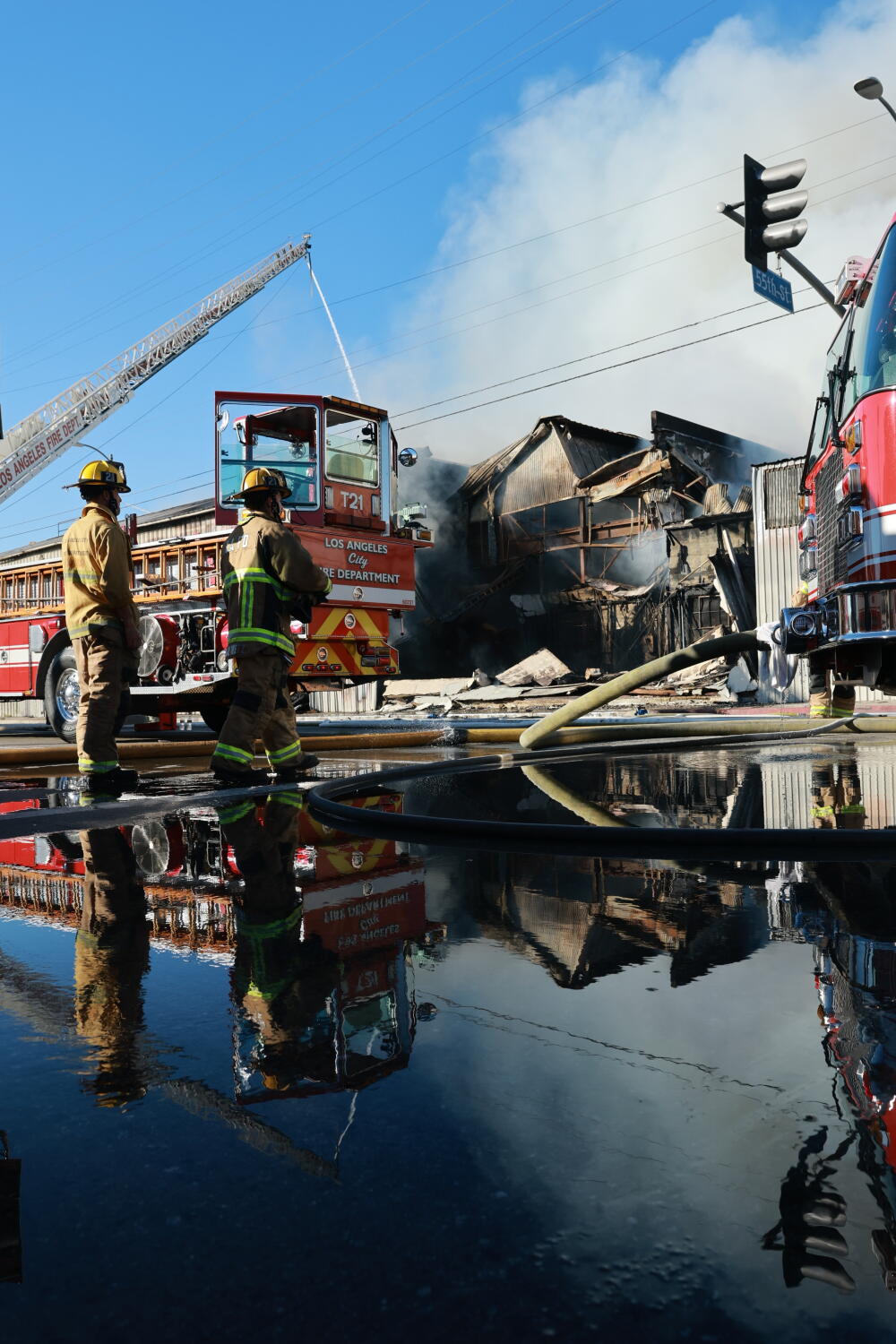
You can look at a charred warehouse in Los Angeles County—sixty thousand square feet of twisted steel beams, collapsed drywall, and gray sludge—and tell yourself the danger has passed. The news helicopters have moved on to the next traffic jam on the 405. The yellow caution tape hangs limp in the coastal breeze. The press releases from the fire department use comforting, past-tense verbs like contained, extinguished, and knocked down.
Then the wind shifts at three in the morning.
Suddenly, that sharp, metallic tang of burning styrene, wet cardboard, and melting lithium cuts through your bedroom window two miles away. Your throat tightens before your eyes even open. You realize the fire didn't die. It just went underground, waiting for the water to evaporate and the cameras to leave.
When a massive commercial facility in L.A. County flares back to life days after firefighters declared victory, the standard local news report treats it like a meteorological fluke. A weird gust of Santa Ana wind. A stubborn pile of rubbish. A minor operational headache for Battalion 14.
That framing misses the entire story. A rekindled industrial fire isn't an accident of weather; it is the inevitable consequence of how we build, store, and insure the invisible engines of modern commerce.
The Architecture of a Slow Burn
To understand why these giants refuse to stay dead, you have to picture what actually sits inside the sprawling tilt-up concrete boxes lining the industrial corridors of Vernon, Carson, Commerce, and the San Gabriel Valley.
Imagine, for a moment, a hypothetical logistics hub we will call Pacifica Fulfillment. From the freeway, it looks like a sterile gray shoebox. Inside, however, it is a vertical labyrinth of high-density storage racks reaching forty feet toward the ceiling. Those racks hold pallets wrapped in thick polyethylene shrink-wrap, stacked with everything from bulk hand sanitizer and synthetic textiles to lithium-ion power tools and aerosolized adhesives.
When a fire breaks out in a space like Pacifica, the modern sprinkler system does its job—up to a point. It dumps thousands of gallons of water per minute onto the upper canopy of the blaze. The flames retreat. The smoke turns from thick, toxic black to wispy white steam. To the human eye, the beast is slain.
But physics is stubborn.
Think of a tightly packed pallet of cardboard boxes wrapped in industrial plastic like a giant log buried under wet leaves. Water cascades over the outside, cooling the surface and starving the visible flames of oxygen. Meanwhile, deep inside the compressed core of that pallet—or beneath a collapsed section of steel roofing that acts like a giant umbrella—the temperature remains above six hundred degrees.
Firefighters call these deep-seated burrowing fires.
I once stood outside a burned-out distribution center in Commerce forty-eight hours after the "all-clear" had been given. The asphalt in the parking lot was still warm through the soles of my boots. Every twenty minutes, a dull, muffled thump echoed from inside the dark ruins—the sound of a structural beam finally losing its temper and snapping, shifting a mountain of wet debris just enough to let a fresh pocket of oxygen hit a hidden ember.
In firefighting, water isn't magic; it is simply a heat sink. It absorbs thermal energy until it turns to steam. Once the hoses are rolled up and the engines return to the station, the residual heat trapped beneath tons of collapsed concrete and melted plastic begins to bake the moisture out of the surrounding rubble. Hours turn into days. The wet cardboard dries out. The trapped gases build pressure. All it takes is a sudden drop in barometric pressure or a late-afternoon breeze blowing through a shattered loading bay to turn a smoldering pocket into a roaring column of flame all over again.
The Invisible Toll on the Perimeter
The dry police blotter version of a rekindle focuses on property damage and lane closures. It rarely mentions Elena.
Let’s introduce Elena as a composite of the thousands of residents who live along the jagged fault lines where L.A.’s heavy industrial zones bleed directly into working-class neighborhoods. Elena lives in a stucco duplex three blocks east of a massive manufacturing plant that caught fire on a Tuesday, flared up on a Thursday, and smoked well into Sunday.
On Tuesday night, Elena packed her two kids into her Honda Civic and drove to her sister’s house in Downey, terrified by the orange glow illuminating the smog. By Wednesday afternoon, the city lifted the evacuation warning. The air quality index on her phone app showed a reassuring yellow dot. She came home, wiped the fine gray ash off her kitchen counter, and sent her kids back to school.
Then came Thursday’s flare-up.
There were no dramatic sirens this time, because engines were already staged on the perimeter. There was no mandatory evacuation order, because the flames stayed mostly within the footprint of the collapsed structure. Instead, there was just a low, persistent plume of acrid smoke that hugged the ground in the cool night air, pooling in living rooms, seeping under front doors, and coating the lungs of everyone who couldn't afford to check into a hotel for a week.
This is the psychological whiplash of a rekindled fire. The first blaze triggers adrenaline and community solidarity; people bring bottled water to the fire line and check on elderly neighbors. The second blaze triggers dread, exhaustion, and a quiet, corrosive anger. You stop trusting the official announcements. You start checking the wind direction every hour. You wonder what exact cocktail of melted plastics, heavy metals, and industrial solvents your children are breathing in while they sleep, knowing full well that air monitoring stations miles away aren't capturing the toxic micro-climate sitting right on your porch.
The Economics of Leaving Things Burning
Why don't fire departments simply tear the building apart on day one, douse every square inch of rubble, and guarantee the fire stays dead?
Because doing so requires money, heavy machinery, and legal authority that rarely align in the chaotic aftermath of a disaster.
Consider the friction between public safety and private property. The moment a fire is declared "under control," a complex bureaucratic clock starts ticking. The site becomes both a potential crime scene for arson investigators and a multi-million-dollar liability puzzle for commercial insurance carriers.
Firefighters cannot simply roll bulldozers through a privately owned warehouse and rip down unstable tilt-up concrete walls without risking their own lives—and without triggering a cascade of legal disputes over structural integrity and evidence preservation. Tilt-up concrete walls are notorious in the fire service; they are massive slabs held together by steel rebar and roof connections. Once the roof burns away, those forty-foot walls become giant dominoes waiting to crush anyone working near their base.
To safely overhaul a massive commercial fire—meaning to pull apart every pile of debris and soak every hidden ember—you need specialized demolition contractors with long-reach excavators. You need environmental hazmat teams to contain the millions of gallons of contaminated runoff water so it doesn't poison the Los Angeles River or the local groundwater table.
Who pays for that heavy equipment on a Wednesday afternoon when the flames aren't visible? The property owner's insurance company often wants to send its own adjusters first. The city's building and safety department has to red-tag the structure and issue emergency demolition orders. While lawyers, adjusters, and municipal officials trade emails, the fire quietly breathes beneath the rubble.
And then there is the sheer scale of modern L.A. commerce. Los Angeles County is the logistical heart of the West Coast, home to the busiest port complex in the Western Hemisphere. Every single day, millions of tons of goods move from container ships in San Pedro and Long Beach into massive inland warehouses before heading across the country.
To maximize profit per square foot, modern warehouses have grown taller, denser, and far more flammable. Forty years ago, a warehouse fire meant burning wood pallets, paper boxes, and cotton textiles. Today, that same square footage is packed with petrochemicals: polyester clothing, polyurethane foam, PVC piping, and high-energy batteries. Pound for pound, modern commercial inventory burns nearly three times hotter than the goods of the 1970s.
We have built temples of concentrated thermal energy right next to densely populated neighborhoods, yet we still rely on nineteenth-century tactics—pouring water from the outside and hoping for the best—when those temples collapse.
The Anatomy of a Rekindle
If you watch the incident command logs of a major L.A. County industrial fire, a predictable, almost rhythmic tragedy unfolds over seventy-two hours.
Hour Zero: The initial call comes in. Thick black smoke is visible from downtown. Within twenty minutes, it escalates to a third-alarm, then a fourth-alarm blaze. Over a hundred firefighters surround the building in a "defensive posture," meaning the structure is too compromised to send crews inside. Ladder pipes arch streams of water through the collapsing roof.
Hour Twelve: The flames are beaten back. The incident commander scales down the response, releasing mutual-aid units from neighboring cities back to their home stations. A "fire watch" is established—usually one or two engine companies left behind to monitor hot spots and wet down smoking piles.
Hour Thirty-Six: The sun comes out, warming the dark, heat-absorbing ruins. The afternoon onshore breeze picks up off the Pacific, pushing east through the basin at fifteen miles an hour. Deep inside the warehouse, a pocket of smoldering polyurethane foam reaches its auto-ignition temperature. A small tongue of blue flame licks up through a crack in a collapsed concrete slab.
Hour Thirty-Seven: Within minutes, the fresh oxygen feeds the hidden fuel load. Thick, gray-black smoke erupts from the ruins once again. The single engine company on fire watch calls for backup. Sirens wail back down the same boulevards. Residents who thought the nightmare was over look out their windows and see the exact same dark column rising into the sky.
It is an exhausting, expensive loop. Every flare-up exposes firefighters to fresh waves of carcinogens—benzene, formaldehyde, hydrogen cyanide—that cling to their turnouts and seep through their skin long after their air tanks run dry. It drains municipal overtime budgets. It disrupts local supply chains, stranding inventory and forcing small businesses that relied on that warehouse to scramble for survival.
Living in the Shadow of the Smoke
I admit, there is something deeply unsettling about watching a massive fire come back to life. It violates our basic human need for closure. We like our emergencies to have clean edges: a beginning, a heroic middle, and a definitive end.
An industrial rekindle refuses to give us that comfort. It reminds us that the physical world we have engineered—with its towering racks of synthetic goods, its lithium batteries, its miles of concrete and steel—possesses a terrifying momentum of its own. Once that stored energy is unlocked, it does not surrender easily.
If you live or work near one of L.A. County’s vast industrial corridors, a flare-up isn't just a headline to scroll past; it is a signal to protect yourself when official messaging lags behind reality. When a major commercial fire happens nearby, the "all-clear" is rarely the end of the air quality hazard. Running HEPA air purifiers indoors for days after the flames disappear, sealing drafty windows with painter's tape when the afternoon winds kick up, and paying attention to your own body—scratchy eyes, a metallic taste in your mouth, sudden fatigue—matter far more than a green dot on a regional weather app.
Because out there in the blackened ruins, beneath the twisted steel and the drying mud, the heat is still waiting.
Night falls over the basin, the freeway taillights blur into ribbons of red and white, and in the dark silence of a collapsed warehouse, a single orange spark catches a breath of coastal wind and begins to glow.