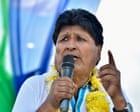
Seventeen years after elite state forces swarmed the fourth floor of Santa Cruz's Hotel Las Américas and left three foreign nationals dead, the ghosts of that bloody April dawn are coming back to haunt Evo Morales.
Bolivia's attorney general announced a formal investigation targeting the leftist former president, probing his direct responsibility in what international bodies have increasingly classified as extrajudicial executions and torture. For a country perpetually trapped in cycles of retributive justice and political score-settling, this move is either long-overdue accountability or the ultimate weaponization of a broken judiciary. Meanwhile, you can explore other developments here: Why the Manchester Synagogue Attack Inquiry Matters More Than You Think.
To understand why this case matters now, you have to look backward to April 16, 2009. Back then, the official narrative broadcasted from La Paz was clean and cinematic: an elite police tactical unit had dismantled a heavily armed, European mercenary cell led by Eduardo Rózsa-Flores, a charismatic, globe-trotting soldier of fortune with a penchant for theatrical warfare. The state claimed Rózsa-Flores and his associates—Irishman Michael Dwyer and Hungarian-Romanian Árpád Magyarosi—were plotting to assassinate Morales and spark a civil war aimed at severing the wealthy, conservative gas-hub of Santa Cruz from the rest of the country.
The men were shot dead in their beds. Two others, Mario Tadic and Elod Toaso, were arrested, dragged through a Kafkaesque legal purgatory, and subjected to years of detention and psychological torment before survivors and families began picking apart the state's pristine version of events. To explore the bigger picture, check out the detailed article by Reuters.
Cracks in the official story appeared almost immediately, widening over the years into a chasm of state-sanctioned impunity. International human rights monitors, including a landmark 2021 ruling by the Inter-American Commission on Human Rights, found that the raid was never a standard law enforcement operation. Instead, evidence pointed toward a premeditated setup designed to decapitate the political opposition in Bolivia's lowlands and cement Morales's grip on power by terrorizing regional rivals. Forensic analyses and leaked documents suggested that some of the targets were captured alive and executed in cold blood rather than killed in a firefight, while survivors endured systematic torture designed to extract coerced confessions that implicated prominent regional opposition leaders.
For over a decade, the investigation into the Hotel Las Américas raid stalled because the men holding the levers of state power were the very architects of the operation. Whenever domestic judges crept too close to the chain of command leading directly to the presidential palace, case files vanished, judges were reassigned, and witnesses fled.
Now, the political terrain in La Paz has fractured entirely. Morales, once an untouchable political titan who reshaped Bolivia's constitution and economy during his nearly fourteen years in office, finds himself isolated, locked in a brutal factional war with his former handpicked successor, and facing multiple legal fronts ranging from electoral unrest charges to historic human rights abuses.
Reviving the 2009 killings investigation is a calculated political maneuver. It signals to international human rights organizations that historical crimes can outlive the administrations that committed them, yet it also exposes the deep structural rot of a judiciary that only prosecutes past leaders when they fall out of favor with current power brokers.
The legal hurdles facing prosecutors are formidable. Decades have passed, physical evidence has degraded or disappeared, and key witnesses are scattered across Europe and South America. Proving that Morales gave direct, actionable orders for the execution of Rózsa-Flores and his men requires bridging the evidentiary gap between political rhetoric and a specific military-style order executed in the dead of night.
Yet, the symbolic weight of the inquiry stretches far beyond courtroom mechanics. The families of Michael Dwyer and the other victims spent years banging on closed diplomatic doors, demanding to know why their sons were executed without trial in a South American hotel room. For them, the sudden awakening of the Bolivian prosecutor's office offers a fragile glimmer of validation, even if it arrives wrapped in the cynical packaging of modern political survival.
History suggests that transitions of power in the Andean nation are rarely peaceful and almost never clean. When a fallen leader's past comes back to haunt him through the very courts he once controlled, the pursuit of justice often looks indistinguishable from political retribution.
The investigation into the 2009 bloodshed is moving forward not because Bolivia has suddenly discovered institutional purity, but because the political utility of protecting the architects of that raid has finally expired.