Deep beneath the Earth's surface, away from the chaotic noise of cosmic radiation, massive underground detectors are finally capturing the first definitive data points from neutrinos—often called ghost particles. These subatomic entities hold the key to understanding why matter dominates the universe, yet they are notoriously difficult to catch. For decades, physicists have built increasingly expensive subterranean traps to intercept them. Recent breakthroughs from these facilities are transforming our understanding of particle physics, proving that the answers to the cosmos lie not in looking up at the stars, but in burying sensors miles beneath solid rock.
The Subterranean Ghost Hunt
Neutrinos are everywhere. Trillions of them pass through your thumb every second, completely unnoticed. They have no electrical charge and almost zero mass, allowing them to slip through solid planets as if they were empty space. To catch something so elusive, scientists cannot rely on traditional telescopes. They have to build in reverse.
By placing detectors deep in abandoned mines, under mountains, or beneath polar ice, researchers use the Earth itself as a shield. The thick layer of rock or ice filters out the constant rain of cosmic rays that would otherwise drown out the incredibly faint signals left behind by neutrinos.
When a neutrino does happen to collide with an atom inside a detector, it produces a fleeting flash of light or a microscopic chain reaction. Capturing these rare events requires massive volumes of medium—usually heavy water, liquid argon, or ultra-pure scintillating fluids—surrounded by thousands of hyper-sensitive light sensors called photomultiplier tubes.
The Heavyweight Contenders in the Deep
Several international projects are racing to map the properties of these particles, each taking a slightly different approach to the same engineering nightmare.
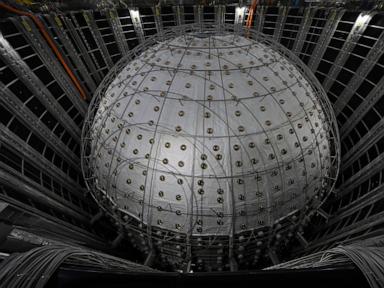
- The Jiangmen Underground Neutrino Observatory (JUNO): Located 700 meters underground in southern China, this project utilizes a massive 35-meter-wide acrylic sphere filled with 20,000 tons of liquid scintillator to measure the mass hierarchy of neutrinos.
- The Deep Underground Neutrino Experiment (DUNE): Based in the United States, this facility sends an intense beam of neutrinos 1,300 kilometers through the Earth from Illinois to a deep underground laboratory in South Dakota, aiming to observe how the particles change flavor during flight.
- Hyper-Kamiokande: Japan’s next-generation detector, buried deep within a mountain, relies on a colossal tank of ultra-pure water to detect the faint ring of blue light, known as Cherenkov radiation, emitted when a neutrino interacts with a water molecule.
The financial and logistical costs of these facilities are staggering. Excavating millions of tons of rock to create sterile, hyper-sensitive physics labs requires billions of dollars and decades of political alignment.
Why the Mass Hierarchy Matters
The immediate goal of these multi-billion-dollar experiments is to solve the neutrino mass hierarchy problem. Physicists know that neutrinos exist in three distinct types, or "flavors": electron, muon, and tau. They also know these particles morph into one another as they travel, a phenomenon called quantum oscillation.
However, we still do not know which of the three types is the heaviest and which is the lightest. It sounds like a minor academic detail. It is not.
Knowing the exact weight distribution of neutrinos determines which theoretical models of the early universe hold up and which belong in the trash. If the mass hierarchy follows the "normal" ordering, it aligns neatly with certain extensions of the Standard Model of physics. If it follows the "inverted" ordering, it could mean our understanding of fundamental forces is missing a massive piece of the puzzle.
The Matter Asymmetry Crisis
The implications stretch far beyond particle cataloging. The ultimate quarry of the ghost particle hunt is the answer to a foundational crisis in cosmology: why does anything exist at all?
According to the laws of physics, the Big Bang should have produced equal amounts of matter and antimatter. When matter and antimatter meet, they annihilate each other instantly, leaving behind nothing but pure energy. If the universe played fair, everything should have canceled out, leaving a barren void of radiation.
Yet, we are here. The planets, the stars, and human beings exist because a fraction of a second after the dawn of time, a slight asymmetry occurred. Matter won the battle.
$$\delta_{CP}$$
Scientists suspect that neutrinos are the culprits behind this cosmic heist. By studying CP violation—a asymmetry in the behavior of neutrinos compared to their antimatter counterparts, antineutrinos—researchers hope to find the exact mechanism that tipped the scales in favor of matter.
The Limits of Subterranean Engineering
Despite the optimism surrounding recent data releases, underground detection is plagued by inherent limitations. The engineering tolerances are unforgiving. A single speck of radioactive dust can ruin an experiment that took ten years to build. The materials used to construct the detectors must be refined to unprecedented levels of radiological purity.
Furthermore, the data arrives at an agonizingly slow pace. Because neutrinos interact so rarely, detectors must run continuously for years, sometimes decades, just to gather enough statistical significance to claim a discovery. It is a game of patience that does not always align with the fast-moving timelines of modern scientific funding.
There is also the problem of the "neutrino floor" for other physics experiments. While neutrino physicists want to catch these particles, dark matter researchers view them as a nuisance. As dark matter detectors grow more sensitive, neutrinos from the sun and cosmic rays begin to trigger them, creating an unbreakable wall of background noise that makes finding dark matter even more difficult.
The Geopolitical Science Race
The hunt for the ghost particle is also a proxy war for scientific dominance. The nations that host these detectors pull in the brightest minds, secure foundational patents in sensor technology, and dictate the timeline of human discovery.
China's rapid construction of JUNO, combined with the scale of the US-led DUNE project and Japan's Hyper-Kamiokande, shows a clear tri-polar race to the frontier of physics. Each region is betting heavily that the first definitive answers to the neutrino mass puzzle will guarantee scientific prestige for the next half-century.
The data streaming from the deep rock is no longer just noise. The initial findings confirm that the instruments are working, the backgrounds are quiet, and the ghost particles are finally being caught in numbers large enough to analyze. The next few years will see the resolution of anomalies that have puzzled physicists since the mid-twentieth century. We are finally stripping away the anonymity of the universe's most elusive building block, one subterranean collision at a time.