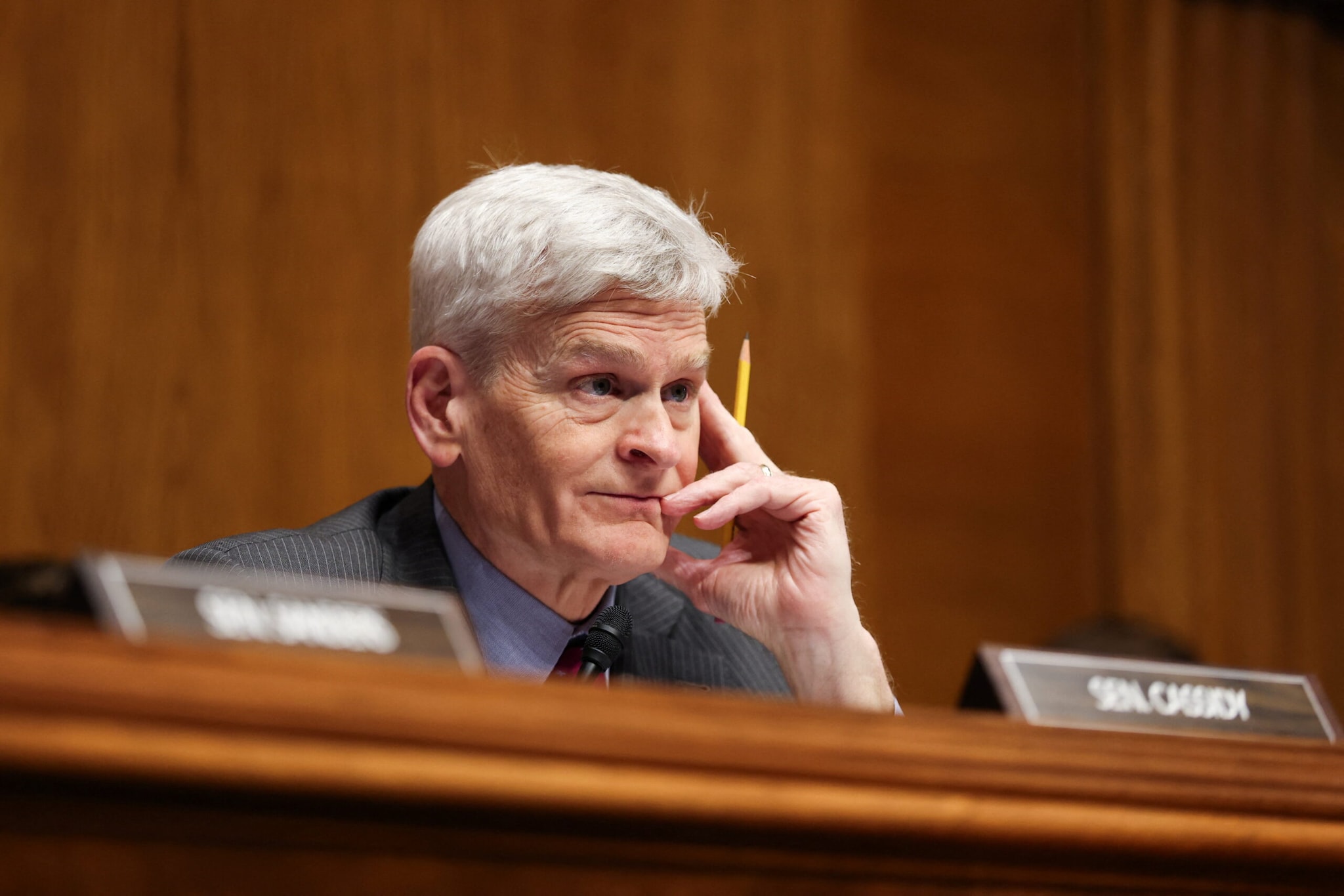
The air inside the Senate chamber carries a specific weight when the cameras turn off. It smells of old wood, floor wax, and the quiet, heavy realization that decisions made in upholstered chairs ripple outward into desert heat thousands of miles away. Most days, votes are calculus. Senators weigh the demands of their donors against the fears of their constituents, balancing on a tightrope of survival.
But political mortality changes a person.
When the Senate recently advanced a critical bill aimed at winding down executive war powers and preventing an unauthorized escalation with Iran, the roll call took an unexpected turn. Bill Cassidy, the Republican senator from Louisiana, cast a vote that caught his colleagues off guard. He flipped. After months of staunch opposition to altering the status quo on Middle East military authorization, he chose to help advance the legislation.
To understand why this matters, you have to look past the sterile language of legislative dockets and into the psychology of a politician who suddenly has nothing left to lose.
Just days prior, Cassidy suffered a bruising primary defeat. In the brutal logic of American politics, a primary loss is a public eviction notice. The donors stop calling. The party apparatus looks through you toward the next candidate. The relentless pressure to conform to the party line evaporates, leaving behind a strange, liberating silence.
For a politician, losing an election is often the moment they finally find their voice.
The Weight of the Blank Check
Every modern conflict has a ghost writer. In the case of American foreign policy in the Middle East, that writer is a piece of legislation passed decades ago. The Authorizations for Use of Military Force, or AUMFs, were originally designed to give the executive branch the agility to respond to immediate threats after the turn of the millennium. Instead, they became a blank check.
Consider a young woman enlisting in the military today. She was not even alive when those original authorizations were debated and passed. Yet, her deployment to a volatile border, her nights spent in a fortified outpost under threat of drone strikes, are governed by those very documents. This is not an abstract debate about constitutional law. It is about who decides when that young woman is placed in harm's way.
For years, the status quo remained untouched because inertia is the safest political strategy. To vote against war powers reform is to wrap oneself in the flag of national security. To vote for it invites primary challengers who will label you soft on adversaries like Iran.
But when the primary is already lost, the calculus changes entirely.
The human mind handles risk differently when the threat of personal ruin is removed. Psychologists call it the post-defeat clarity. In the hallways of Capitol Hill, a senator who no longer needs to raise money for a reelection campaign can look at a piece of war powers legislation and see it for what it actually is: a question of life and death, rather than a talking point for a Sunday morning news show.
The Calculus of the Flip
The debate surrounding Iran has always been charged with an intense, often blinding emotion. The memory of historical grievances, the ongoing proxy conflicts, and the terrifying specter of nuclear proliferation dominate every committee hearing. In that environment, nuance dies quickly.
Opponents of the bill argue that stripping the executive branch of these legacy war powers sends a signal of weakness to Tehran. They argue that deterrence requires ambiguity—that the president must have the unquestioned authority to strike instantly if a red line is crossed. It is a powerful argument, one that Cassidy himself championed for a very long time.
But the counterargument is quieter, steadier, and rooted in the bloody lessons of the last quarter-century.
When the power to initiate conflict is concentrated in a single office, the guardrails of democracy begin to warp. The founders of the American republic intentionally placed the power to declare war in the hands of the legislature, the body closest to the people who would actually fight and pay for that war. They knew that a single executive, insulated by advisors, could easily miscalculate.
Imagine a scenario where a localized skirmish involving an Iranian-backed militia in the Syrian desert escalates over the course of forty-eight hours. Under the old framework, the president could launch a full-scale retaliatory campaign without ever consulting Congress, relying on an authorization written before smartphone technology even existed. The nation could wake up to a new war before the public even understood the provocation.
By advancing this bill, the Senate is attempting to reclaim its constitutional duty. They are forcing a reality where any sustained military action against Iran must be debated openly, transparently, and with the explicit consent of the people's representatives.
The Silence of an Empty Office
Walk down the corridors of the Russell Senate Office Building after a member loses a primary. The shift is palpable. The staff is quiet, looking at job boards. The boxes are stacked in the corners. The phone rings far less often.
It is in this specific atmosphere that Cassidy made his choice. His flip was not accompanied by a grand speech or a dramatic press conference. It happened in the ordinary cadence of a Senate workday, a simple notation on a tally sheet that signaled a profound shift in alignment.
Critics will call it cynical. They will say that a politician should hold their convictions regardless of their electoral fortunes, that changing a vote only after a loss proves the initial stance was purely performative. And perhaps there is truth in that. Politics is a game of survival, and survival dictates compromise.
But there is another, more human way to view it.
Sometimes, the system is so broken that a leader can only do the right thing when they are no longer trapped inside it. The primary loss was a professional tragedy for Cassidy, but it also functioned as a sudden release from a cage of political expedience. Free from the need to appease the loudest, most hawkish elements of the base, he could look at the reality of a potential conflict with Iran and vote his conscience.
The real tragedy is that such freedom requires a defeat.
The chamber is empty now, the desks cleared, the senators gone home for the evening. The bill moves forward, carrying with it the quiet momentum of a shifting consensus. Somewhere in America, a family sits at a kitchen table, unaware of the debate that took place in Washington, unaware of the senator who lost his job and changed his mind. Their son or daughter is packing a duffel bag for a deployment overseas. Because of a sudden flip in a quiet room, the rules governing where that soldier goes, and under whose authority they fight, might finally begin to change.