Paper does not forget.
That is the first lesson you learn when you sit in a fluorescent-lit compliance office at four in the morning, staring at a wire transfer that has been frozen for seventy-two hours over a spelling variation that nobody in the room can prove is a crime. Outside, rain streaks the glass. Inside, the air smells of burnt coffee and cold printer toner. A shipment of pediatric insulin pumps—or maybe it is hydraulic valves for a municipal water station, or spare parts for a regional airline—sits in a customs yard thousands of miles away because a name on a manifest brushed up against a list maintained in Washington, D.C. For a closer look into this area, we recommend: this related article.
Nobody pressed a big red button that says Stop. Nobody walked into the bank vault and threw a chain across the door. Instead, a line of ink appeared on a federal registry, and that line has a peculiar property that textbooks rarely explain with enough honesty: sanctions behave as if they are permanent, right up until the exact moment Washington decides otherwise.
Wait. Read that again. For additional details on this development, extensive reporting can also be found on BBC News.
When a government imposes economic sanctions—whether through the Treasury Department's Office of Foreign Assets Control, export-control blacklists, or secondary measures aimed at third-country banks—it often speaks in the language of urgency. Immediate pressure. Targeted leverage. Swift accountability. Yet on the ground, urgency cools into crust. Rules stack on rules. Waivers expire or get denied. Bureaucracies shift priorities from one administration to the next, and what began as a sharp, pointed tool starts acting like a geological stratum. Once laid down, people build around it, under it, and in fear of it.
I have spent years watching how these restrictions ripple through supply chains, compliance teams, and ordinary livelihoods far from the Potomac. At first, the whole apparatus feels like a maze built by lawyers for lawyers. You read a regulation three times and still find yourself asking: Am I allowed to ship this? What if the buyer's cousin owns ten percent of a holding company in a third country? What if I ask a question and trigger an investigation? Honestly, that uncertainty is half the point. Ambiguity makes people cautious, and caution does half of Washington's enforcement work for free.
How Temporary Measures Turn Into Concrete
To see how a legal decree becomes an invisible wall, let us trace a hypothetical scenario—clearly labeled as a composite illustration drawn from real-world compliance bottlenecks rather than a single real person.
Picture Tariq, a procurement director for a mid-sized medical and industrial distributor operating out of a port city outside the United States. Tariq is not a spy, a warlord, or an oligarch. He is a man who checks spreadsheets, worries about freight delays, and tries to keep hospital clinics supplied with diagnostic reagents and replacement parts. One Tuesday morning, a long-standing supplier in a neighboring country tells Tariq that a routine component—a circuit board used in blood-analysis machines—cannot be cleared for export because a sub-tier manufacturer in the chain shares an address or ownership link with an entity placed under U.S. sanctions years earlier.
Tariq calls his bank. The bank's compliance officer speaks politely, carefully, and with unmistakable caution. Even if the transaction does not strictly violate U.S. law, the bank clears dollars through correspondent accounts that touch the American financial system. One misstep can mean steep penalties, reputational ruin, or the loss of correspondent banking access altogether. So the bank freezes or rejects the payment.
Days stretch into weeks. The clinic runs low on test cartridges. Technicians improvise workarounds that take twice as long. Tariq writes emails that go unanswered or return with boilerplate citations to dense regulatory sections.
Here is the paradox that traps people like Tariq: on paper, sanctions are policy instruments, not eternal curses. Governments lift them, narrow them, issue general licenses, or grant specific waivers when diplomatic goals shift or humanitarian exemptions are carved out. In reality, however, lifting a sanction is vastly harder than imposing one. Imposing takes a signature and a press release. Unwinding takes political capital, interagency sign-off, fear of looking "soft," and the monumental task of convincing nervous banks and vendors that the coast is truly clear.
Even after a restriction is officially eased or lifted, the shadow lingers. Risk officers have long memories and short tolerances for surprise. A compliance database might lag behind a policy change. A foreign bank might keep its internal block active for months—or years—because de-risking is safer for its balance sheet than taking a chance on a newly reopened channel.
A metaphor for sanction inertia: Imagine a city builds a concrete dam across a river to stop a flood. Years later, the drought ends, the valley needs water, and engineers open a small sluice gate. Yet the river still moves at a trickle because silt has packed against the walls, downstream farmers have already dug dry wells elsewhere, and nobody wants to be blamed if the water rises too fast.
That is what permanence feels like to the people living in the wake of policy. The official line may say conditional or subject to review. The lived experience says do not count on tomorrow.
The Invisible Stakes Behind Every Line Item
When headlines cover sanctions, they usually zoom out to satellite altitude. They talk about gross domestic product, currency swings, diplomatic standoffs, or geopolitical chess. Those numbers matter. They tell us how an economy bends under pressure.
Still.
Numbers do not feel the heat of a stalled warehouse. Numbers do not explain why a small family-owned factory closes its doors because a single imported seal cannot pass customs, leaving thirty machinists without a paycheck before the rent comes due. Numbers do not show the quiet exhaustion of a compliance analyst at midnight, trying to decode whether a software update counts as controlled technology or routine maintenance.
Consider what happens next when a sanction stays in place long enough to become normal:
First, markets adapt around the friction. Legitimate companies pull back because the legal and auditing costs exceed the profit margin. When established, transparent players exit a market, they do not always leave a vacuum; often they leave room for opaque intermediaries, shell structures, or slower, costlier workarounds that raise prices for everyone at the end of the line. Everyday consumers—patients, commuters, shopkeepers—pay a quiet tax in higher costs and fewer choices.
Second, political incentives harden. In Washington, as in many capitals, lifting a sanction carries a distinct political asymmetry. If a restriction stays on, few critics punish the decision-maker for being "tough." If a restriction is lifted and something goes wrong later—even something loosely connected—opponents can pounce on the reversal as naivety or weakness. That asymmetry creates a built-in bias toward keeping measures alive long past their original tactical moment.
Third, trust erodes across borders. When financial networks and export rules are wielded repeatedly, partners outside the United States begin asking uncomfortable questions about predictability. Even allies sometimes grumble behind closed doors when extraterritorial reach or sweeping compliance demands collide with their own trade ties or sovereign priorities.
Let me admit something candidly: trying to draw a clean line between legitimate national security and collateral human harm is genuinely hard. States face real threats—proliferation, aggression, corruption, human rights abuses—and policymakers argue, not without reason, that economic pressure can sometimes force negotiations or raise the costs of bad behavior without firing a shot. I do not pretend the choices are easy. Anyone who claims there is a simple formula is selling an illusion.
Yet acknowledging the motive does not erase the mechanism. A blunt or sprawling sanction does not hit only the target named in the decree. It hits suppliers, shippers, hospitals, students trying to pay tuition fees, and workers who had no seat at any bargaining table.
Why Washington Holds the Switch—and Why It Hesitates to Flip It
Why does so much of this gravity pull toward Washington? Because of structural power, not magic. The U.S. dollar remains central to global trade and finance, major clearinghouses sit within reach of U.S. jurisdiction, and American technology and intellectual property thread through countless modern supply chains. When Washington speaks—or when its regulators issue guidance—global institutions listen because the cost of ignoring them can be existential.
Think of it like gravity in a solar system. You do not have to be standing on the sun to feel its pull; your orbit is shaped by it anyway.
Now trace what happens when the political weather in Washington changes. A new administration arrives with a different doctrine. Or a diplomatic breakthrough opens a narrow window. Or negotiators reach a deal that promises relief in exchange for verifiable steps. On paper, that is the moment when "permanent until Washington decides otherwise" meets its second half: until Washington decides otherwise.
In practice, flipping that switch is rarely clean.
Suppose officials want to ease restrictions on certain agricultural or medical exports so ordinary families are not crushed by shortages. Even when a legal exemption exists on paper, banks may hesitate to process the payments. Why? Because compliance teams fear running afoul of adjacent restrictions, or misreading fine print on dual-use items, or facing scrutiny over how funds move. Relief on paper can look like a locked door in practice unless clear guidance, banking channels, and political backing align at the same time.
Conversely, suppose Washington decides to tighten screws—adding new designations, expanding secondary sanctions, or closing loopholes that merchants used to keep basic goods flowing. That happens fast. A new list drops, screening software updates, and overnight a trade route that functioned yesterday becomes radioactive today.
Let us return to Tariq in our hypothetical scenario. Months into his ordeal, news breaks that a partial exemption or policy adjustment might ease pressure on certain medical supply chains. For a fleeting second, Tariq feels hope. Then he remembers how long it took to get a single clarification from his bank the first time around. Hope in sanctions work is always rationed, always conditional on another review, another form, another signature in a city three thousand miles away.
The Quiet Cost of Living in the Grey Zone
There is a particular kind of stress that comes from living in a grey zone—where something is neither strictly forbidden by every conceivable reading nor clearly safe enough to execute without fear.
Compliance officers feel it. Business owners feel it. Aid workers feel it. Even diplomats feel it when well-intentioned carve-outs get bogged down in technical friction. Over time, this grey zone teaches people a defensive habit: when in doubt, say no.
Saying no is efficient for risk management. If a bank declines a borderline transfer, it loses a fee, maybe annoys a client, and sleeps soundly. If it approves a transfer that later draws a regulatory inquiry, the headache can last years. Multiply that rational individual calculation by thousands of banks, insurers, shipping lines, and software vendors worldwide, and you get a massive, invisible brake on global commerce and humanitarian movement.
History shows us again and again that economic pressure rarely produces instant miracles on its own. Sometimes it brings parties to the table; sometimes regimes dig in, redirect trade through shadow networks, or shift blame outward while domestic hardship deepens. And when sanctions drag on for years, their original purpose can blur into inertia. What started as a lever becomes a fixture.
Meanwhile, the people caught in the gears adapt in ways that are rarely heroic and often exhausting. A small exporter spends hours rewriting paperwork. A hospital administrator hunts for alternative vendors at twice the price. A young engineer watches an international payment bounce back with no clear explanation.
None of these moments makes the evening news. None of them looks like a dramatic turning point.
Yet together, they form the real ledger of sanctions: not just the decrees signed behind closed doors in Washington, or the speeches announcing tough new measures, but the quiet, daily friction felt by human beings trying to get medicine, parts, food, or money from Point A to Point B.
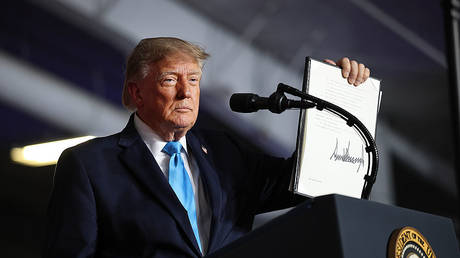
A signature on a page can freeze a world in place for years, and a single change of heart in a distant capital can set it moving again—if anyone still trusts the ice to hold.