She moved through the suburban sprawl like a rumor.
To the delivery drivers rushing past driveways on aluminum bicycles, she was just a flash of gray in the periphery. To the toddlers pressing their sticky palms against front-window panes, she was a ghost dog, a wild thing wearing the shape of something familiar. But to the residents of a quiet, tree-lined pocket where manicured lawns bled into untamed arroyos, she became a shared heartbeat.
Her name was Wendy. Or at least, that is what the neighborhood called her after the flyers went up.
For weeks, she lived in the interstitial spaces of human habitation. She slept beneath rusted backyard sheds where the smell of motor oil mixed with damp earth. She scavenged what the city left behind—discarded crusts of sourdough, the forgotten corners of takeout boxes, the bitter mercy of irrigated lawns during a brutal dry spell. Yet, her survival was precarious. Every passing car was a rolling hazard. Every shift in the autumn weather threatened her fragile equilibrium.
Wild animals do not ask for our pity. They demand our attention.
When Wendy first appeared, limping slightly on a front paw that carried the silent history of a past collision, most people looked away. That is the default setting of modern life. We train our eyes for the highway ahead, for the glowing rectangles in our palms, for the curated order of our own four walls. We practice a polite blindness toward the margins.
Then came the change.
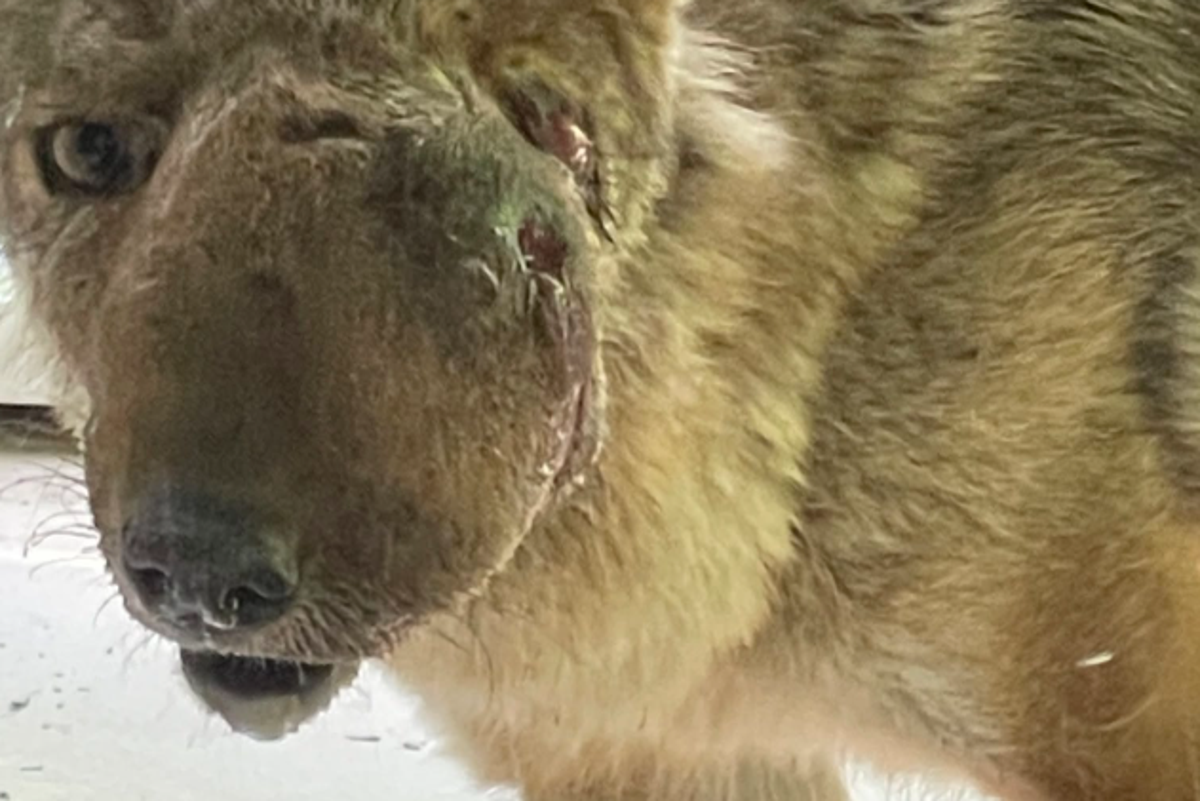
It started with a woman named Sarah, who lived in the corner house with the overgrown lilac bush. Sarah noticed a bowl of water left out on a back porch was emptying faster than the neighborhood cats could manage. She set up a trail camera, cheap and battery-operated, strapped to the trunk of an oak tree. What flickered across the small screen at two in the morning was not a feral dog or a raccoon. It was a coyote. Gaunt, wary, carrying the unmistakable geometry of survival in her ribs, but unmistakably injured.
That footage changed the arithmetic of the street.
You cannot unsee a creature in pain once you know its face. Within forty-eight hours, the digital grapevine caught fire. Local group chats—usually reserved for complaints about missed trash pickups or lost tabby cats—transformed into command centers. Neighbors began mapping Wendy’s nocturnal routes. Someone brought heavy-duty humane traps. Someone else, a retired veterinarian who kept his license framed in a dusty study, volunteered his garage as a staging ground.
We live in an era that insists we are utterly disconnected from the natural world, that we have paved over every square inch of wildness until only concrete and convenience remain. But Wendy’s presence proved otherwise. She was a living suture, pulling together a fractured community that had previously spent years barely nodding to one another across property lines.
The rescue effort was not a clean, clinical operation. It was messy, human, and laced with quiet desperation.
For nearly a month, the trap sat baited with rotisserie chicken, its metal jaws yawning open in the dark. Wendy was too smart for it. She would approach, her sensitive nose testing the air for betrayal, her amber eyes reflecting the amber glow of streetlamps. She would circle once. Twice. Then melt back into the shadow of the oleander bushes.
Frustration mounted. Winter was descending, the nights biting down with an iron frost that turned breath to smoke. People worried she wouldn't make it.
(Note: While coyote behavior in suburban environments is frequently misunderstood as aggressive, animal behaviorists note that urban coyotes like Wendy are remarkably adaptable opportunists who typically avoid direct human contact unless cornered, sick, or habituated through accidental feeding.)
The turning point came on a Tuesday night when the rain came down in sheets, turning the dry creek beds into churning brown veins.
A dozen people stood under oversized umbrellas at the edge of the brush. They weren't there to capture her by force. They were there to watch, to wait, to bear witness. Among them was Marcus, a teenage boy who had spent his entire allowance on high-protein dog food, hoping to coax her closer to his family's back fence. Beside him stood Mrs. Gable, an octogenarian who remembered when these suburban streets were still open pasture.
They saw Wendy before she saw them.
She was shivering, her gray coat matted with mud, her injured paw tucked tightly against her chest. She wasn't running. She didn't have the energy left to run. She stood near the base of a weeping willow, staring at the circle of hooded figures with an expression that defied simple categorization—not quite fear, but a profound, ancient exhaustion.
No one lunged. No one shouted.
Instead, the retired veterinarian stepped forward alone, holding an open tin of sardines, his movements agonizingly slow, like a man defusing a bomb made of glass. He spoke in a low, rhythmic hum—the universal cadence used to soothe things that have every reason to distrust the world.
Wendy did not bolt. She took one step forward. Then another.
When the specialized rescue team finally secured her and transferred her to a wildlife rehabilitation sanctuary two counties over, the street went quiet again. The trail cameras were unstrapped from the oaks. The group chats fell silent.
Yet, the neighborhood was not the same.
People were leaving their front porches on evening walks, actually looking at one another, asking if the gray ghost had made it safely to the sanctuary. They had shared a secret burden and, in doing so, remembered what it felt like to care for something that offered no return on investment.
Wendy is gone now, roaming the protected hills where traffic cannot reach her and wild rabbits outnumber discarded food wrappers. But out there, beneath the hum of the overhead wires and the glow of the porch lights, the grass still grows high where the arroyo bends. And the people who live beside it still leave their back gates unlocked just a fraction wider, listening for a rustle in the dark.