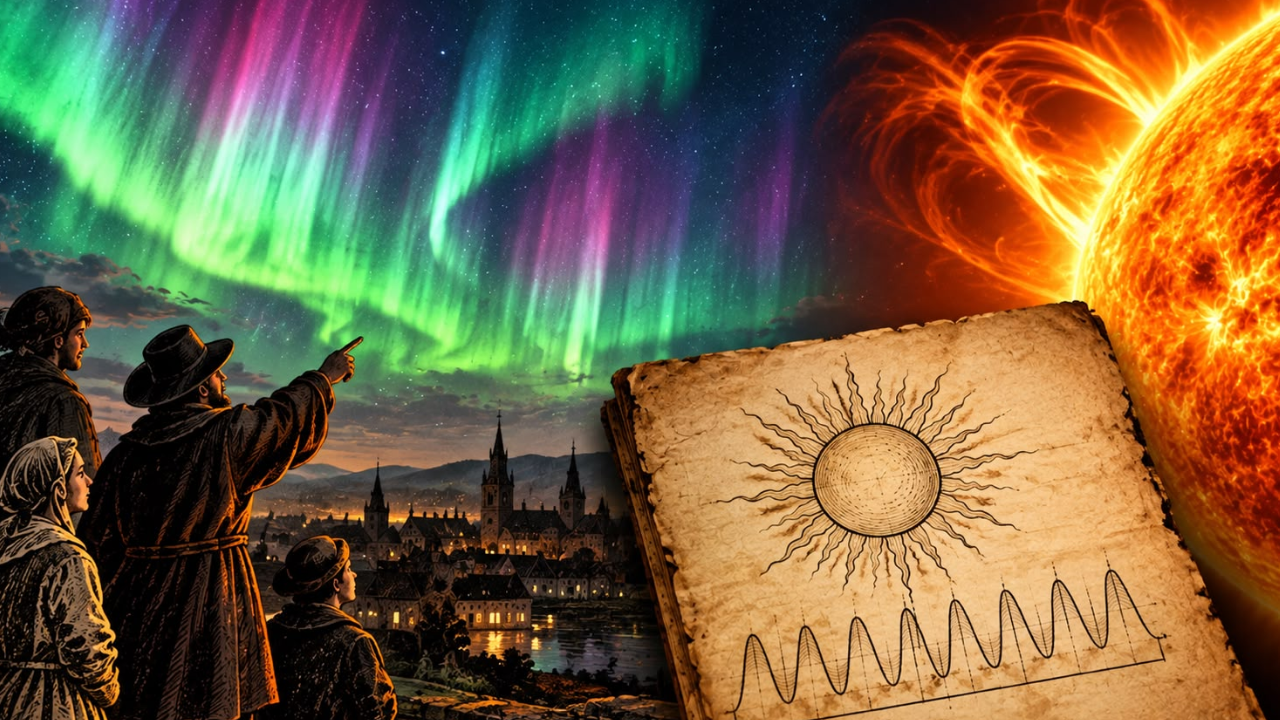
Picture a monk in a drafty stone monastery in twelfth-century England. His fingers are stiff with cold, his breath pluming white in the dim candlelight as he hunches over a vellum manuscript. Outside, the night sky does something impossible. It bleeds. Ribbons of crimson, violet, and emerald ripple across the dark, turning the heavens into a theater of quiet, terrifying beauty. He dips his quill and writes what he sees, recording a crimson omen in the margins of his chronicle, entirely unaware that he is signing his name to a message meant for people living a thousand years in the future.
We tend to think of history as something written in ink on paper, carved into stone, or buried in the dirt. But the Earth keeps another ledger, written in light.
For generations, scientists have tried to peer backward into the violent, unpredictable breath of our nearest star. The Sun is not a steady, unchanging lantern. It beats with a rhythmic heart, expanding and contracting, throwing tantrums of solar flares and magnetic storms in cycles that span roughly eleven years. Yet those cycles are notoriously fickle. Sometimes the heart skips a beat. Sometimes it falls into a deep, prolonged slumber known as a solar minimum, where sunspots vanish and the solar wind grows eerily calm.
Understanding these ancient rhythms is not merely an academic exercise for astronomers chasing ghosts in dusty archives. It is a matter of profound modern survival. When the Sun throws a fit, our modern world of silicon, satellites, and power grids trembles. A severe geomagnetic storm can fry transformers, blind navigation systems, and cripple orbital infrastructure in a matter of hours. To know how the Sun will behave tomorrow, we must understand how it behaved when kings fought with swords and monks tracked the heavens by candlelight.
The problem has always been the fog of time. Instrumental records of the Sun—sunspot counts carefully logged by astronomers with telescopes—only stretch back a few hundred years. Beyond that, the trail goes cold.
Until now.
A brilliant team of researchers decided to stop looking at modern instruments and start looking at the sky's old ghosts. They gathered centuries-old historical records, scouring yellowed texts from medieval chronicles, Korean dynastic annals, Arabic manuscripts, and European broadsheets. They hunted for eyewitness accounts of aurora borealis—the northern and southern lights—spotted far outside their usual polar boundaries.
Think about what an aurora actually is. It is the visible ghost of a solar punch. When the Sun hurls high-energy particles toward Earth, our magnetic field traps them and funnels them toward the poles, lighting up the upper atmosphere in luminous curtains. When those lights are spotted unusually far south—say, lighting up the night skies over Cairo, Seoul, or London—it means the Sun has unleashed a ferocious eruption.
By mapping these historical sightings across centuries, the researchers essentially built a cosmic seismograph out of ancient human awe and terror.
The statistical rigor applied to these historical accounts is staggering. History is messy. Monks exaggerated; scribes made copying errors; weather obscured the skies; political propaganda sometimes colored descriptions of natural portents. To cut through the noise, the team developed a sophisticated probabilistic method, cross-referencing multiple independent historical sources from different corners of the globe. If a chronicler in Japan and a monk in England recorded a blood-red sky in the exact same lunar month, the signal began to emerge from the static.
The results of this painstaking detective work are nothing short of breathtaking.
By correlating these ancient auroral peaks with the physics of solar magnetic cycles, the researchers found they could place historical solar minima within a margin of just two years. More remarkably, their statistical reliability soared past ninety percent.
Consider what that means. We now have a high-resolution map of the Sun's temperament stretching back through the Middle Ages, reconstructed not from silent ice cores or tree rings alone, but from the actual, recorded eyewitness shock of people who looked up at the night sky and wondered if the world was ending.
This is where the cold statistics of science brush up against the fragile, enduring thread of human experience.
Imagine living through the Maunder Minimum in the seventeenth century, a decades-long solar slumber coinciding with the coldest depths of the Little Ice Age in Europe. The Thames froze solid. Crops withered in stunted fields. People huddled around hearths, watching frost crawl up the inside of windowpanes, having no vocabulary for magnetic fields, coronal mass ejections, or solar wind pressure. They only knew that the sky was quiet, the sun felt weak, and the cold was a relentless neighbor.
Today, we look back at their journals and chronicles not just for poetry, but for data. We find the heartbeat of our star hidden in the margins of their suffering and wonder.
The implications for our hyper-connected, fragile civilization are immense. As we push further into the twenty-first century, our vulnerability to space weather grows exponentially. A solar minimum is followed by a solar maximum, a pendulum swing from quiet to chaotic. By tightening our historical timeline of solar activity, climatologists and astrophysicists can better model the long-term relationship between solar output and Earth's climate, disentangling natural solar forcing from human-driven greenhouse warming. We learn how the Sun breathes over centuries, giving us a clearer lens through which to view our planetary future.
The monk in his freezing cell did not know he was working for NASA. He did not know that his cramped Latin scribble about a burning sky would one day help protect a global network of satellites he could never have conceptualized in his wildest dreams. He only knew that the world was vast, mysterious, and occasionally set on fire by invisible forces.
We are standing on the shoulders of giants, yes, but also on the shoulders of terrified, curious observers across thousands of years of human history. They looked up at the dark, saw the heavens dance, and wrote it down. And in doing so, they left us a map to navigate the future.