Stone does not bleed, yet in Eastern Europe, granite has a way of opening old wounds.
Walk down a quiet boulevard in Lviv or a bustling avenue in Kyiv, and you will see them. Metal plaques bolted onto pre-war masonry. Street signs painted in crisp blue and yellow. To an outsider rushing for a morning espresso, they are merely navigation markers, the mundane infrastructure of a modern city trying to survive a brutal invasion. To a neighbor just across the western border in Warsaw, however, a single name stamped into that steel can feel like a slap across the face.
History here is not a closed book sitting quietly on a library shelf. It is a live wire.
When Polish officials recently announced that Kyiv had quietly stepped back from plans to honor a controversial World War II-era nationalist figure—a man viewed by many Ukrainians as a fierce anti-Soviet freedom fighter, and remembered by Poles as a Nazi collaborator complicit in the mass slaughter of Polish civilians—the diplomatic press releases were predictably sterile. Words like recalibration, bilateral dialogue, and mutual understanding did the heavy lifting. A headline flashed across news wires: Kyiv retreats on tribute, Warsaw approves.
End of story. Move on to the next crisis.
Except that is never the end of the story. Behind that dry bureaucratic retreat lies one of the most agonizing, delicate, and high-stakes moral tightropes in modern geopolitics. It is a story about what happens when two nations—bound together by an existential fight for survival against Russian aggression—are forced to confront the ghosts that still haunt their shared borderlands.
Two Kitchens, One Haunted Past
To understand why a municipal naming committee in Ukraine holds the power to rattle military supply chains in Poland, step away from the ministries and imagine two kitchens. (This is a hypothetical scene, yet it mirrors thousands of real conversations happening from Lublin to Ternopil right now.)
In the first kitchen, just outside Warsaw, an elderly grandmother named Halina sets down a cup of tea. Her hands tremble slightly, not from age, but from a memory passed down like an heirloom she never wanted. Her father survived the Volhynia massacres of 1943—a dark, horrific chapter of World War II in which the Ukrainian Insurgent Army, alongside local nationalists, systematically murdered tens of thousands of ethnic Poles in an attempt to cleanse the region. To Halina, the leaders of those factions, and the men who briefly aligned with Nazi Germany in hopes of securing an independent Ukrainian state, are not complex historical figures. They are monsters. When she turns on the evening news and sees a stadium or a street in Ukraine named after one of those commanders, the air leaves her lungs. She has donated blankets, money, and spare bedrooms to Ukrainian refugees fleeing Putin’s bombs. Yet seeing those names honored feels like an erasure of her family’s graves.
Now, picture a second kitchen, four hundred miles east, in a chilly apartment in Kyiv. A young history teacher named Taras sits by a window taped against blast waves, grading essays by the glow of a battery-powered lamp. For Taras, growing up under the long shadow of Moscow’s imperial rewriting of history, the men who fought the Red Army in the 1940s were the only symbols of defiance available. Soviet textbooks painted every Ukrainian independence fighter as a fascist traitor. When Russia invaded in 2014, and again in 2022, Ukrainians reached desperately into their past for icons of unyielding resistance—anyone who had ever stood up to the Kremlin’s war machine and refused to kneel. In the heat of an existential war, nuance is often the first casualty. People look for shields, not case studies.
Both Halina and Taras are real in spirit, even if their names here are invented. Both are grieving. Both are fiercely loyal to their homelands. And both are staring at the exact same historical photograph, seeing entirely different realities.
This is the invisible trap of Eastern European memory. Think of it like two neighbors trying to put out a raging wildfire that threatens to burn down both of their houses, while standing directly over an unexploded landmine buried along their property line. One wrong step, one careless word, and the ground beneath their feet vanishes.
The Architecture of a Diplomatic Retreat
Let us look closely at the reality on the ground, stripped of political spin.
Since February 2022, Poland has been Ukraine’s indispensable lifeline. Over three million Ukrainian refugees crossed into Poland in the opening months of the full-scale invasion, met not with cold detention camps, but with open doors, hot soup at train stations, and ordinary citizens handing over their house keys. Militarily, Poland became the beating logistical heart of the Western alliance—the hub through which tanks, artillery shells, air defense systems, and intelligence flowed into Ukraine. Warsaw emptied its own Soviet-era arsenals to keep Kyiv fighting, often faster and with fewer hesitations than larger Western powers.
Yet beneath that extraordinary solidarity, friction was building.
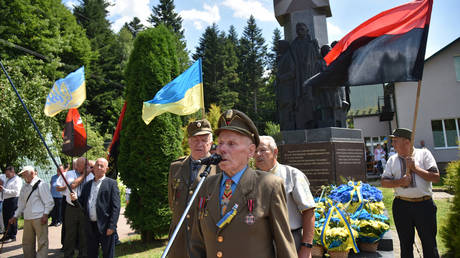
Over the past decade, as Ukraine systematically dismantled its Soviet-era monuments—a process known as decommunization—local councils across the country scrambled to replace names like Lenin and Marx with Ukrainian historical figures. In that rush, several municipalities elevated leaders from the Organization of Ukrainian Nationalists (OUN) and the Ukrainian Insurgent Army (UPA), including figures like Roman Shukhevych, Stepan Bandera, and regional commanders whose units collaborated with Wehrmacht forces or participated in ethnic cleansing against Poles and Jews.
For Warsaw, this was intolerable. Polish officials, across nearly every political party, warned that European integration and deep strategic trust could not be built on the glorification of perpetrators of mass atrocities. In 2016, the Polish parliament officially recognized the Volhynia killings as a genocide. The wound was raw, unhealed, and politically explosive.
When recent plans surfaced in Ukraine to bestow new honors and public tributes upon a prominent figure tied to Nazi collaboration and anti-Polish violence, Warsaw applied quiet, relentless pressure. There were no public tantrums from Poland’s foreign ministry this time—just blunt, behind-closed-doors truth-telling. Polish diplomats made it unmistakable: celebrating men who wore Nazi uniforms or orchestrated the slaughter of Polish villagers undermines the very moral clarity Ukraine needs to win the support of the democratic world.
Kyiv listened. And Kyiv stepped back.
The planned tribute was shelved. The plaques were quietly paused. Warsaw acknowledged the move publicly, signaling that sanity and strategic foresight had prevailed over domestic nationalist impulses.
Why Admission Is Hard—And Necessary
If you have never lived in a country fighting for its right to exist, it is easy to judge Kyiv’s hesitation from the comfort of a peaceful armchair. I will admit something uncomfortable: there are moments when untangling this history feels nearly impossible, even for seasoned historians who have spent their lives studying the bloodlands between Berlin and Moscow.
During World War II, the territories of modern-day western Ukraine and eastern Poland were crushed between two totalitarian nightmares—Hitler’s Third Reich and Stalin’s Soviet Union. Local populations were caught in a meat grinder. Some Ukrainian nationalists made the catastrophic, morally indefensible gamble that aligning tactically with Nazi Germany would help them destroy Soviet rule and carve out an independent state. That gamble led directly to complicity in the Holocaust and the ethnic cleansing of Poles. Nothing can wash away that blood. No geopolitical context excuses the murder of innocent families in burning villages.
At the same time, acknowledging that dark truth feels terrifying to many Ukrainians right now because Russian propaganda weaponizes every admission of Ukrainian historical guilt.
Moscow’s disinformation machine spends billions of dollars trying to convince the world that modern democratic Ukraine is a hotbed of neo-Nazism. Every time a Ukrainian city council names a street after a problematic 1940s figure, Kremlin propagandists pop champagne. They screenshot the news, translate it into twenty languages, and broadcast it across Western Europe and North America to argue that Ukraine does not deserve Western weapons or European Union membership.
Kyiv’s retreat on this tribute was not a sign of weakness. It was an act of strategic maturity.
By walking away from a toxic tribute, Ukrainian leadership did two vital things at once. First, it respected the legitimate grief of its closest ally, proving that the living partnership between Warsaw and Kyiv matters more than stubbornly defending the worst chapters of the twentieth century. Second, it denied Moscow a propaganda gift wrapped in a bow.
The Long Road to Exhumation
Still, canceling a ceremony is only clearing the brush; it is not yet tending the soil.
The deeper issue lingering between Warsaw and Kyiv is not just about street signs—it is about bones. For years, Polish families and historians have pleaded for full, unrestricted access to conduct exhumations of Polish victims buried in unmarked mass graves across western Ukraine, so their remains can be identified and given a proper Christian burial. For years, bureaucratic freezes and tit-for-tat disputes over damaged monuments stalled that process.
Imagine knowing your great-uncle lies under a cornfield two hours away, and not being allowed to light a candle over a stone bearing his name.
True reconciliation requires letting the dead rest with dignity so the living can finally breathe. When historians from both nations are allowed to work side by side without political interference, something remarkable happens: myths dissolve, propaganda loses its oxygen, and shared humanity takes over.
Consider how France and Germany rebuilt Europe after centuries of slaughter. They did not pretend the atrocities never happened. They did not erect statues to generals who massacred each other’s civilians. Instead, they looked squarely into the abyss of their past, owned their crimes without excuses, and built a future so deeply intertwined that war between them became unthinkable.
Poland and Ukraine stand at that exact threshold today.
What Remains When the Headlines Fade
The news cycle has already moved on from Warsaw’s brief statement. Tomorrow, another missile strike, another diplomatic summit, or another economic report will capture our attention.
Yet out in the borderlands, where the Bug River winds quietly between Polish fields and Ukrainian forests, the real work continues. Trucks loaded with humanitarian aid still rumble eastward through the night. Polish doctors still treat wounded Ukrainian soldiers in rehabilitation clinics near Krakow. Ukrainian mothers still drop their children off at Polish schools, speaking a blend of two Slavic languages that sound remarkably like family.
The alliance between these two nations is too precious, and the stakes for European freedom far too high, to be held hostage by men who died eighty years ago.
Somewhere in a municipal archive in Kyiv, a folder containing blueprints for a controversial monument now sits closed in a drawer. No ribbon will be cut. No speeches will be given. No plaque will be bolted to the stone.
And because that stone remains bare, a bridge between two nations stays standing.