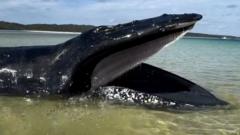
When a young girl stumbled upon a massive marine mammal stranded on an Australian coastline, the immediate public reaction followed a familiar, sentimental script. Social media feeds flooded with awe, local news outlets praised a heartwarming discovery, and the incident was filed away as a rare encounter with the wild. That initial wonder misses the grueling reality of what happens when massive cetaceans meet the shallow surf. Behind every viral image of a stranded creature lies a complex, high-stakes emergency involving marine biologists, heavy machinery, veterinary science, and hundreds of ordinary citizens standing chest-deep in freezing water.
Strandings are not isolated anomalies. They are stark indicators of environmental shifts, navigational errors, and biological distress. Understanding why these magnificent animals end up on dry land requires looking past the surface-level emotion of a single rescue operation.
The Anatomy of a Mass Stranding Event
To comprehend the scale of a beaching, one must first look at the physiological constraints of marine life. Whales are adapted for the immense, buoyant support of the open ocean. When a creature weighing several tons rests entirely on a sandy shore, its own weight becomes an existential threat. Without water to support their massive frames, large cetaceans experience severe internal trauma.
The primary danger is compressive myopathy. The animal's immense weight restricts blood flow to its muscles. As muscle tissue breaks down, toxins flood the bloodstream, overwhelming the kidneys and leading to rapid organ failure once the animal is re-floated.
Furthermore, whales rely on a thick layer of blubber to regulate body temperature in cold oceans. On a sun-baked beach, that insulation traps heat. The animal quickly overheats, leading to thermal stress and dehydration.
Marine biologists divide strandings into two main categories: single strandings and mass strandings. Single strandings often involve a single animal that is sick, injured, elderly, or disoriented by disease or vessel strikes. Mass strandings, by contrast, involve multiple individuals, frequently of the same species such as pilot whales or sperm whales. These events point to deeper systemic issues.
Navigational Error and Sensory Disruption
Whales navigate vast ocean expanses using sophisticated systems of echolocation and geomagnetism. They tune their internal compasses to the Earth's magnetic field, following invisible geological contours across ocean basins.
When those navigational cues fail, disaster follows.
[Open Ocean Navigation]
       │
       ▼ (Geomagnetic Anomalies / Submarine Canyons)
[Sensory Disorientation]
       │
       ▼ (Gradual Slope / Gentle Bathymetry)
[Shoreline Trapping]
Submarine topography plays a massive role. Coastlines with gently sloping sandy beaches, such as those found in parts of southern Australia and New Zealand, act as acoustic traps. The shallow gradient scatters echolocation clicks, preventing the whale from receiving a clear echo return. The animal perceives the coastline not as a solid barrier, but as open water until it is too late.
Human activity also distorts marine acoustics. Naval sonar, seismic testing for oil and gas exploration, and heavy commercial shipping noise create deafening underwater soundscapes. These intense frequencies can disorient marine mammals, driving them away from deep feeding grounds and directly onto dangerous shores.
The Logistics of Saving a Multi-Ton Patient
When a stranded whale is reported, the clock starts ticking immediately. Every hour the animal spends out of water decreases its chances of survival exponentially.
Rescuers face severe operational hurdles. You cannot simply push a forty-ton animal back into the surf. Doing so without proper equipment can fracture ribs, rupture internal organs, or crush the rescuers caught in the surf zone.
The rescue protocol follows a strict sequence:
- Triage and Assessment: Marine wildlife officers evaluate the animal's respiration rate, skin condition, and level of alertness. Animals suffering from severe internal injuries or advanced disease are often humanely euthanized to prevent prolonged suffering.
- Moisture and Temperature Control: Rescuers immediately cover the animal in wet blankets or burlap sacks. They continuously douse the skin with cool seawater, taking care to keep the blowhole clear. Shade tents are erected to protect the animal from direct solar radiation.
- Excavation and Flotation: As the tide rises, heavy machinery or specialized pontoon systems are brought in. Rescuers dig shallow trenches around the animal's flukes and pectoral fins to allow water to lift the weight gradually.
Specialized rescue pontoons—inflatable slings placed beneath the animal's belly—are towed by marine rescue vessels. These cradles stabilize the whale in the water column, allowing it to regain its equilibrium and reorient its breathing rhythm before swimming away into deeper currents.
The Unspoken Truth About Post-Release Survival
Public narratives usually end the moment a whale swims back into the deep blue. The crowd cheers, the cameras stop rolling, and everyone feels a collective sense of triumph.
The reality for veterinary teams is much more sober.
Data collected by marine mammal rescue networks indicates that a significant percentage of successfully re-floated whales strand again within days. This secondary stranding usually happens because the underlying trigger—whether a parasitic brain infection, heavy metal toxicity, or severe disorientation—was never resolved.
[Initial Beaching] ──> [Successful Rescue] ──> [Underlying Pathology Unresolved] ──> [Secondary Stranding]
Pathogens like Morbillivirus or biotoxins from harmful algal blooms can severely impair a whale's central nervous system. An animal suffering from these conditions lacks the cognitive capacity to navigate effectively, even after human intervention restores it to the sea.
Furthermore, the physical trauma sustained during the stranding process leaves lasting damage. Torn pectoral muscles, skin necrosis from sun exposure, and psychological stress compromise the animal's ability to hunt or keep up with its pod.
Beyond the Spectacle
When a child discovers a stranded giant, it captures our collective imagination because it exposes our intimate proximity to the wild ocean. Yet treating these events as isolated human-interest stories ignores the broader ecological warnings written in the sand.
Every stranded cetanean is a messenger from an increasingly crowded, noisy, and chemically altered ocean. Until we address the systemic pressures driving these animals off course, the sight of massive bodies on our shores will remain an urgent reminder of a marine ecosystem under severe strain. The real work does not begin with the bucket of water thrown onto a sun-dried flank on the beach; it begins miles offshore, in the quiet depths we are slowly rendering unnavigable.