We built them to catch the wind. Tall as cathedrals, their long white blades slicing silently through the upper atmosphere, pulling energy from thin air. For twenty or thirty years, they stand watch over ridgelines and coastal plains. They turn invisible power into electricity that hums through copper wires and lights up kitchen tables miles away.
They look immortal from a distance.
Up close, the illusion fractures. Stand at the base of a decommissioned turbine blade and you realize you are looking at a fossil of the clean energy transition. These structures are not made of easily meltable steel or biodegradable timber. They are built from glass fiber and epoxy resin—materials engineered to withstand gale-force winds, freezing rain, and relentless ultraviolet radiation for decades without flinching.
That chemical stubbornness is a virtue when the blade is spinning. It becomes a nightmare when the turbine reaches retirement age.
For years, the dirty secret of wind energy has been sitting in landfills across the globe. When a turbine blade ages out, cutting it down is only the first step. Because the composite materials refuse to rot, snap, or melt down easily, most end up buried in trenches, entombed in earth like fiberglass dinosaurs. We traded smokestacks for subterranean graveyards. We congratulated ourselves on zero emissions while burying thousands of tons of indestructible plastic polymer underground.
Enter a different kind of ambition in Sweden.
Imagine walking into a workshop where the air smells faintly of resin and pine. On the workbench lies a curved cross-section of a retired turbine blade. It is thick, heavy, layered like geological strata. A team of engineers and designers—let us call one of them Henrik, a man with sawdust in his beard and grease permanently wedged beneath his fingernails—runs a heavy-duty diamond saw through the fiberglass curve.
Screeech.
Sparks fly. The blade yields. What comes out of that cut is not waste. It is raw material.
The core idea is deceptively simple. If a material is strong enough to survive twenty years of violent atmospheric battering, it is strong enough to bear the weight of a roof, the stress of a downhill ski slope, or the load-bearing walls of a micro-dwelling.
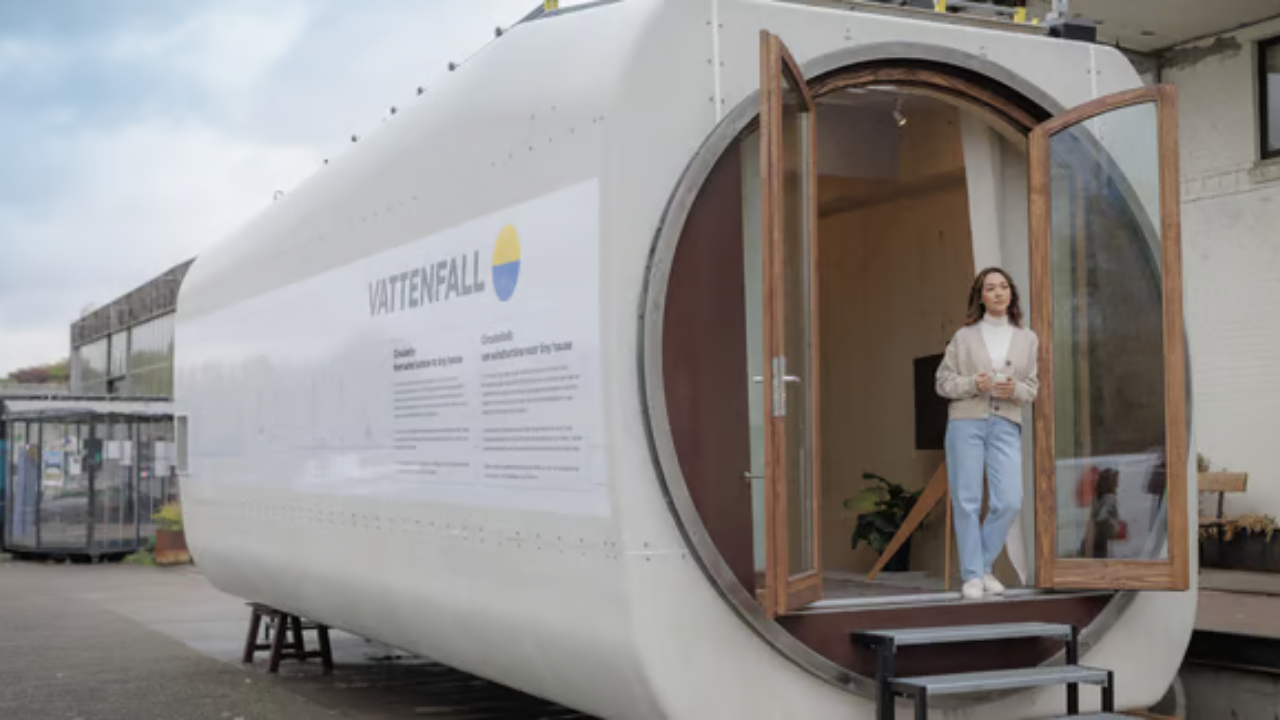
Consider the tiny home project born from this discarded infrastructure. These are not flimsy novelty shacks built for Instagram algorithms. They are sturdy, compact living units engineered from curved turbine sections that naturally form aerodynamic, weather-resistant roofs and curved structural shells. By repurposing the hollow cylindrical and aerodynamic shapes of the blades, builders bypass the carbon-heavy processes of framing, pouring concrete foundations, and manufacturing siding from scratch.
Solar panels gleam on top of the recycled curved roof. Inside, the space is warm, efficient, and surprisingly intimate. Sunlight filters through a small window carved neatly into what was once the aerodynamic tip of a giant machine.
Down the road in a different facility, another slice of that same blade undergoes a transformation of a completely different sort. Skis.
Winter sports enthusiasts understand the sacred bond between equipment and terrain. We buy high-performance gear designed to flex, absorb shock, and track smoothly through powder. Skis carved from recycled wind turbine composites inherit the exact mechanical properties that engineers designed for aerospace-grade stress management. They are impossibly light, torsionally rigid, and indestructible. When you point those skis down a steep alpine slope, you are literally skiing on the ghost of an energy generator that once powered thousands of homes.
The physics of this transformation deserve a closer look. Composite materials are notoriously difficult to recycle because the glass fibers and the polymer matrix are chemically locked together. Traditional recycling meant shredding them into low-value filler dust for cheap plastics, or burning them in cement kilns to recover a fraction of their energy while releasing toxic fumes.
Swedish innovators bypassed the chemical separation problem entirely by practicing upcycling through structural preservation. Instead of trying to un-glue the molecules, they keep the macro-structure intact. They let the original curvature do the heavy lifting. A curved piece of turbine blade becomes a curved wall, a roof arch, or the camber of a ski. The engineering has already been done by wind tunnel technicians years ago. Human ingenuity simply redirects the vector.
This philosophy changes how we look at industrial obsolescence.
We live in a culture of disposability disguised as progress. When a machine breaks, we discard it. When a building ages, we demolish it. We treat our industrial output as a linear line stretching from factory floor to landfill pit. But the wind turbine problem forces us into a circular reality. We are running out of space to hide our trash, and the atmosphere can no longer stomach the carbon cost of manufacturing everything fresh.
When Henrik holds up a finished pair of skis, buffed to a high-gloss matte finish with the faint, fibrous texture of the original composite visible just beneath the wax, he is not just selling sports equipment. He is demonstrating a mindset.
The transition to a sustainable economy will not be won solely by inventing cleaner ways to generate electricity. It will be won by redesigning our relationship with the heavy materials we leave behind. The wind giants that built our renewable future are now aging. How we handle their retirement will determine whether our green revolution is truly circular or merely delayed.
Outside the workshop, the wind picks up. Another massive blade spins into the gray northern sky, humming with invisible power, entirely unaware of its eventual second life.