The sound of a whistle cutting through the thick valley air doesn't usually signal freedom. For months, sometimes years, a whistle meant something entirely different. It meant roll call. It meant handcuffs clicking into place. It meant the heavy, metallic thud of a cell door sliding shut in a detention center run by Immigration and Customs Enforcement.
But on a sun-baked Saturday afternoon in California, the whistle just means kickoff.
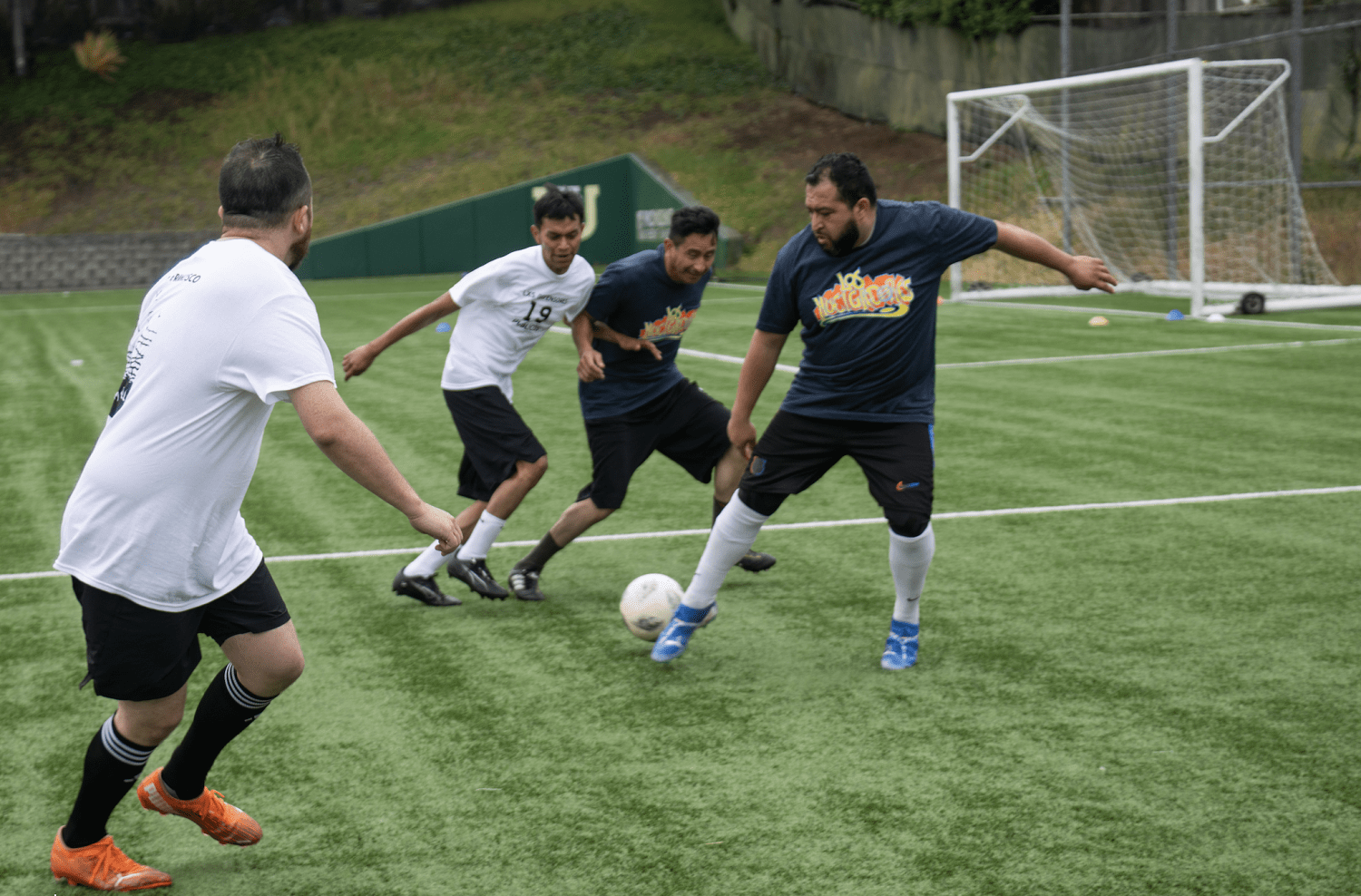
Dust rises from the dry grass as a scuffed leather ball is sent flying across the pitch. A forward gives chase, his lungs burning, his eyes locked on the white net ahead. For ninety minutes, the weight that has been pressing down on his chest since he crossed the border disappears. The anxiety doesn't vanish entirely, but it is outrun.
This is not just a weekend league. It is a quiet, radical act of reclamation.
Across California, grass-roots soccer tournaments are becoming unexpected sanctuaries for individuals who have survived the grueling ordeal of immigration detention. These fields offer something that courtrooms, paperwork, and ankle monitors never can: a place to exist without explanation.
The Phantom Cell
To understand why a simple game of soccer matters so much, you have to understand what happens to a human being inside detention.
It is a common misconception that freedom begins the moment someone walks out of the facility gates. The reality is far heavier. The trauma of confinement doesn't stay behind the razor wire. It follows you home. It sits on your chest while you try to sleep. It makes every sudden knock at the front door feel like a raid.
Psychologists call it institutionalization, but survivors describe it as a phantom cell.
Consider a hypothetical young man named Mateo. He spent eight months inside a privately run facility in the California desert. Inside, his days were dictated by fluorescent lights, bad food, and the constant, low-humming dread of deportation. When he was finally released on bond, his family celebrated. They cooked his favorite meals. They embraced him.
But Mateo was still trapped.
He found himself pacing the perimeter of his living room, exactly twenty paces across, the same length as the recreation yard. He stopped speaking. The world outside felt too loud, too fast, and profoundly unsafe. His body was free, but his nervous system was still wearing a jumpsuit.
Trauma locks itself into the physical body. When you are constantly told where to stand, when to eat, and how to move, you lose ownership of your own physical self. The mind detaches from the muscles as a survival mechanism.
That is where the game comes in.
The Geography of Healing
You cannot pace a twenty-foot circle when you are trying to beat a defender to the ball.
On the pitch, the geography changes completely. The boundaries are wide open. The sky is overhead, unblemished by chain-link fences. To play soccer is to demand that your body perform, react, and explode with energy. It forces a person back into the present moment.
When Mateo was dragged to a local tournament by a cousin, he didn't want to play. He sat on the sidelines, watching the chaotic, beautiful blur of jerseys. But then a team found themselves short a man. Someone tossed him a pair of borrowed cleats.
He laced them up. He stepped onto the grass.
"Pass it!" someone screamed in Spanish.
The ball rolled toward him. In that split second, Mateo didn't think about his upcoming immigration court date. He didn't think about the ICE check-ins. He didn't think about the guard who used to mock his accent. His brain simply calculated the speed of the ball, the position of his teammate, and the angle of his foot.
He kicked it.
The connection was clean. The ball soared across the midfield line, finding its target perfectly. A cheer went up from the sidelines. In that single, fleeting moment, Mateo wasn't a case number. He wasn't a statistic in a political debate. He was a midfielder.
He was human again.
Community on the Touchline
These tournaments are built from nothing but passion and necessity. They are organized by local community groups, churches, and mutual aid networks who recognize that formal therapy isn't always accessible or culturally resonant for everyone.
Traditional mental health care can feel clinical, expensive, and intimidating, especially for undocumented folks or those carrying the stigma of detention. Sitting in a room and talking about your deepest fears to a stranger with a clipboard can feel uncomfortably similar to an interrogation.
But a soccer field requires no confessions.
The sidelines function as a informal network of survival. Between matches, while players drink water and slice oranges, information flows freely.
Someone knows a lawyer who takes pro bono asylum cases. Someone else knows a construction crew looking for workers who pay a fair wage. Another person offers a ride to the next check-in appointment at the federal building. It is a self-assembling ecosystem of mutual support, disguised as a sports league.
The statistics surrounding immigration detention in America are staggering. Tens of thousands of people are held on any given day, costing taxpayers billions of dollars while extracting an incalculable human toll. But numbers are cold. They numb the mind. They hide the faces of the fathers, daughters, and brothers who are waiting in limbo.
On the field, the scale shrinks back down to something manageable. The macro-crisis of global migration simplifies into a micro-moment of joy.
The Beautiful Game's Real Power
There is a reason soccer is called the beautiful game, and it isn't just because of the spectacular goals or the tactical brilliance of elite professionals. It is because the game belongs to the people who have nothing else. It requires no expensive equipment. You need a ball, some space, and a few people who agree on the rules.
For immigrants who have been stripped of their identity by a bureaucratic machine, the game is a portable homeland. The rules are exactly the same in California as they are in Michoacán, San Salvador, or Tegucigalpa. The pitch is a familiar territory in a strange, often hostile new world.
When you run hard enough that your lungs ache, when you sweat through your shirt, when you collide with another player and pull each other back up with a grin, something shifts inside the brain. The fight-or-flight response that kept you alive during detention finally begins to shut down. The body learns that it can be tired without being in danger.
It is a slow process. One tournament doesn't cure PTSD. A single goal doesn't fix a broken immigration system or guarantee legal status. The threat of deportation still looms over the weekend like a storm cloud just past the horizon.
But for those few hours, the cloud doesn't drop any rain.
The sun begins to dip below the California hills, casting long, dramatic shadows across the worn turf. The final whistle blows, sounding three short blasts. The players gather at the center circle, shaking hands, slapping shoulders, their faces flushed and covered in sweat.
Mateo walks off the field, his legs heavy, his breath coming in deep, steady rhythms. He sits on the cooler, unlacing his borrowed cleats. His fingers are dirty. His shins are bruised. He looks down at his hands, then out at the empty field where the dust is finally settling back into the earth. For the first time in a very long time, he isn't looking over his shoulder. He is just breathing.