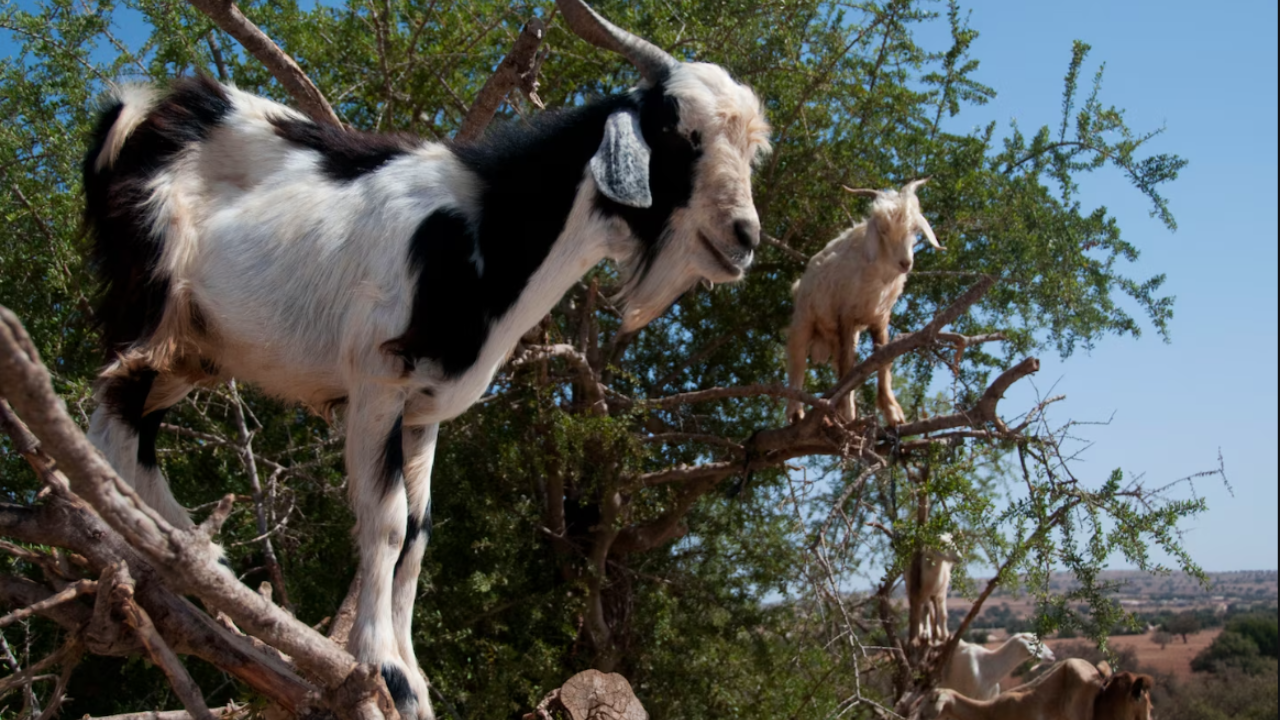
The afternoon sun in the Souss Valley does not just shine. It heavy-presses against the earth like a hot iron. Dust settles into the deep lines of Brahim’s face, tracing the geography of a life spent walking alongside a herd of ninety goats. To a stranger, the scene looks like a hallucination born of heatstroke. A gnarled, thorny tree stands alone in the arid dirt, and balanced perfectly on its highest, spindly branches are a dozen cloven-hoofed animals. They look like strange, feathered birds from a distance, silhouetted against the blinding North African sky.
They are balanced on branches thin enough to snap under a human hand. They are chewing.
For decades, travel magazines treated this as a quirky roadside spectacle. A postcard trope. Tourists pull over their air-conditioned vans, snap photos of the "tree goats," toss a few dirhams to a herder, and drive away thinking they just witnessed a bizarre evolutionary parlor trick. But look closer at Brahim’s eyes. He is not smiling at a gimmick. He is watching a delicate, ancient engine of survival at work. If these goats stop climbing, the desert wins.
The tree beneath them is the Argan (Argania spinosa), a prehistoric survivor that stands as the final green wall between the fertile valleys of Morocco and the choking, relentless advance of the Sahara Desert. The relationship between the herder, the beast, and the tree is not just a curious bit of natural history. It is a masterclass in ecological architecture, one that scientists are only recently beginning to fully comprehend.
To understand why a goat would risk a ten-foot plunge onto hard packed clay for a snack, you have to understand the Argan fruit. Imagine a cross between an olive and a small plum, wrapped in a thick, bitter peel that protects a layer of sweet, irresistible pulp. Inside that pulp lies a nut so fierce, so thick-walled, that a human needs a heavy stone and a lifetime of practiced precision just to crack it open.
During the searing drought of the summer months, the ground offers nothing but dust and withered thorns. The goats look up. Up there, suspended in the canopy, is moisture. Energy. Life.
For centuries, the conventional wisdom among locals and early naturalists was simple. The goats ate the fruit, digested the pulp, passed the incredibly hard nuts through their digestive tracts, and excreted them onto the forest floor. Local cooperatives would then collect these washed nuts from the dung, crack them open, and roast the kernels to produce Argan oil—the liquid gold that fuels the local economy and populates high-end cosmetic shelves worldwide.
It was a tidy story. It was also wrong.
A few years ago, a team of Spanish ecologists noticed something that disrupted this long-held narrative. They looked at the sheer size of an Argan nut. It is massive, roughly the size of a large almond or a small walnut. Anyone who has ever owned livestock knows that passing an object of that volume through a goat’s complex, four-chambered stomach is not just difficult; it is biologically hazardous.
The researchers began tracking the animals closely, observing them not just from the roadside, but during the quiet hours of rumination. They discovered a hidden mechanism. The goats were not pooping out the seeds. They were spitting them.
Goats are ruminants. They swallow their food quickly, store it in the rumen, and later bring it back up to chew it again as cud. The scientists realized that while the goats easily digested the sweet, fleshy pulp of the Argan fruit, the massive, rigid nuts were too cumbersome to slide through the rest of the digestive tract. During the cud-chewing process, the animals would meticulously separate the hard nuts from the softened pulp and spit them out, pristine and undamaged.
This distinction matters. It changes everything.
When an animal ingests a seed and passes it through its entire digestive system, the harsh stomach acids often scarify the seed coat. While this helps some plant species germinate, the intense environment of a goat’s gut can frequently kill the delicate embryo inside a larger seed. By regurgitating the nuts instead, the goats act as a highly efficient, non-destructive seed dispersal mechanism. They fly into the canopy, harvest the fruit from branches that no human or heavy mammal could ever reach, and drop the seeds gently onto the earth, perfectly primed for the winter rains.
Brahim watches a young kid, barely a year old, test its weight on a branch no thicker than a broomstick. The animal shifts its center of mass, its unique, rectangular-pupil eyes locked on a cluster of yellowing fruit at the very tip of the bough. The goat’s hooves are marvels of biological engineering. They are not rigid blocks of bone; they are soft, rubbery pads wrapped in a hard, gripping outer shell. They can spread wide to catch the contours of rough bark, functioning like a rock climber’s specialized shoes.
But this ancient symbiosis is facing an unprecedented modern strain.
The global demand for Argan oil has skyrocketed. What was once a hyper-local resource managed by indigenous Amazigh women has become a multi-million-dollar international commodity. A single liter of cosmetic-grade Argan oil can fetch hundreds of dollars in Western markets. This economic boom brought much-needed infrastructure, schooling, and independence to women in rural Moroccan villages. It also changed the incentives for herders.
More money from oil means more pressure on the forest. In some areas, herds have grown too large. When too many goats occupy a single grove, they do not just harvest the fruit; they strip the bark, trample the saplings, and destroy the very trees that keep the desert at bay.
Worse still is the tourism trap. Some enterprising individuals discovered they could make faster, easier money by forcing goats into trees along heavily trafficked tourist routes, keeping them stranded on branches for hours in the midday heat just to collect tips from passing tour buses. It is a perversion of a natural survival strategy, turning an ecological dance into a cruel circus.
The solution is not to ban the goats from the trees. Without the herders and their livestock, the Argan forests lose their primary distributors. The seeds would simply fall beneath the mother tree, suffocating in the shade, unable to compete for precious water and sunlight. The ecosystem requires the movement, the wandering footsteps of the herd to stretch the boundaries of the forest.
True conservation here requires balance. Local cooperatives and forward-thinking herders are now establishing seasonal bans, keeping the goats out of the forests during the late spring when the trees are flowering and the young fruit is setting. This allows the trees to heal, the branches to grow, and the ecosystem to breathe. Once the harvest season ends, the gates are opened, and the gravity defiers return to the skies.
The sun begins its slow drop toward the Atlantic horizon, turning the dust in the air into an amber mist. Brahim gives a sharp, guttural whistle. It is a sound his family has used for generations, a vocal frequency the herd knows intimately.
One by one, the goats begin their descent. They do not scramble or panic. They drop cleanly from branch to branch with a fluid, casual grace that defies their clumsy reputation. As they hit the dirt, a few of them pause, their jaws moving in a rhythmic, side-to-side grind.
A small, dark object drops from the mouth of a lead doe, thudding softly into the dry soil. It is a single Argan nut, stripped clean of its pulp, heavy with the promise of a tree that might stand here a century from now, long after Brahim and his herd have passed into memory.