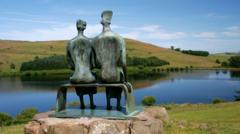
The sale of a massive 12,000-acre slice of the Scottish Highlands for £26 million is not just a high-end property transaction. It is a symptom of a feverish new economy where carbon is the new gold and the soil of the North is being treated like a financial derivative. While the public sees a picturesque stretch of heather and glen, institutional investors see a massive carbon sink capable of washing away the environmental sins of heavy industry. This isn't about conservation in the traditional sense. It is about a structural shift in land ownership that is pricing out local communities and turning the Highlands into a giant balance sheet for multinational corporations.
The estate in question—a sprawling expanse that has defined the local geography for centuries—was snatched up in a deal that highlights the aggressive rise of "green lairdism." In decades past, these estates were bought by wealthy individuals looking for a private sporting retreat to hunt deer or fish for salmon. Today, the buyers are more likely to be pension funds, insurance giants, or "natural capital" investment firms. They are betting that the ability to plant trees and restore peatlands will generate carbon credits so valuable that the £26 million price tag will eventually look like a bargain.
The Mechanics of the Natural Capital Gold Rush
To understand why a piece of remote wilderness commands such a staggering price, you have to look past the scenery and into the world of ESG (Environmental, Social, and Governance) mandates. Companies under pressure to hit "Net Zero" targets have two choices. They can radically overhaul their internal operations, which is expensive and slow, or they can buy land that absorbs carbon and claim the offset. Scotland, with its vast peatlands and suitability for afforestation, has become the premier destination for this strategy.
The math is relatively straightforward but the implications are messy. Peatlands, when healthy, are among the most efficient carbon stores on the planet. However, centuries of drainage and overgrazing have left much of Scotland's peat in a degraded state, actually leaking carbon into the atmosphere. An investor who buys this land and "restores" it by blocking drainage ditches can claim the difference in carbon emissions. These claims are then converted into credits. On a 12,000-acre estate, the potential for credit generation is enormous, especially as the price of carbon on the global market continues to climb.
This creates a perverse incentive. The more degraded the land is at the point of purchase, the more "improvement" an investor can claim. We are seeing a market where ecological failure is a prerequisite for financial gain. The £26 million paid for this estate reflects the anticipated future value of these credits, essentially turning the Scottish landscape into a factory for atmospheric scrubbing.
The Human Cost of Abstract Ownership
The problem with treating land as a financial instrument is that it ignores the people who actually live there. For generations, the Highland population has struggled with a lack of housing and economic opportunity. Now, they are facing a new wave of displacement driven by environmentalism. When an investment firm buys an estate for carbon credits, they rarely need a local workforce to manage it. A few contractors might be brought in to plant saplings or dig ditches, but the long-term, year-round employment associated with traditional estate management often evaporates.
Furthermore, the surge in land prices makes it impossible for local farmers or community trusts to compete. When a property is valued based on the global price of carbon rather than its agricultural or residential worth, the locals are effectively locked out of their own backyard. This is the irony of the modern green movement in Scotland. The push to save the planet is, in many cases, destroying the social fabric of the Highlands.
Community buyouts, once seen as the future of Scottish land reform, are now hitting a wall. How does a small village raise £26 million to buy the hill behind their houses when a hedge fund can wire the money in an afternoon? The Scottish Government has talked a big game about land reform, but the reality on the ground is that the market is moving much faster than the legislation.
The Illusion of Reforestation
There is a visual component to this transition that often masks the underlying complexity. When people hear about "rewilding" or "reforesting," they imagine a return to the ancient Caledonian Forest. The reality is often far more industrial. Investors looking for a quick return on carbon credits often favor Sitka spruce—a non-native, fast-growing conifer that creates "green deserts." These plantations are biologically poor, blocking out sunlight and acidified the soil, but they pack on biomass quickly.
If the goal is purely carbon sequestration, a dense block of spruce is an efficient tool. If the goal is biodiversity and ecological health, it is a disaster. The current subsidy and credit systems don't always distinguish between the two. An investor can get paid to plant a monoculture that does very little for the local golden eagle population but looks great on a spreadsheet in London or Frankfurt.
The Regulatory Void
The most alarming aspect of the £26 million sale is the lack of oversight. Scotland has some of the most concentrated land ownership in the developed world, a legacy of the Highland Clearances. Rather than diversifying this ownership, the carbon credit boom is consolidating it further. Currently, there are few restrictions on who can buy these estates or what they must do with them once they own the titles.
We are watching a massive transfer of national assets into private, often offshore, hands. The "public benefit" of these carbon projects is frequently cited, but rarely quantified in a way that helps the local economy. The money generated from the sale of carbon credits usually leaves the area entirely, flowing back to shareholders while the local village sees its school roll shrink and its last pub close.
There is also the question of "additionality." In the world of carbon offsets, additionality means that the carbon savings would not have happened without the specific investment. If an estate was already sequestering carbon, or if the government would have eventually stepped in to restore the peatland anyway, the credits are effectively a sham. Yet, the verification process is opaque and largely self-regulated by the industry itself.
A Precarious Financial Bubble
History is littered with examples of Highland land bubbles. From the sheep craze of the 19th century to the sporting estate boom of the late 20th, the land has always been subject to the whims of outside capital. The current "green" boom feels different because of its scale and its link to global climate policy, but it is no less volatile.
What happens if the global standards for carbon accounting change? If a new treaty suddenly decides that peatland restoration doesn't count toward corporate mandates, the "value" of these £26 million estates could crater overnight. The investors will cut their losses and move on, leaving behind a landscape that has been fenced off, drained, and replanted in ways that may not be reversible.
The Scottish landscape is being used as a giant laboratory for a new form of capitalism that values the air above the ground more than the people on it. This isn't just a property story. It's a warning about what happens when the fight against climate change is handed over to the highest bidder without a compass or a cage.
The £26 million price tag isn't a victory for the environment. It is the cost of entry for a game that the Scottish people aren't being invited to play. We are witnessing the commodification of the horizon, and once the hills are sold, they don't easily come back.
Go look at the Land Register of Scotland and see who actually owns the mountains you hike on.