Russia cannot build a durable peace in the Persian Gulf because its own strategy relies entirely on the instability it claims it wants to fix. Vladimir Safronkov, the Russian Foreign Ministry envoy for the Middle East, recently declared that the Kremlin's longstanding proposal for a collective security architecture remains active on the table, framing it as the only viable alternative to western containment policies. This diplomatic push follows massive regional escalation, including Iranian drone strikes on Omani infrastructure and a highly volatile direct conflict between Washington, Jerusalem, and Tehran that completely shattered old containment models. By offering a diplomatic framework that explicitly promises an indivisible security matrix, Moscow is positioning itself as a neutral arbiter capable of uniting the Gulf Cooperation Council states and Iran under a single strategic umbrella.
The entire initiative is built on a fundamental structural contradiction. Moscow is pretending to be an objective mediator while operating as a critical strategic partner to Tehran, formalizing their relationship through a Comprehensive Strategic Partnership Treaty that includes significant military technology transfers. The Arab Gulf monarchies have spent years building integrated air and missile defense systems explicitly to intercept Iranian payloads. They are not going to rely on a Russian-led diplomatic architecture that protects the very actor launching missiles at their oil infrastructure. Moscow does not actually expect this security concept to become operational reality. The diplomatic maneuver is a calculated geopolitical distraction designed to erode American influence, expand Russian arms sales, and force regional capitals to treat the Kremlin as a primary power broker.
The Structural Fraud of Indivisible Security
The core mechanism of Russia's proposal relies on what the Kremlin calls the principle of common and indivisible security. This framework demands that no state in the region should strengthen its own security at the expense of another. On paper, it sounds like standard diplomatic boilerplate aimed at establishing hotlines, joint counterterrorism centers, and mutual non-aggression pacts. In practice, it is designed to achieve a very specific and highly disruptive outcome.
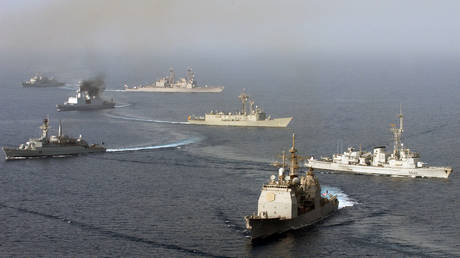
The real objective is the systemic dismantling of the Western security footprint in the region. Russia's official documentation explicitly calls for a balanced reduction of foreign armed forces and the elimination of international military bases. For Saudi Arabia, Bahrain, Qatar, and the United Arab Emirates, this demand is completely untenable. These nations rely directly on bilateral security pacts with Washington and the physical presence of the US Fifth Fleet to guarantee the free flow of energy through the Strait of Hormuz.
Moscow is asking the Arab states to trade a functional, hardware-backed American defense commitment for a paper guarantee signed by a country that is actively supplying their primary adversary with advanced military hardware. The strategic math does not add up. The Gulf capitals view the proposal not as a blueprint for peace, but as a mechanism to expose them to regional intimidation.
The Multi Billion Dollar Balance Sheet
Moscow's regional engagement is split into two completely separate, mutually exclusive silos. One side is driven by security; the other is driven by cash. This split creates a permanent structural friction that makes long-term diplomatic alignment with both sides of the Gulf impossible.
| Regional Blocs | Primary Russian Interactivity | Key Strategic Intersections |
|---|---|---|
| Iran | High-level military partnership | Advanced weapon trade, electronic warfare, drone tech development |
| Gulf Cooperation Council | High-value commercial investment | OPEC plus oil production tracking, sovereign wealth diversification, real estate |
The economic tier is focused heavily on the Arab monarchies. Trade turnover between Russia and the UAE surged past 12 billion dollars, turning Dubai into a crucial operational hub for Russian capital diversification. Parallel to this, the Russian Direct Investment Fund maintains active joint ventures with Saudi Arabia, while a dedicated investment platform with Qatar is explicitly designed to bypass traditional Western financial channels.
The military tier belongs entirely to Tehran. The Comprehensive Strategic Partnership Treaty signed by Moscow and Iran solidified a massive defense-industrial pipeline. Russian forces depend heavily on Iranian drone manufacturing capabilities, while Tehran demands advanced Russian air defense hardware and electronic warfare systems to protect its domestic military facilities.
This creates an irreconcilable conflict of interest. The exact same Russian defense technology exported to Iran is used to upgrade a military apparatus that routinely targets the critical infrastructure of Russia's top economic partners in Riyadh and Abu Dhabi. Moscow is trying to cash checks from the victims while providing technological upgrades to the aggressor.
Why the Regional Defense Realities Reject Moscow
The Gulf monarchies have entirely evolved beyond the need for vague, multilateral diplomatic forums that rely on broad consensus. The kinetic reality of modern regional warfare has forced these states to invest heavily in physical, integrated military hardware rather than diplomatic empty promises.
[Threat Profile: Iranian Missile and Drone Infrastructure]
                        │
                        ▼
[Gulf Reality: Integrated Air and Missile Defense Systems]
                        │
                        ▼
[Strategic Imperative: US Hardware and Intelligence Integration]
This defense reality leaves no functional role for Russia. When drone swarms and ballistic missiles hit regional shipping routes and coastal facilities, the response is managed through high-speed radar data tracking, automated interceptors, and real-time intelligence feeds tied directly into American systems. Moscow cannot participate in this defense framework without compromising its strategic relationship with Tehran.
The Kremlin's diplomatic proposals frequently highlight the necessity of joint environmental protection programs, regional tourism initiatives, and maritime safety centers. These suggestions are intentionally superficial. They are designed to create a false sense of diplomatic momentum while ignoring the hard, unresolved issues of missile proliferation and regional proxy networks. The Gulf leadership recognizes that a security architecture that refuses to address offensive missile capabilities is functionally useless.
The Mediator Maneuver as an End in Itself
The Russian leadership understands that a comprehensive, region-wide security treaty will never be signed. They are completely comfortable with that outcome because the actual pursuit of the initiative delivers all the strategic utility they require.
By constantly introducing revised versions of their collective security concept at the United Nations Security Council, the Kremlin forces international diplomats to debate on Russian terms. This strategy successfully challenges the traditional American monopoly on regional crisis management. It allows Russian state media and diplomats to present Moscow as a constructive, peace-seeking global actor, effectively distracting from its highly disruptive foreign policy objectives elsewhere.
The initiative also functions as an exceptionally effective diplomatic marketing campaign for Russian defense products. Each round of security consultations gives Russian state enterprises a direct venue to pitch air defense systems, radar installations, and security software to Gulf buyers under the guise of building regional confidence-building measures. It is a cynical loop. Moscow uses the threat of regional instability to market defensive weapons to the Gulf, while using the revenue to sustain its wider strategic operations.
The current diplomatic push is a sophisticated display of geopolitical theater. It offers an elegant, highly structured solution to a complex regional conflict, but it requires the target audience to intentionally blind themselves to Moscow's primary strategic partnerships. The Arab Gulf monarchies have spent decades navigating brutal regional realities, and they understand that paper treaties cannot intercept incoming hardware. Moscow will continue to pitch its grand security architecture at every available international forum, not because it can actually build peace, but because the process of selling the illusion pays massive strategic dividends.