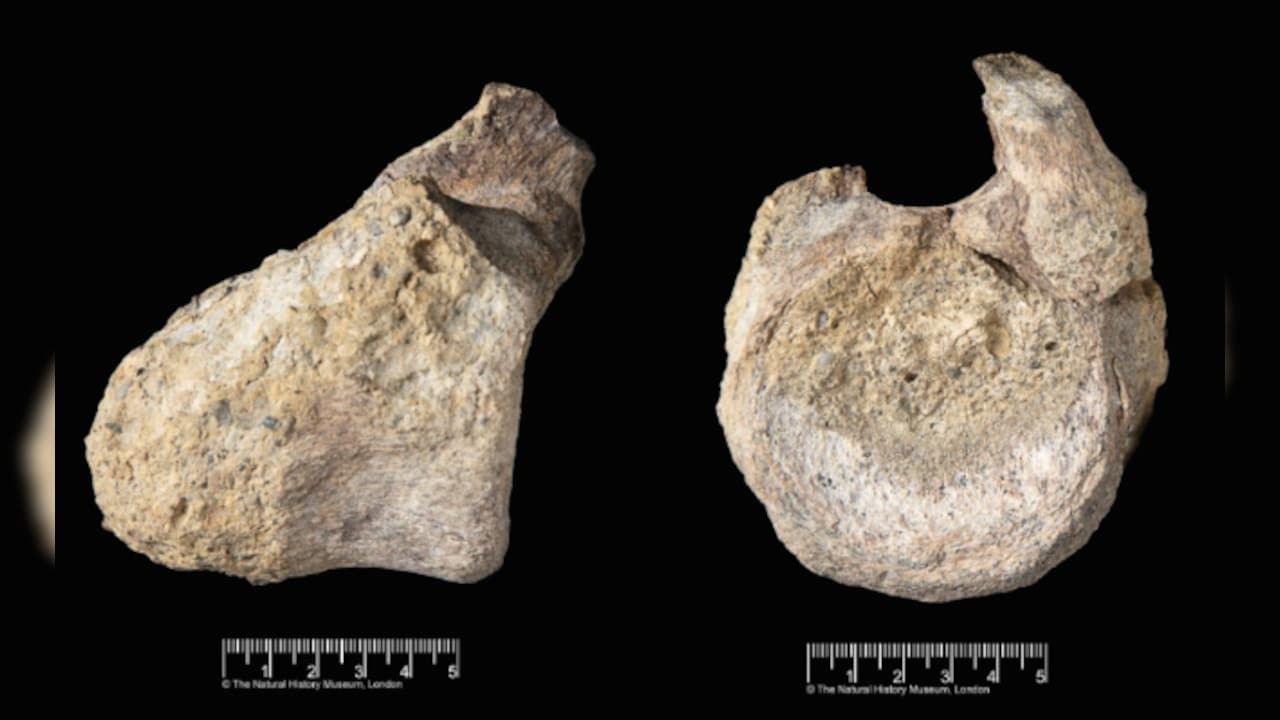
The ice of James Ross Island does not care about human ambition. In December 1985, a biting polar wind whipped across the frozen landscape as geologist Mike Thomson bent down against the cold. He was mapping rock layers for the British Antarctic Survey, scanning the stark ground for clues of an ancient, submerged world. His eyes caught a dark shape embedded in the rock—a heavy, ten-centimeter piece of petrified bone.
Thomson was an expert in marine geology, accustomed to finding the remains of ancient sea monsters like plesiosaurs and mosasaurs that once ruled prehistoric oceans. He pulled out his field notebook, wrote a brief description, and sketched the find. His entry read simply: vertebra of large reptile.
He packed the bone into a wooden crate. It went on a ship, crossed the equator, and eventually arrived at a storage facility in Cambridge. There, it was slid into a metal cabinet drawer.
The drawer closed. The lights went out. The specimen spent nearly forty years forgotten in the dark, labeled as an ordinary ocean-dwelling creature.
But science has a way of leaving loose ends. The true identity of that bone, unlocked decades later, completely rewrites our understanding of how life moved across the prehistoric globe.
The Mirage of the Frozen Continent
When we look at Antarctica today, we see an icy wasteland. It feels alien, empty, and sterile. This makes it incredibly easy to misinterpret what we find there. When Thomson picked up that bone in 1985, his working assumption was entirely logical. The rock formation was marine in origin. Therefore, the bone must belong to a sea reptile.
This logic went unchallenged for decades due to a mundane reality of scientific institutions: the backlog. Museum archives are often overwhelmed by thousands of specimens awaiting specialized analysis. The bone was placed in the queue. Decades passed. Thomson retired, and in 2020, he passed away, never knowing the true nature of the fossil he had pulled from the ice.
Consider what happened next. Five years ago, a paleontologist named Mark Evans was appointed as the curator of the collection. He began a systematic review of the drawers, item by item. When he opened the specific cabinet containing Thomson’s 1985 find, he stopped.
To an untrained eye, the bone looks like a rough, gray stone. To a dinosaur specialist, it was loud. Marine reptiles have relatively flat vertebrae, designed for the fluid, undulating movements of swimming through water. This bone was different. It featured a distinct hollow cup on one end and a rounded, protruding bump on the other.
It was a ball-and-socket joint.
This anatomical structure is a signature engineering marvel of the land. It belongs to a titanosaur—a member of the sauropod family, the massive, long-necked, plant-eating giants that were the largest land animals to ever walk the Earth.
Evans immediately contacted Paul Barrett, a dinosaur expert at the Natural History Museum in London. Barrett looked at the unique combination of the ball-and-joint articulation and the proportions of the bone. The diagnosis was undeniable. This was not a sea monster. It was a dinosaur tail bone.
A Postmortem Journey across 80 Million Years
The realization that a land giant was found in a marine rock formation sounds like a contradiction. It forces us to piece together a tragic, ancient story.
Imagine an ecosystem entirely different from the frozen desert of today. Eighty million years ago, during the Late Cretaceous period, Antarctica was covered in lush, dense forests. It was warm, green, and hospitable. The titanosaur that owned this specific tail bone was relatively small for its kind—roughly seven meters long, about the size of a couple of cars parked bumper-to-bumper. It was likely a juvenile, navigating the forested pathways of the polar peninsula.
We do not know how the young dinosaur died. What we do know is what happened to its body. After it perished, a river or a heavy flood carried its carcass away from the shore and out into the open ocean.
The body floated for days, buoyant with decomposition gases, acting as a prehistoric hitchhiker drifting farther into the sea. Eventually, the tissues ruptured. The skeleton collapsed, sinking down through the dark water into the deep seafloor mud. It settled alongside ammonites and marine shells, waiting millions of years for the continents to shift, the ice to freeze, and a shivering geologist to stumble across its final resting place.
The Land Bridge at the Bottom of the World
The identification of this single tail bone, published in the journal Acta Palaeontologica Polonica, is much more than a correction of an old museum catalog. It resolves a massive, frustrating puzzle about how dinosaurs populated the earth.
For a long time, the fossil record of the Southern Hemisphere was deeply uneven. South America is teeming with titanosaur fossils; their massive skeletons practically fall out of the hillsides in Patagonia. Meanwhile, Australia has yielded almost none, and New Zealand has only a few fragmentary hints.
Paleontologists struggled to understand how these animals distributed themselves before the supercontinent of Gondwana tore itself apart. The discovery of this bone provides the missing link.
It proves that the Antarctic Peninsula was not an isolated island; it was a vital, lush land bridge. These massive herbivores literally marched across Antarctica, using it as a terrestrial highway to travel from South America toward New Zealand, skipping the Australian landmass entirely.
The first dinosaur bone ever collected from Antarctica was sitting right under our noses, tucked between old field notebooks in a quiet British university town. It required forty years of patience, a shift in technology that allows us to peer deep inside fossilized cell structures, and a curious curator willing to ask a simple question about a forgotten drawer.
The bone has finally been given its proper name. It stands as a profound reminder that the most revolutionary discoveries do not always require a multi-million-dollar expedition to the ends of the earth. Sometimes, they just require us to open the drawers we have already filled, look past our assumptions, and listen to what the quietest stones are trying to tell us.