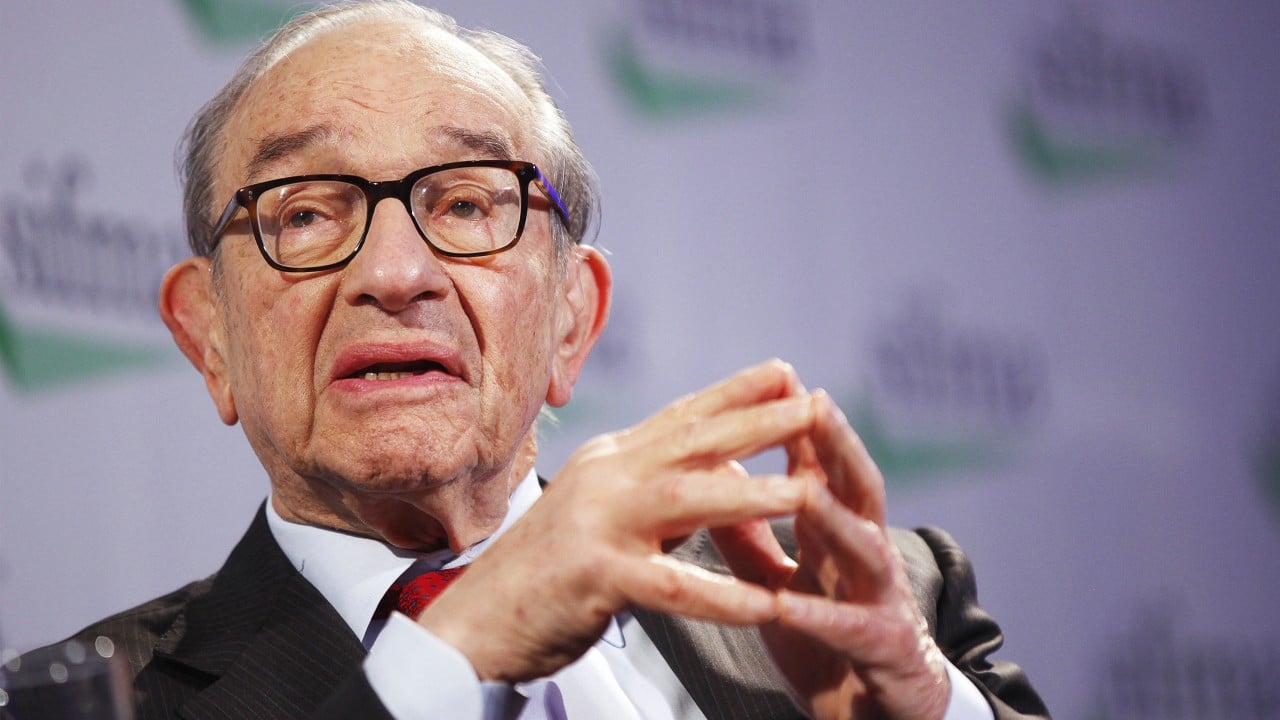
The death of Alan Greenspan at age 100 marks the conclusion of an era that defined the modern mechanics of central banking. Serving as Chairman of the Federal Reserve from August 11, 1987, to January 31, 2006, Greenspan engineered a fundamental shift in monetary policy execution. He replaced the reactive, rigid targeting frameworks of his predecessors with a highly discretionary, data-driven system of preemptive interventions. This approach generated the 1990s expansion—the longest recorded economic expansion in United States history up to that point—yet left behind an asymmetric intervention policy that restructured the global financial system's pricing of risk.
To evaluate Greenspan's 18.5-year tenure requires isolating the three structural pillars of his policy framework: preemptive inflation targeting, the creation of asymmetric liquidity guarantees, and a foundational reliance on financial institution self-regulation.
The Structural Pillars of Greenspan's Monetary Framework
[Economic Disruption] ---> [Asymmetric Liquidity Provision (The Greenspan Put)]
                                      |
                                      v
                        [Suppressed Risk Premiums]
                                      |
                                      v
                        [Accelerated Asset Inflation]
1. Preemptive Inflation Targeting and the Neutral Rate Strategy
Greenspan altered the Federal Open Market Committee (FOMC) playbook by decoupling interest rate adjustments from realized inflation. His predecessor, Paul Volcker, broke the stagflation of the late 1970s through reactive, aggressive increases to the federal funds rate after consumer prices spiked. Greenspan shifted the policy variable to inflation expectations and structural productivity shifts.
The clearest application of this preemptive strategy occurred during the tightening cycle of 1994–1995. Recognizing that unemployment was falling rapidly toward levels traditionally associated with accelerating inflation under the non-accelerating inflation rate of unemployment (NAIRU) framework, Greenspan doubled the federal funds rate from 3.0% to 6.0% within twelve months. Crucially, he executed these hikes before standard metrics like the Consumer Price Index (CPI) recorded significant upward movement. The strategy successfully neutralized inflationary pressures without triggering a contraction, establishing the precedent that the central bank should operate based on predictive modeling rather than lagging economic indicators.
2. Asymmetric Liquidity Provision: The Genesis of the Put
The secondary pillar of the Greenspan era was the systematic deployment of liquidity injections to insulate capital markets from systemic shocks. This mechanism, later formalized by market participants as the "Greenspan Put," functioned as an unwritten insurance policy for asset valuations.
The causal chain of the Greenspan Put operated through a distinct structural loop:
- Systemic Shock Event: A sharp drop in equity markets or a sudden freeze in credit markets threatened broader economic transmission.
- Aggressive Intervention: The Fed aggressively lowered the federal funds rate and expanded its balance sheet via open market operations to flood the banking sector with reserves.
- Asymmetric Reassurance: The central bank consistently intervened during market downturns but rarely tightened policy purely to curb asset bubbles.
- Altered Risk Calculus: Market participants recognized that the downside risk was capped by the central bank, which systematically compressed the equity risk premium.
This mechanism was first deployed during the Black Monday stock market crash on October 19, 1987, when the Dow Jones Industrial Average dropped 22.6%. Within 24 hours, Greenspan issued a brief statement affirming the Fed's readiness to "serve as a source of liquidity to support the economic and financial system." The subsequent reduction in the federal funds rate stabilized Wall Street clearing banks and prevented a broader solvency crisis.
The identical template was deployed during the 1997 Asian financial crisis, the 1998 collapse of Long-Term Capital Management (LTCM), the Y2K transition, and the aftermath of the September 11, 2001, attacks. By repeatedly lowering interest rates to cushion asset markets, the policy altered the behavioral economics of Wall Street. It introduced moral hazard directly into the credit allocation mechanism: financial institutions retained 100% of the upside during expansions, while the Federal Reserve socialized the tail risk during contractions.
3. The Self-Regulation Fallacy and the Regulatory Void
Greenspan’s operational philosophy was rooted in free-market ideology, influenced significantly by his early association with novelist and philosopher Ayn Rand. He operated on the premise that commercial banks and investment houses possessed a powerful, rational self-interest to protect their own capital base. This self-preservation instinct, he argued, was far more efficient at monitoring counterparty credit risk than any government regulatory apparatus.
Guided by this hypothesis, Greenspan consistently opposed the expansion of regulatory oversight into emerging financial markets:
- Over-the-Counter (OTC) Derivatives: In the late 1990s, Greenspan, along with Treasury officials, actively blocked attempts by Commodity Futures Trading Commission (CFTC) Chair Brooksley Born to regulate OTC derivatives, including credit default swaps (CDS). This policy culminated in the passage of the Commodity Futures Modernization Act of 2000, which explicitly shielded these instruments from federal oversight.
- Shadow Banking Expansion: The regulatory exemption allowed for the unmonitored growth of the shadow banking system—a network of non-bank financial intermediaries that engaged in maturity transformation (borrowing short-term to invest long-term) without the capital requirements or liquidity backstops of traditional commercial banks.
- Subprime Mortgage Markets: As structural changes in mortgage lending accelerated in the early 2000s, Greenspan resisted calls to use the Fed's authority under the Home Ownership and Equity Protection Act (HOEPA) to crack down on predatory, non-traditional subprime lending practices. He maintained that financial innovation, including the securitization of subprime loans into residential mortgage-backed securities (RMBS) and collateralized debt obligations (CDOs), was successfully dispersing risk across the global financial system rather than concentrating it.
The Cost Function of Over-Extended Easy Money
Following the bursting of the dot-com bubble in 2000 and the 2001 recession, the Fed cut the federal funds rate to a then-historic low of 1.0% in June 2003, maintaining it there for a full year. This prolonged period of ultra-low nominal interest rates created a severe macroeconomic distortion. Because inflation was running near 2.0%, the real federal funds rate (the nominal rate minus inflation) dropped into negative territory.
$$\text{Real Interest Rate} = \text{Nominal Interest Rate} - \text{Inflation}$$
This negative real interest rate environment served as the primary catalyst for the subprime housing boom. It severely compressed yields on traditional low-risk assets like U.S. Treasuries, forcing global institutional investors—pension funds, insurance companies, and sovereign wealth funds—to "search for yield." This massive capital pool shifted toward structured credit products that offered higher returns.
Wall Street met this demand by accelerating the creation of RMBS and CDOs. Because traditional mortgage lending standards were exhausted, lenders lowered underwriting requirements to generate the raw material required for these financial products, giving rise to no-documentation and adjustable-rate mortgages (ARMs).
The Fed attempt to normalize policy was too slow to break this momentum. Beginning in June 2004, the FOMC raised interest rates in measured, predictable increments of 25 basis points per meeting, eventually reaching 5.25% in 2006. However, this highly broadcasted trajectory allowed financial markets to easily price in and bypass the tightening. Furthermore, Greenspan observed a structural anomaly he termed the "conundrum": despite the Fed raising short-term interest rates, long-term bond yields remained stubbornly low. This was driven by a global savings glut, particularly from emerging Asian economies and oil-exporting nations, which flooded U.S. capital markets and kept long-term mortgage rates low, blunting the Fed's attempts to cool the housing market.
The Post-Crisis Paradigm and Structural Flaws
The ultimate test of the Greenspan framework occurred two years after his retirement, when the U.S. housing market collapsed, triggering the global financial crisis of 2007–2008. The highly complex securitized products that Greenspan believed had diversified risk instead acted as transmission lines for systemic contagion. Because these derivatives were opaque and traded over-the-counter, the sudden rise in subprime mortgage defaults triggered a total freeze in interbank lending, as no institution could verify the solvency of its counterparties.
In October 2008, appearing before the House Committee on Oversight and Government Reform, Greenspan delivered his most significant intellectual capitulation. He testified that he was in a state of "shocked disbelief" regarding the breakdown of the financial system, admitting that his ideological framework had a major flaw:
"I made a mistake in presuming that the self-interests of organizations, specifically banks and others, were such that they were best capable of protecting their own shareholders and their equity in the firms."
This admission exposed the core vulnerability of the Greenspan method: the systemic failure to account for how micro-prudential rational self-interest can aggregate into catastrophic macro-prudential instability.
Strategic Asset Allocation Under Asymmetric Policy Regimes
For corporate treasurers, portfolio managers, and chief financial officers, the legacy of the Greenspan era is not merely historical; it establishes the structural baseline for contemporary market behavior. The "Greenspan Put" evolved under Ben Bernanke, Janet Yellen, and Jerome Powell into quantitative easing (QE) and explicit emergency lending facilities, hardcoding central bank intervention into corporate capital structures.
To optimize asset allocation and risk management under this continuous policy regime, institutions must deploy explicit structural adaptations:
- Asymmetric Risk Structuring: Since central bank policy continuously short-options tail risk in equity markets during crises, long-term investment strategies should structurally favor asset classes that benefit from liquidity expansions. Corporate capital allocations must prioritize high-margin, scalable business models that can absorb rapid monetary inflation.
- Counterparty Credit Architecture: The collapse of the self-regulation hypothesis means corporate treasurers cannot rely on standard credit ratings or the perceived institutional pedigree of financial partners. Risk frameworks must enforce real-time, quantitative tracking of counterparty liquidity metrics, specifically clearing spreads and credit default swap pricing, independent of regulatory capital ratios.
- Duration Sensitivity Management: The long-term consequence of the Greenspan era's low-rate regime is a structurally permanent vulnerability to sudden inflationary shocks. Capital expenditure models must be stress-tested against volatile discount rates, using dynamic hedging strategies to protect long-duration projects from sudden capital shifts.
The modern financial architecture remains a direct product of the Greenspan mechanism. It is a system characterized by high transactional efficiency and prolonged periods of low volatility, but one that contains structural fragility due to the persistent suppression of market-driven risk premiums. Strategy requires operating with the explicit understanding that central bank intervention is a structural variable, and that liquidity is a policy choice rather than a market constant.