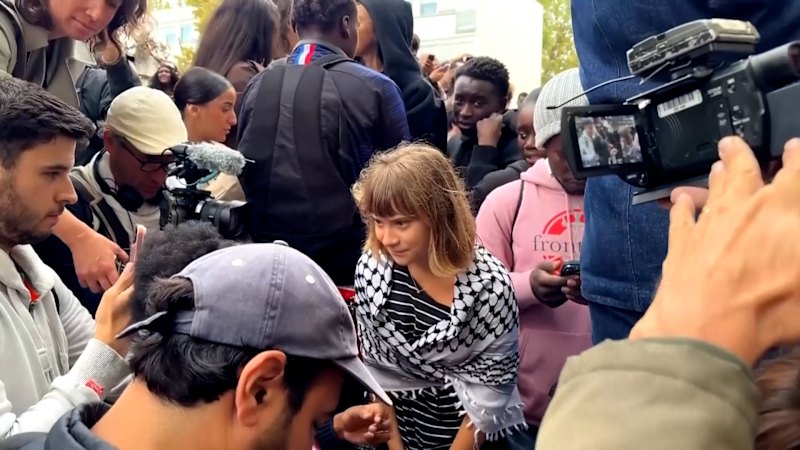
A banner drops in Paris. Cameras flash. A Swedish activist stands shoulder-to-shoulder with French students demanding urgent climate action.
Every standard recap writes the same story. It treats the alliance as an automatic boost for green policy. Moral clarity meets youthful energy. What could possibly go wrong?
Plenty.
When coverage frames Greta Thunberg supporting Parisian students as a pure triumph of movement building, it misses the hardest friction points in European politics. Street theater in Paris does not operate in a vacuum. It collides with French industrial history, grid physics, tax fatigue, and institutional gridlock.
I have watched advocacy campaigns burn millions of dollars and months of momentum because strategists confused media applause with policy leverage. A headline looks great in an international feed. On the ground in France, the same image can harden opposition before a single regulation is drafted.
The Lazy Consensus Around Street Solidarity
Conventional reporting assumes that high-profile solidarity scales linearly. One famous voice joins local students, crowds swell near Place de la République or the Panthéon, and pressure mounts on ministers.
That model is lazy. It treats protest volume as proof of political persuasion.
In France, public demonstrations are a staple of civic life, not a rare shock to the system. When marches become routine, politicians price them in as background noise rather than an existential threat. Worse, when outside icons step into domestic debates, opponents quickly reframe a local youth push as imported moralizing.
Attention Is Not Distribution
Visibility is cheap. Durable coalition power is expensive.
A high-profile visit guarantees cameras. It does not build neighborhood chapters in post-industrial towns where commuting costs and heating bills dominate every kitchen-table conversation. Without local roots, a rally peaks on broadcast news and fades by Monday morning.
Consider the gap between two kinds of political pressure:
- Spectacle pressure: High-decibel marches, viral clips, and sharp moral slogans aimed at national and international media.
- Institutional pressure: Detailed technical proposals, municipal alliances, union negotiations, and legislative amendments that survive committee scrutiny.
Spectacle gets quoted. Institutional work changes statutes. Mistaking the first for the second is how movements win applause and lose votes.
Why France Is Not a Blank Canvas
To understand why Greta Thunberg supporting Parisian students carries real strategic risk, you have to look at how France actually generates electricity and taxes carbon.
Much of mainstream climate commentary treats every wealthy European nation as if it runs on coal and gas like Germany or parts of Eastern Europe. France does not. Thanks to decades of state-backed nuclear investment, France has historically maintained one of the lowest carbon intensities per kilowatt-hour among major economies.
When protest slogans attack broad industrial systems without distinguishing between fossil fuels and low-carbon baseload power, credibility suffers among engineers and centrist policymakers. Nuclear energy is a polarizing topic in France, not a settled consensus. Treating all heavy infrastructure as a villain alienates people who care deeply about emissions but rely on stable grid power and skilled industrial jobs.
The Carbon Tax Hangover
French politics carries a scar that foreign activists rarely weigh properly: the Yellow Vest revolt sparked by fuel tax increases.
When climate messaging sounds detached from household cost of living, backlash arrives fast. Students in central Paris often have dense transit options, university housing, and fewer immediate car-dependency pressures than workers living in outer suburbs or rural departments. If a campaign frames urgency purely around moral blame rather than practical affordability, critics paint it as out-of-touch urban activism.
That framing is brutal to fight once it sticks. Fair or not, perception shapes electoral math.
Redefining the Real Question
Most coverage asks a narrow question: Does Greta Thunberg supporting Parisian students energize young protesters?
Usually, yes. That is the wrong question.
The real question is: Does this alliance expand the governing coalition needed to pass enforceable climate rules without triggering a populist backlash?
Energy transitions succeed or fail on execution. They require permitting reform, grid transmission upgrades, building retrofits, industrial decarbonization, and political durability across election cycles. None of those happen through moral condemnation alone.
Dismantling Common "People Also Ask" Assumptions
- "Do student protests force governments to cut emissions faster?" Sometimes they put climate on the agenda, which matters. Yet emissions fall when concrete rules change investments, prices, and infrastructure—not when slogans get louder. Agenda-setting without implementation leaves carbon budgets intact.
- "Does a global activist make local students more influential?" It brings international spotlights and helps activists network across borders. At the same time, it can hand domestic rivals an easy narrative about outside influence, narrowing appeal among swing voters.
- "Is moral urgency enough to overcome political gridlock?" No. Politics is a tug-of-war over costs, jobs, rights, and timelines. Moral urgency can start a fight; only clear trade-offs and broad coalitions finish one.
Where the Nuance Lives
Calling out the limits of street solidarity does not mean students have nothing to offer. Quite the opposite.
Young people bear the longest horizon of climate risk. Their willingness to challenge complacent institutions is vital. When student organizers pair urgency with technical literacy—studying grid bottlenecks, municipal procurement, housing insulation, and local transit gaps—they become formidable.
Thought experiment: Imagine a scenario where Parisian students pair a visible demonstration with a line-by-line audit of their own city's public building energy waste and transit delays, backed by local engineers and union apprentices. Instead of asking ministers to "do more" in the abstract, they hand over costed fixes and demand specific deadlines. Suddenly, dismissal gets much harder.
That is the shift from noise to leverage.
The Downsides of Playing Contrarian
Before anyone treats restraint as a cure-all, I will own the downsides of this contrarian view.
First, pragmatic incrementalism can look timid when climate targets slip. If movements tone down every sharp edge to stay polite, urgency can drain out of the room entirely. History shows that uncomfortable pressure sometimes forces leaders to move sooner than comfort alone would allow.
Second, over-indexing on political palatability can lead to endless compromise that waters down rules until they stop cutting emissions. A law that pleases everyone and changes nothing is a waste of time.
Third, I am an analyst looking at incentives, friction points, and coalition dynamics—not a protester standing in the rain. It is easy to critique tactics from a desk. Executing strategy under media scrutiny and state pressure is much harder.
What Actually Works Next
If students and climate advocates want Greta Thunberg supporting Parisian students to leave a mark beyond a single news cycle, they need discipline over drama.
- Name exact targets, not vague villains. Tie every demand to a specific bill, municipal budget, utility rule, or regulatory deadline. Vague calls for "system change" let officials nod along and change nothing.
- Build cross-class alliances before marching. Talk to commuters, small-business owners, mechanics, and local workers first. Show how cleaner transit, lower heating waste, and industrial investment protect wallets and jobs.
- Bring receipts on feasibility. Pair moral pressure with realistic timelines and cost awareness. Policymakers ignore demands that ignore physics and budgets; they struggle to brush off proposals backed by hard numbers.
- Measure legislative outcomes, not crowd size. Track committee votes, budget allocations, and permitting reforms months after the cameras leave. Crowds disperse; statutes stay on the books.
Cameras move on to the next story by tomorrow morning; laws are written by the people who stay after the crowd goes home.