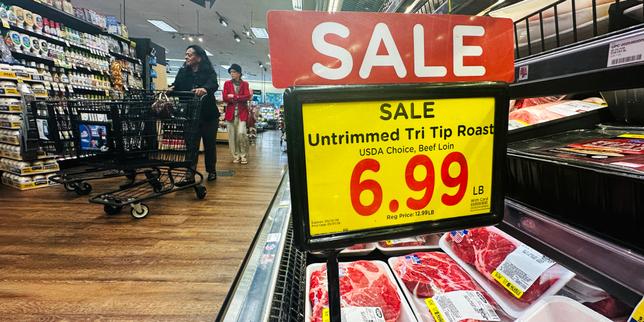
The neon humming of the supermarket aisle has a way of stripping away political theater. Watch the hands of the person ahead of you in line. They pick up a carton of eggs. They look at the printed price tracking code. They hesitate. The fingers tighten slightly, a silent calculation running through their head like a glitching spreadsheet, before the carton is placed back on the shelf.
This is the quiet choreography of modern anxiety. It is played out millions of times a day across the United States.
For over two years, the emotional baseline of the American consumer has been dictating by a relentless, creeping invisible tax. Just when the global supply chains seemed to steady after years of pandemic-induced whiplash, the geopolitical chessboard shattered again. The escalation of conflict in the Middle East did not just dominate cable news networks; it traveled silently through underground pipelines, shipping lanes, and corporate algorithms, landing squarely on the sticker prices of local grocery stores and gas stations.
Then, a voice from a gilded stage cuts through the anxiety with an unexpected confession.
"I love inflation."
The words belonged to Donald Trump, speaking to a crowd of donors and supporters as the latest economic indexes showed consumer prices ticking upward once again. To the family stretching a paycheck to cover a tank of gas, the statement sounds like a cruel paradox. How could anyone love the slow erosion of purchasing power? But in the arena of modern political warfare, economic pain is a potent currency. The hotter the fire burns under the average voter's wallet, the faster the incumbent leadership's prospects turn to ash.
To understand how a macroeconomic metric became a weapon of high-stakes persuasion, we have to look past the campaign podiums and look at how global chaos bleeds into daily survival.
The Invisible Pipeline from the Strait to the Checkout Line
Consider a hypothetical logistics manager named Marcus. He does not work in politics. He monitors freight container routes from an office in New Jersey. When a drone strike hits a commercial vessel thousands of miles away in the Red Sea, Marcus does not just see a headline. He sees a digital map turn red. Ships are forced to bypass the Suez Canal entirely, charting a massive, costly detour around the Cape of Good Hope.
That detour adds ten to fourteen days of travel time. It burns hundreds of thousands of gallons of marine fuel. It triggers a cascade of insurance premium hikes that would make an actuary weep.
Marcus's company imports components for everything from medical equipment to basic household appliances. When his shipping costs double overnight, his company faces a stark, binary choice: absorb the loss and risk bankruptcy, or pass the bill down the line. They always pass the bill.
This is how a geopolitical conflict halfway across the world transforms into a more expensive pair of shoes, a costlier gallon of milk, or a higher interest rate on a car loan. It is a slow-motion car crash where the impact is felt months after the initial collision.
The federal data backing this up is stark. When energy markets twitch due to instability in oil-producing regions, the ripple effect is immediate. Diesel fuel prices climb. Because every single item in your house arrived there on the back of a diesel-burning truck, the cost of distribution rises uniformly. Inflation is not a localized storm; it is an atmospheric shift.
The Calculus of Chaos
When Donald Trump declared his affection for inflation, he was not praising the economic hardship of his base. He was acknowledging a brutal, historical reality of American elections: voters vote their pockets, not their foreign policy ideals.
Historically, when the Consumer Price Index rises, confidence in the sitting administration plummets. It is an almost mechanical relationship. The average citizen may not know the intricate details of Federal Reserve policy or the nuances of quantitative easing. They do know that a hundred dollars buys significantly fewer groceries than it did four years ago.
By leaning into the crisis, the former president flipped the script of traditional political empathy. Instead of merely offering condolences for high prices, he framed the inflation spike as an inevitable consequence of current leadership—a self-inflicted wound born of weakness on the global stage. The chaos in the Middle East became a proxy argument for domestic mismanagement.
The strategy relies on a simple, powerful human instinct: the need to assign blame. When a bill is high, we want a target for our anger. A complex web of global supply chains, maritime law, and energy speculation is too abstract to hate. A political opponent, however, is concrete.
But this rhetorical maneuver carries immense risk. For the voter watching their savings account dwindle, treating inflation as a political win can taste like ash. It highlights the vast, echoing distance between the people who discuss the economy from television studios and those who live it at the kitchen table.
The Human Ledger
We often talk about inflation in percentages. Three percent. Four percent. Eight percent. These numbers are comforting to economists because they turn human struggle into clean, manageable data points.
But the real math of inflation is written in sacrifices.
It is the parent deciding which child gets new sneakers this semester and which one wears the hand-me-downs with the thinning soles. It is the retiree skipping a dose of medication to ensure the heating bill gets paid during a cold snap. It is the small business owner, running on razor-thin margins, staring at a ledger at midnight, wondering if they have to lay off a loyal employee of ten years just to keep the lights on.
These are not statistics. They are heartbeats.
The danger of the current political discourse is that it treats these lived experiences as mere ammunition for the next news cycle. When inflation becomes a talking point to be cheered or weaponized, the actual human beings bearing the weight of the burden are obscured by the smoke of the battlefield.
The conflict abroad shows no signs of an easy resolution. The shipping lanes remain perilous. The energy markets continue to fluctuate with every breaking news alert. As long as those fundamentals remain unstable, the pressure on the American consumer will persist.
The next time you stand in a checkout line, look around. The tension in the air is not just about money. It is about a loss of control. In an unpredictable world, we long for stability, yet we find ourselves at the mercy of forces far beyond our horizon. The politicians will continue to argue, to claim credit, and to weaponize the pain of the ledger.
But the ledger doesn't care about speeches. It just keeps demanding to be paid.


