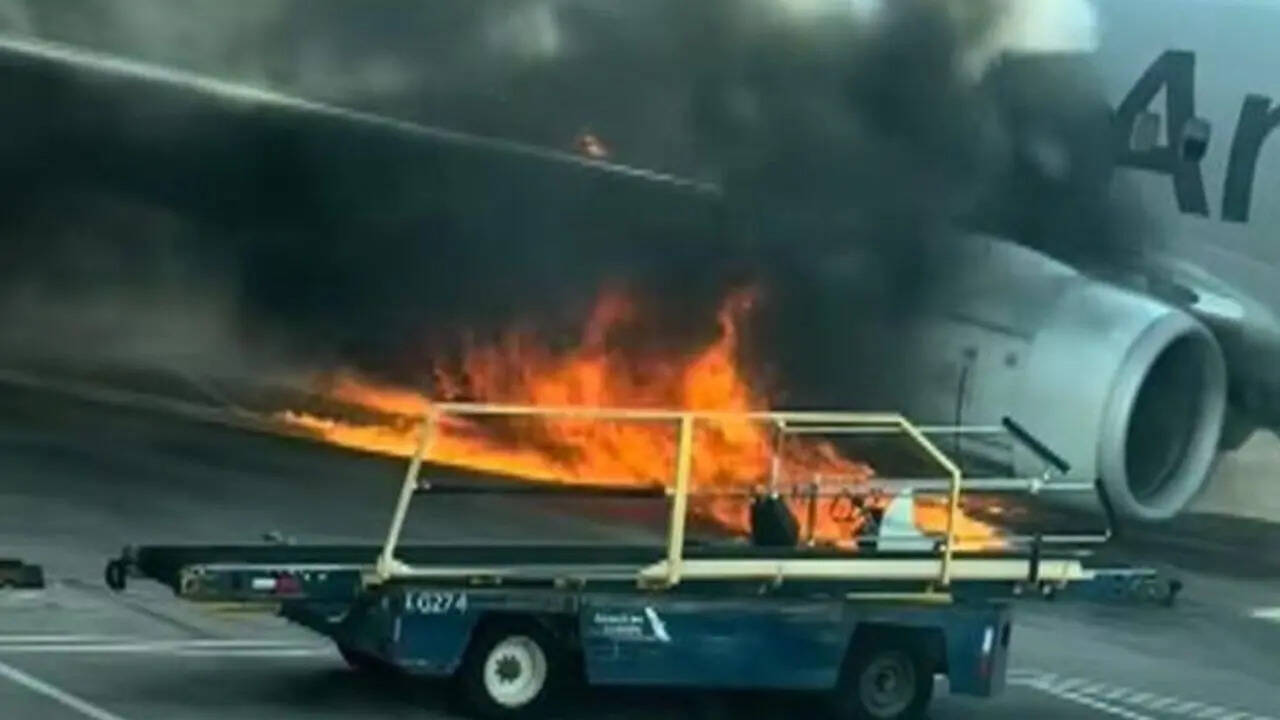
A Boeing 777 carrying 231 passengers was accelerating down a darkened runway when the unthinkable happened. A person, standing where no human should ever be, was struck by the massive aircraft. The impact was instantaneous, but the consequences rippled through the airframe immediately. Seconds after the collision, the right-side engine erupted in a geyser of flame, forcing the flight crew to abort takeoff and initiate an emergency evacuation. While the headlines focus on the gruesome nature of the accident, the real story lies in the systemic breakdown of airport security and the physics of "foreign object debris" that turns a high-performance jet engine into a self-destructing bomb.
Airports are designed to be the most controlled environments on earth. Multiple layers of fencing, motion sensors, and patrols are meant to ensure that the "sterile" side of the terminal remains exactly that. When a pedestrian—often referred to in incident reports as a "jaywalker" or unauthorized person—manages to breach these defenses, the result is rarely a simple trespass. On a runway, it is a catastrophic failure of infrastructure.
The Anatomy of a High Speed Impact
When an aircraft is at V1—the speed beyond which a takeoff cannot be safely aborted—every square inch of the runway must be clear. At these speeds, hitting a human body is not like a car accident. The kinetic energy involved is staggering. The landing gear of a 777 is built to withstand the force of a 200-ton machine hitting the pavement at 150 miles per hour, but it is not designed to process the uneven, high-mass obstruction of a person without consequence.
The initial strike usually damages the nose gear or the main landing gear struts. However, the secondary effect is often more dangerous. Debris from the impact, or the body itself, can be sucked into the intake of the massive turbofan engines. These engines, like the General Electric GE90 or the Pratt & Whitney PW4000, are marvels of engineering, but they are essentially giant vacuum cleaners. They pull in massive volumes of air to generate thrust. When they pull in something solid, the results are explosive.
Compressor stalls and blade failures occur in milliseconds. The fan blades, made of titanium or advanced composites, are spinning at thousands of revolutions per minute. If a blade hits a high-density object, it can snap or deform. This creates an imbalance that shakes the entire engine housing. If the debris moves further back into the "hot section" of the engine, it disrupts the carefully managed airflow, causing the fuel to ignite outside of the combustion chamber. This is the "fire" witnesses see trailing behind the wing. It is a terrifying sight for passengers, but for the pilots, it is a race against time to stop a fuel-laden tube before it runs out of tarmac.
The Security Gap That Nobody Wants to Discuss
The industry likes to talk about "perimeter integrity." It sounds professional and handled. The reality is far more porous. Most major international airports cover thousands of acres, much of it bordering wooded areas, highways, or industrial zones. While the areas around the gates are heavily guarded, the "back 40" of a large airfield is often protected by little more than chain-link segments and the occasional security camera.
We have spent billions on TSA checkpoints and cockpit doors, yet the most basic element of aviation safety—keeping the runway clear—remains a vulnerability. Investigators will look at the specific point of entry for this incident, but the broader trend shows an increase in perimeter breaches by those suffering from mental health crises, individuals attempting to "stow away" in wheel wells, or people simply lost in the fog of a night-time trespass.
Each breach represents a failure of the Safety Management System (SMS) that every airline and airport is required to maintain. If a person can walk onto a live runway at a major hub, the "layers of Swiss cheese" have aligned in a way that suggests the security culture has become reactive rather than proactive.
Why Engines Fail After a Strike
Modern jet engines are tested for bird strikes. They can ingest a four-pound goose and keep running, or at least shut down without exploding. But a human being is not a four-pound goose. The mass is significantly higher, and the density of bone and clothing creates a different profile of destruction.
- Blade Out Event: The centrifugal force of a spinning fan is so high that a broken blade can carry the energy of a hand grenade. The engine "cowling" or outer shell is designed to contain this, but the internal damage is total.
- Thermal Runaway: Once the airflow is disrupted, the internal temperatures of the engine, which already exceed the melting point of the metal components, spike uncontrollably.
- Fuel Line Rupture: The vibration from an imbalanced engine can crack fuel or hydraulic lines, providing a constant source of accelerant for the fire.
The pilots in this incident had to manage a "rejected takeoff" (RTO) under the worst possible conditions. An RTO at high speed puts immense strain on the brakes. To stop 300,000 pounds of metal and fuel, the carbon-fiber brake discs must glow red-hot, often reaching temperatures over 1,000 degrees. If the fire from the engine spreads to the wings or the leaking fuel hits those brakes, a survivable ground incident can turn into a mass casualty event in minutes.
The Passenger Experience vs. The Technical Reality
For the 231 flyers on board, the experience was likely a series of violent jolts followed by the orange glow of flames outside their windows. The psychological trauma of such an event is often overlooked in the technical analysis. In the cabin, the "brace" command is not a suggestion; it is the only way to prevent blunt force trauma during a high-speed emergency stop.
Panic is the enemy of a successful evacuation. When the plane finally stops, the flight attendants have 90 seconds to get everyone out. This is a global certification standard. However, that 90-second rule assumes passengers aren't stopping to grab their carry-on luggage. In every recent emergency evacuation, we see footage of people dragging suitcases down the inflatable slides. This is more than an annoyance; it is a lethal behavior. A single bag snagging on a slide or blocking an aisle can cost dozens of lives.
In this specific case, the fire was contained to the engine and the immediate wing area, but the risk of "hull loss"—the total destruction of the aircraft—was high. The fact that all 231 passengers survived the stop and the exit is a testament to the airframe's design, but it does not excuse the security lapse that put them in danger.
The Financial and Regulatory Fallout
An incident like this isn't just a news story; it’s a multi-million dollar disaster for the carrier. A Boeing 777 engine can cost upwards of $30 million. If the fire damaged the wing spar, the entire aircraft might be written off. Then there are the lawsuits.
Insurance companies and the Federal Aviation Administration (FAA) will now scrutinize the airport’s Airport Improvement Program (AIP) funding. If it is discovered that security upgrades were delayed or ignored, the airport authority could face massive fines and a loss of federal backing.
We must also look at the "Ground Radar" or ASDE-X systems. These systems are designed to track every vehicle and aircraft on the ground to prevent collisions. If the system didn't trigger an alert for a pedestrian, there is a technical gap in how we detect non-metallic or small-scale targets on the runway.
The Hard Truth About Airport Boundaries
We treat runways as sacred ground in the air, but on the ground, they are often just the edge of a field. If we are to prevent the next engine fire and the next loss of life, the industry must move beyond "good enough" fencing. We are talking about the integration of AI-driven thermal imaging and acoustic sensors that can tell the difference between a deer and a human from a mile away.
Until we treat the perimeter with the same intensity we treat the cockpit door, these "jaywalking" incidents will continue to occur. Every time an unauthorized person steps onto a runway, they are essentially handing a loaded gun to the flight crew. This time, the pilots managed to keep the plane on the ground and the passengers alive. Next time, the engine might fail 50 feet in the air, where there is no more runway left to land on.
The investigation will take months. The black boxes will be analyzed, the security tapes will be reviewed frame by frame, and the victim will be identified. But for the 231 people who walked away from that burning wing, the only thing that matters is that a system failed them at the exact moment they were most vulnerable.
Aviation safety is a game of inches and seconds. When a human body meets a jet engine, the physics are unforgiving. The industry must stop treating perimeter breaches as minor trespassing and start seeing them for what they are: a direct threat to the structural integrity of the aircraft and the lives of everyone on board. Check the fences. Calibrate the radar. Ground the sensors. The cost of a new fence is nothing compared to the cost of a 777 in flames.