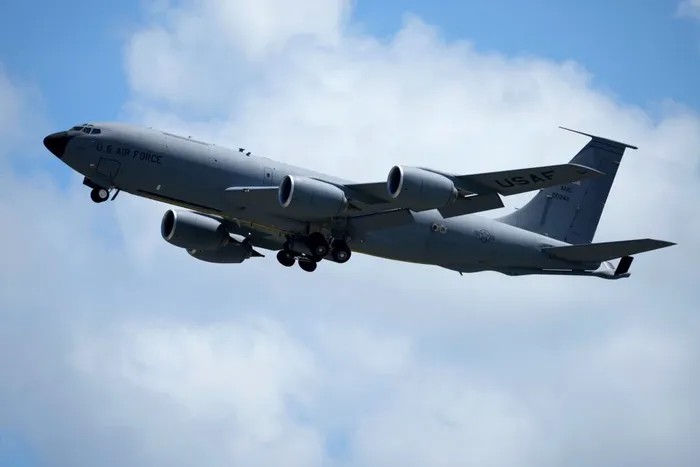
The Pentagon has released the names of the six airmen killed when their refueling aircraft went down in western Iraq, a grim reminder of the persistent dangers inherent in global reach operations. While the Department of Defense initially pointed to a technical failure during a routine repositioning flight, the incident pulls back the curtain on a much larger, systemic crisis within the United States Air Force’s aging tanker inventory. These aircraft are the invisible backbone of every strike mission, yet they are being flown well past their intended lifespans in high-stress environments.
The fallen service members were part of a specialized unit tasked with keeping the skies crowded with American steel. Without these flying gas stations, the reach of the U.S. military shrinks from global to regional. The crash occurred near Al-Anbar province, a region that has seen a resurgence of logistical demand as tensions fluctuate across the Middle East. Initial reports suggest the crew was attempting an emergency landing following a catastrophic loss of hydraulic pressure, a failure mode that has become increasingly common in airframes that first rolled off assembly lines decades ago.
Engineering Limits and the Stress of Modern Sorties
Modern warfare demands more than just advanced fighters; it requires a constant, reliable flow of fuel at 30,000 feet. The aircraft involved in this tragedy was an older variant of the Stratotanker family, a design that has seen more upgrades than almost any other platform in history. Maintaining these machines is no longer a matter of routine service. It is an act of industrial archaeology.
Mechanics often have to fabricate parts from scratch because the original manufacturers went out of business during the Cold War. This creates a precarious maintenance environment. When an aircraft is pushed to fly more hours than its structural designers ever envisioned, metal fatigue becomes a silent killer. Microscopic cracks in the wing spars or fuel lines don't always show up on standard inspections. They wait for a moment of high vibration or heavy load to fail.
The pressure on these crews is immense. Refueling involves maneuvering two massive aircraft within feet of each other while traveling hundreds of miles per hour. There is no room for a mechanical hiccup. If a pump fails or a flight control surface freezes, the pilot has seconds to react before a routine mission turns into a fireball.
The Procurement Bottleneck and Strategic Risk
The tragedy in Iraq exposes the failure of the military’s procurement cycle. For years, the replacement of the tanker fleet has been mired in political infighting, budget overruns, and technical setbacks with newer models. While the Air Force waits for a modernized fleet to reach full operational capacity, the current "workhorse" planes are being run into the ground.
- Average Fleet Age: Many tankers in the current inventory average over 50 years of service.
- Maintenance Man-Hours: For every hour spent in the air, these planes require dozens of hours of ground work.
- Operational Tempo: Despite their age, these aircraft are flying more missions now than they did ten years ago due to shifting global priorities.
We are asking twenty-somethings to fly museum pieces into combat zones. It is a testament to the skill of the maintainers that these planes fly at all, but skill cannot override the laws of physics. Eventually, the metal gives out. The decision to delay fleet-wide modernization has a direct correlation with the safety of those in the cockpit.
The Pentagon’s focus has often been on the "pointy end of the spear"—the stealth bombers and fifth-generation fighters that grab headlines. However, those assets are grounded without a functional tanker bridge. By underfunding the support infrastructure, the military has created a single point of failure that adversaries are well aware of. If the tankers can’t fly, the F-35s are just expensive paperweights.
Human Cost of Operational Continuity
The six airmen lost were not just statistics; they were highly trained specialists who represent years of institutional knowledge. Replacing a seasoned boom operator or a veteran flight engineer takes a decade. When we lose a crew, we lose more than just a mission capability; we lose the mentors who train the next generation.
The investigation into the Al-Anbar crash will likely focus on a specific component failure, but the broader "why" is clear to anyone who has spent time on a flight line. We are overextending a finite resource. The crews know the risks, and they fly anyway, because the mission doesn't stop just because the equipment is tired.
There is a growing disconnect between the strategic goals set in Washington and the mechanical reality on the ground in places like Iraq. You cannot project power across the globe using a fleet that is structurally exhausted. Every time an older tanker takes off, the risk profile is higher than it was the day before.
The Path Forward Requires Brutal Honesty
Addressing this issue requires more than just a momentary surge in funding. It requires a fundamental shift in how we value logistics. We need to stop viewing refueling as a secondary support function and start treating it as the primary vulnerability it has become.
- Accelerate Retirement: Airframes that show signs of chronic metal fatigue must be decommissioned immediately, regardless of the gap it creates in coverage.
- Redundant Systems: Newer tanker designs must prioritize mechanical simplicity and redundancy over complex software integrations that have delayed their deployment.
- Increased Spare Parts Inventory: The military must invest in 3D printing and on-site manufacturing to ensure that aging planes aren't flying with "patched-together" components.
The families of the six airmen deserve a full accounting of what happened in the skies over Iraq. But more than that, the airmen still flying these missions deserve a commitment that they won't be the next names on a casualty list because of a part that should have been replaced twenty years ago. The era of making do with antiquated equipment must end before the next structural failure occurs.
Demand an immediate audit of airframe hours across all active-duty refueling wings.



